

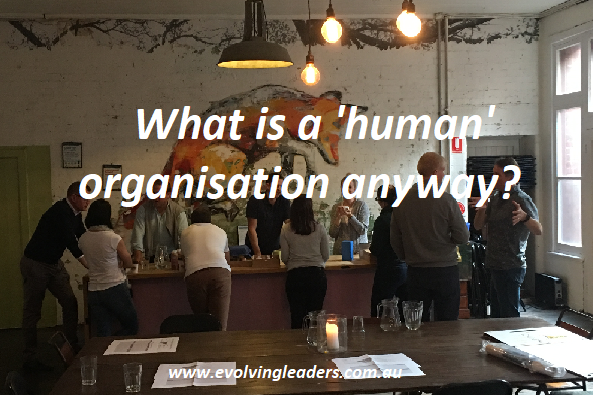
This post includes our vision for the ‘human’ teams and organisations of the future that we need to be designing and creating right now to respond and flourish in a rapidly changing world. We call these ‘human organisations’. The post includes the characteristics of a human organisation to help you do a ‘mini-audit’ on the health of your own team/organisation.
“A culture in which everyone could overcome their own internal barriers to change and use errors and vulnerabilities as prime opportunities for personal and company growth.”
– Robert Kegan in Everyone Culture: Becoming a deliberately developmental organisation
Almost anyone who has worked in an organisation has experienced at least some of the aspects of disconnection that have become commonplace in workplaces everywhere. Too often businesses seem to lose sight of the fact that they are, at their core, the sum of the humans of which they are composed. There is ample evidence that this needs to change if businesses are serious about flourishing in the complexity of today’s world.
What is a human organisation?
Human organisations are ‘well’ organisations that are on a deliberate and focussed developmental and cultural evolutionary pathway towards full spectrum consciousness.
There are two central threads that are the woven foundations of a human organisation:
Connection – Connection to self, connection to each other, connection to purpose and vision and connection to the people they serve; and
Accountability – Accepting and embracing accountability to self, each other, the reality (role, team, goal, project, organisation) and holding self and others to account.
Human organisations exude a healthy vibrant culture in which people are inspired to bring out the best possible versions of themselves. In human organisations, people perform at their best without being coaxed or bribed to do so. Instead of reverting to immature behaviours of blame and justification when they come to work, they see themselves as well-rounded adults whose task is to make a meaningful contribution and to help others do likewise.
The result is far more significant contributions from many more people, and a lot less wasted time and emotional energy. The result is greater success in traditional business measures (e.g. profitability and customer satisfaction) as well as improved wellbeing, increased engagement and sustainable human potential.
What are the characteristics of a human organisation?
Some of the characteristics you’re likely to see in a human organisation include:
- Customers feel listened to and their needs are meet at a level beyond their expectations because employees deeply care and feel cared for and supported by the organisation.
- Leadership is less about position than it is about mindset and behaviour. Everyone in the organisation is capable of being recognised as a leader through the way they behave and the choices they make, through supporting others and taking personal responsibility rather than resorting to blame, justification and denial. No one is seen as a leader unless they demonstrate leadership in this way, regardless of their position or title.
- Purpose driven: there is a clear and central ‘why’ that is harvested and activated by the people for the people. It is a grounded source of energy and focus that clarifies, inspires and informs decisions, action and behaviour.
- People are motivated through feeling valued. There is an alignment between what matters to them, the work they do and the workplace culture.
- Connection – real, human connection – with courage and compassion are at the heart of everything that is done within the organisation and for those it serves. Get Connected
- People feel empowered to make choices. High levels of confidence, personal awareness, and accountability exist throughout the organisation.
- People are held to account – They know what is expected of them in their roles and how they ‘show up’ and there are efficient and effective practices and leadership capability to manage this effectively.
- People take responsibility for their own development in a culture of learning and growing.
- People feel a sense of belonging. It feels safe for people to fully show up as who they are and make a meaningful contribution with their unique skills, strengths and preferences. The workplace and its practices are diverse and inclusive and team members experience high levels of psychological safety which results in higher levels of team performance.
- People are highly engaged, feeling a greater sense of connection with their own sense of purpose, with their colleagues and as co-contributors to the organisation’s success in terms of profitability, wellbeing and benefit to the community.
- Internal divisions and turf wars are minimised. Shared values and purpose provide the framework for conversations, decision-making and behaviour. Strategy, culture, purpose and wellbeing are aligned.
- People listen to one another.
- Innovation and creativity are well understood, practised and regarded as ways the organisation can ‘separate itself from the crowd’.
- Reflective practices are woven into the fabric of the organisation. This may include specific mindful moments in meetings, the way performance conversations are had, allocated time and expectations for people to build reflective practice into their weekly rhythm.
- Time and space to think and learn are valued. The space is created to allow people to get to know each other and to reflect on the learning from projects and other experiences they encounter in their day to day. This becomes a part of the daily, weekly, monthly and annual rhythm.
You may like to pause and reflect for a moment here:
- What is the current state of health of your team or organisation?
- What are the strengths that you can build on?
- What areas do you need to bring greater focus to?
- What is one step you can take this week to get started?
Where it starts
Ignoring the need to make your organisation more human is to turn a blind eye to what we know requires a new level of response. It is no longer an option to stand still. The teams and organisations that will thrive and attract the best people are the ones that make the courageous and bold step to begin this developmental, leadership and cultural evolution journey.
However, it needs to be recognised that human organisations are not created overnight. They need to be imagined and designed ‘by the people, for the people’, then given the guidance, investment, nourishment and support they need to grow.
The shift towards a human organisation begins with bringing new awareness to the leadership team about the possibilities of becoming such an organisation. We help leaders to make the connection between the cycle of pain, dysfunction, cultural entropy and poor performance that they may be experiencing in their teams and organisations and bring focus to the antidote for this – which is intentionally growing and creating ‘human organisations’.
Initial steps often involve understanding the current stage of cultural maturity and the cultural evolution required for the team /organisation to evolve to a level of cultural maturity that will enable the business aspirations, measurement of the existing organisational culture, beginning the conversation around organisational purpose and vision and igniting the learning journey for leaders and their teams.
A key part of the learning here is about helping leaders to better understand the visible and invisible forces driving, engagement, wellbeing and performance in the organisational eco-system. A great basis for this conversation and to help build understanding of the organisation as a whole interconnected system is Ken Wilbur’s four quadrant model. It helps to bring a ‘whole of system’ focus and is a great basis for surfacing what is currently helping and what is hindering the organisation’s progress, ahead of then designing a roadmap for cultural and leadership evolution.
If all this sounds just too complex and difficult right now, may I offer one powerful snippet of wisdom:
Connection and Accountability are the golden threads that are woven throughout a human organisation.
In every moment – thought, action, word, decision – we have a choice. We can choose to move towards disconnection or we can choose to move toward connection. In that very action we are being accountable to ourselves, each other and our workplaces.
I choose to grow connection.
What do you choose?
In my next post, I will explore the personal leadership that is required to grow a human team/organisation.

The previous post outlined why reflective practice is a leadership super power and surfaced some of the richness that reflection brings. This post explores three of the barriers to creating space and time to reflect and provides you with a structure to get started.
My previous blog post explored why reflective practice is a leadership super power and surfaced some of the benefits and insights that reflection helps us with. In this post I want to explore three of the internal barriers to getting started and provide you with a framework and some great questions to inspire you to do it anyway!
The reality is that reflective practice is something most people, including most leaders, have never done. We live in a society, and certainly in workplaces, in which ‘doing’ and ‘tasks’ are what are valued and creating space to reflect and learn is far from the reality.
Three main barriers to reflective practice
There are three main barriers that get in the way of us creating space and therefore creating the environment to reflect:
- We don’t schedule it/plan for it/turn up for it
- We don’t value it – ‘Why would I bother doing that?’
- We think that what it might show up for us feels too daunting and scary – so it is safer/better not to do it at all
Let’s explore these:
- We don’t schedule it/plan for it/turn up for it
In my earlier ‘Five keys to creating conscious change and restoring wellbeing’ post, I introduced the 5S leadership self-care model. The first S in this model talks about making ‘space’ – carving out space – which means scheduling it into your calendar and creating the conditions to support that schedule (such as finding the best environment for you to be able to bring your full focus to the intended activity: reflection).
Even if you do schedule time for reflective practice, it can be all too easily get ‘bumped’ for something more ‘important’ that appears on your to-do list. The biggest tip I can offer here is schedule it and show up fully for yourself – no excuses. Treat it as you would a meeting with your boss or a client.
2. We don’t value it – ‘Why would I bother doing that?
If we don’t understand the benefits of a new practice, we won’t value it. My hope is that if this is new for you, that some of what has been explored in the previous post will help you to at least feel tempted to give it a go. Perhaps ask around and connect with another leader who you know does use reflective practice and ask them personally about why they do it and how they go about doing it.
3. We think that what it might show up for us feels too daunting and scary – so it is safer/better not to do it at all
In a crazy-busy life, we often have a backlog of things we need to process and make sense of. If this is the case for you, then carving out space can feel quite daunting and even scary. Why?
Because sometimes we keep ourselves so busy because that means we don’t have to look at and face up to what is really happening and true for us. If we don’t look towards this stuff and keep running from it, then we don’t need to have that honest conversation with ourselves or another, and we won’t need to make a choice or decision that may mean change. Right?
This can be a sensible and even worthy strategy in the short term, depending on life circumstances. However, in the medium to longer term it will catch up with us. If we keep ‘shying away’ from what we know is true for us and pretending that everything is okay – if we don’t start to face up to what is really true for us – we can begin to compromise the very core of our being. That doesn’t serve you, the situation or anybody else.
Can you relate to any of the above? What is standing in the way of you reflecting?
Getting started with reflective practice
Here is a framework that might help to get you started:
- Schedule it
- Show up for it
- Structure it
Option 1
- Recall and review: identify a recent situation/event/conversation/feeling/trigger that you want to explore. Capture the key points you recall, replay the conversation in your head and/or begin the process of a written journal.
- What are the key learnings?
- What did you notice?
- What did you say?
- How did you feel?
- What were you most proud of?
- What were you not so proud of?
- What do you now understand about yourself?
- What do you now understand about the situation?
- Set direction with what you now understand about yourself. The situation, the other person, etc. What will you do differently next time? What is your intention and course of action from here?
Option 2
Thinking about the past week or month, ask yourself the following questions:
- What am I most proud of?
- When have I felt triggered by a particular situation or event?
- What made me feel that way?
- What can I observe/learn about myself in this situation?
- What action do I need to take from here (if any?)
Leaders who thrive are those who care enough about themselves and those they lead to do this – to look in their own backyard and do their own self-work.
Still feeling too tough? You don’t have to go it alone. A good way to start might be to get yourself a leadership coach who can ‘hold the space’ for you so you can begin a gentle journey inwards.
I also recommend the host of resources referred to in my ‘Five keys to creating conscious change and restoring wellbeing’ post. Perhaps you simply feel ready to grab a notebook and get started?
To reiterate the closing words in my last post:
One of the greatest leadership/life challenges is knowing who we are and what matters to us at our core AND not letting the busyness of life and a multitude of external distractions pull us away from that.
One thing is guaranteed: unless you deliberately and regularly carve out space to engage in reflective practice and take a balcony perspective, life will pull you off course from your centre – from who you are and what matters to you.
If you do build a reflective practice into your rhythm in life, the conversations might be tougher but the outcomes will also be richer.
The choice is yours. What do you choose?

The previous post involved a personal story that highlighted the shifts that can happen when we make space to reflect. This post builds on that example and explores other benefits of reflection, why the reflective practice is a leadership super power and how to build it as a practice into your own way of being.
Leaders whom I work with in a coaching capacity often comment that during our time together they experience a sense of space and an absence of judgement. They appreciate the chance to slow down and reflect. It’s from this place that clarity and insight become available resulting in better decisions, choices and outcomes.
To be truly conscious, awake and aware of both your inner landscape and the outer terrain of work and life requires a paradigm shift for leaders about the importance of something I believe is a leadership ‘super- power’: reflective practice.
I wish I could find a better term for it than ‘reflective practice’ – I know it sounds more like something that nuns would prescribe as a punishment at boarding school than a leadership super power. (Perhaps you can suggest a better name?)
Nevertheless, it’s the sentiment rather than the name that is important.
Reflective practice needs to become something that happens not just in a formal setting such as coaching. Rather, it needs to extend to become an integrated part of your daily, weekly, monthly and yearly modus operandi as a leader.
What is reflective practice?
Joseph A Raelin, in his article‘”I don’t have time to think” versus the art of reflective practice’,defines reflection as:
‘the practice of periodically stepping back to ponder the meaning of what has recently transpired to ourselves and to others in our immediate environment. It illuminates what the self and others have experienced, providing a basis for future action.’
How does reflective practice help?
As highlighted in the personal story in my previous post, often when we are in the middle of a situation, particularly a stressful one, we cannot maintain the perspective we need to be able to see the situation holistically. It’s only when we create the space and time to reflect that we are able to ‘step off the dance floor’ and get a broader ‘balcony’ perspective of what’s going on. The outcome? Insight, insight, insight. Insight about how you showed up effectively (or not so effectively). A greater capacity to see the perspective of others. The opportunity to identify what ‘triggers’ you and to explore why. The chance to bring light to a problem that may have felt impossible to solve, creating new options and a clear pathway forward.
Why does this matter? Because the consequence of not making time to reflect is quite possibly collateral damage to projects and relationships; damage that is inevitable when we operate completely in action and reaction.
Perhaps you can recall a specific example of where this may have happened to you? Or the opposite: can you think of a time when you did create the time and space to reflect on a challenge and experienced a positive outcome as a result?
What are the benefits?
Some of the benefits of reflective practice are:
- Seeing below the surface to reveal what really is happening. Reflective practice can make the invisible visible. For instance, it can bring to the surface a personal value that might be important to yourself or others and that might explain why a conversation/ outcome/ situation went in a particular direction.
- Restoring wellbeing:
- A simple shift from ‘doing’ constantly to taking space out to ‘be’ helps our nervous system to restore balance (Blog: Mastering thinking and doing AND feeling and being).
- A dose each of compassion and self-compassion will go a long way towards resolving something that doesn’t feel so good so that you can let it move through you (Blog: Are you being a good friend to yourself?)
- Reflective practice opens the opportunity for gratitude. Research has shown that the practice of gratitude has many positive benefits (https://positivepsychologyprogram.com/benefits-gratitude-research-questions/ )
- Connecting the dots. With reflective practice we may begin to see connections between behaviours, actions or situations that previously didn’t appear to be connected. For example, when I learned that one of the personal values of a colleague was ‘control’, I started to understand some of the ways she was behaving in our collaboration. I had previously I felt that her behaviour was out of character and not really serving our partnership. This provided an opportunity to open up the conversation. Connecting the dots can also happen within our own internal landscape. To share a personal example: understanding that the reason I was overprotective of my daughter stemmed from an experience in my past in which I didn’t feel safe.
- Insight, insight, insight. Reflective practice ignites learning about ourselves and the people and world around us. This is essential if we want to live and lead consciously and learn and grow.
- Strengthening connections: with ourselves – what matters to us at our core – and in our relationships with other people.
- Shifting you out of a reactive mindset to allow constructive ‘above the line’ responses. Reflective practice will make you less likely to react and add fuel to what might already be a difficult situation. You are more likely to ‘discharge the heat’ and approach the next conversation in a more open and constructive manner. ( If this concept is new to you – check out this 3 minute u-tube – it’s a concept well worth knowing)
One of the greatest leadership/life challenges is knowing who we are and what matters to us at our core while also not letting the busyness of life and a multitude of external distractions pull us away from that.
One thing is guaranteed: unless you deliberately and regularly carve out space to engage in reflective practice and take a balcony perspective, life will pull you off course from your centre – from who you are and what matters to you.
On the other hand, if you do build reflective practice into the rhythm of your life, the conversations might be tougher but the outcomes will be so much richer.
In my next post, I outline one of the big road blocks that many people experience in getting started with reflection and provide some tips and great questions to get you started.
This post highlights the importance of space and time to reflect away from the ‘noise’ of life to refocus on what matters so that we can see different perspectives, shift energy and beliefs that are stagnant and move forward with a clear and healthy intention that can restore connection.
This week I am working remotely from Bright in north-east Victoria. It’s become the space that I take to regroup, reflect and refocus a few times a year. I never really know what is going to surface at these times but have learned to just create space and get out of my own way. What surfaced on day one this week took me a little by surprise.
But first – a little of the back story so it makes sense.
A month ago my eldest daughter (age 19) announced that she was heading overseas on a solo adventure for seven – s-e-v-e-n – months to Japan and South East Asia then finishing in India and Nepal. I have witnessed Amelia working three jobs to save the funds for her adventure along with the clarity and conviction in her decision to defer from her second year of university. I have also known for some months that the trip was coming. But her intention had been to travel with a friend – the whole ‘travelling alone’ thing was new. And it really sent me into a spin. In fact, I went into a whole fear-based reaction that left me with nightmares about abduction in Japan. I had broken sleep, waking up asking myself ‘Is this really happening, or did I dream it?’ I was generally motionless and speechless for a day or two as I tried to process the news.
From Fear to Courage
Over the days that followed, I started to move beyond my own fear-based reaction. I was able to step a little more off the dancefloor and up to the balcony and a broader perspective. I was then able to see and be present with the extraordinary courage of this amazing young woman. Here I was a short jog away from 50 and I have never done anything as seemingly courageous as this. My broader perspective helped me to re-frame a number of beliefs and stories that were much more useful:
- If anyone’s got what this takes, she does. She’s street smart, savvy and quick to think and act when she needs to.
- She always attracts amazing people into her life. She knows how to have fun and have deep honest conversations and connection with people so interesting people are always drawn to her.
- From the moment she was born, she has always been well and truly looking out into this wondrous world – this is just who she is. She has work to do in the world and this is the natural next step – into the world.
- If life is not a daring adventure – then what is it?
- She’s ready to step away from home – and if we’re honest with ourselves, we’re ready for her to take that step away from home too. (We’re a bit over being treated like a hotel and in many ways, this is payback time – as I recall doing exactly the same with my mum.)
Secretly (or perhaps not so secretly now) there is also a part of me that would love to head out into the world just as she is, into an adventure into the unknown…
Roll forward to yesterday – day one in this next week of space in Bright.
I had been feeling something was stuck energetically in me all day long and I was getting frustrated because I should be working/ writing/ planning/ thinking … doing something! Then inspiration struck me. What was needed was a walk by the river with the dog, revealing in the present moment through the dog’s pure joy as she chased the ducks (no hope of catching them) and fetched sticks along the Ovens River.
Perhaps you have had a similar experience too? Trying so hard to ‘do’ and needing to make a decision just to ‘be’? I surprise myself at how often I fall into this same trap.
The Realisation
As I sat on the riverside listening to the birds and watching the water flowing over the rocks, I was struck by something in relation to my daughter. It was time to make a choice – a choice to let go. I hadn’t explicitly been thinking about her travel that day but clearly it was right there not too far from the surface, waiting to be revealed when I finally found the space to reflect.
‘“To let go means to let be. When we let be with compassion – things come and go on their own’
Jack Kornfield
Emotion rose and tears rolled down my cheeks as this energy that had been ‘stuck’ started to move through me – the realisation that that I had been emotionally holding on to my ‘baby girl’ for too long now.
I spent the next hours journaling and reflecting on what it meant as a mother to ‘let go’ with compassion and to ‘let be’. I also called on Google for some parenting advice and came across the following statement: ‘The most productive relationship for adult children is for them taking primary responsibility for their lives and parents acting as their consultants’. Okay. Yep. Well, that makes sense – I could certainly transition to that, if that’s what Amelia needs.
Change and Transition
In my work supporting leaders to navigate change in organisations I have often spoken about ‘change’ being the external act – the decision to go overseas, the leaving home, etc. in this situation. But then equally I bring focus onto the transition that change brings – that is the internal emotional changes that must happen through the cycle of emotions to arrive at acceptance. I could now see that clearly Amelia and I (and the whole family in fact) were in the midst of an important life transition.
‘Space’ Creates Insight
I’m not in the habit of always sharing personal stories on this blog however I share this story as a great example of the need to carve out pockets of space in our lives and/or moments to take a balcony perspective. Unless we do that, it can be difficult to see what is right under our nose.
Had I stayed in Melbourne this week, I would still be ‘holding on’, not seeing that it’s high time to let this gorgeous, creative, amazing, strong, self-focussed angel spread her wings.
Being a big fan of the healing power of ritual, right there by the river yesterday I carefully chose three healthy green gum leaves. As a I released them into the free-flowing water of the Ovens, from deep within the core of my being and surrounded with so much love I spoke these words:
“I choose to let you go.”
And I did.
Are you needing some space in your life right now to give yourself permission to do some inner processing? Schedule a conversation with Nicola to discuss how Leadership Coaching or our new Coaching Program – Cultivating Well for senior women can work for you or the people in your organisation.
In my next post I will explore why the practice of reflection is a leadership ‘super power’ and how to build it into your own leadership rhythm.
This post was orginally published in 2018
This post explores compassion and self-compassion through a personal story and invites the reader to reflect on their own levels of self-compassion based in the work of Kristin Neff.
Late last year I had a call from my daughter’s teacher. Chiara (age 15) was midway through a nine-week personal leadership experience based at Snowy River Campus in East Gippsland (provided by the Victorian government’s School for Student Leadership initiative).
The teacher shared with me the wonderful level of commitment, enthusiasm, goal achieving and social contribution that Chiara was making. When I asked her what she saw as the greatest development area for Chiara, she replied without hesitation in two simple words: greater self-compassion.
While this was not a surprise to me to hear someone else – with an opinion that I valued – reflect this back to me, I had a sinking feeling in my heart.
Instantly feeling ‘at fault’ as a mother (as we mothers can do so masterfully), I found myself thinking about the role model that I had been and still was for my daughter. I started wondering why it is often the case that those people who are the most kind and compassionate and loving to others find it hard to provide this same nourishment and nurturing for themselves?
It also got me thinking about the drivers that can contribute to this way of being. There’s the personal focus on external measures of success that are driven by an internal tendency to not feel good enough or worthy enough. These measures often create a false or short-lived sense of success. There are things that society values and that get rewarded in school, in the community and at home – being a ‘good girl’ and looking out for others, for instance. There are those things that take us away from feeling worthy of loving ourselves in the same way that we intrinsically offer love to the people in our lives.
‘Self-compassion is a measurable trait. In 2003 no-one had defined or measured it. In 2017 there were 1340 studies on self-compassion. Self-compassion is strongly linked to wellbeing.’ [ Source: Neff 2018
What is it to be compassionate?
Meet Chiara. Chiara is a gentle, kind and compassionate teenager who is wise beyond her years. She has natural care and concern for all living things – people, pets, trees. She takes great care in rescuing the spider or bug from her bedroom and returning it to the natural environment. She is empathic – she knows how others are feeling. She’s the kid who’ll notice the person in the corner who’s been excluded and approach them to make them feel not alone. She is the granddaughter who asks her nana from a place of genuine interest, ‘How are you Nanna? What’s been happening in your day?’, instead of a typical teenage response of a one-way street and it being all about her. She’s the first to make you a cup of tea if she senses you are out of sorts or need a bit of love.
Chiara is the kid who takes time morning and night to sit on the ground with the dog and give her some real care and attention. Each morning she appears at your side just like a pussy cat and wraps you in a blanket of love to start your day. Yes, we are truly blessed to have her in our lives.
So you see? She is actually one of the most compassionate people I know and such a great teacher to me and to her sisters and peers. Compassion is the essence of this young lady. She knows it well.
Turning this compassion that she knows so well into watering and nourishing herself – that would appear to be the next step in her learning journey. And I know she is not alone. I for one need to turn up this dial on self-compassion. Perhaps you do too?
This might help:
In the later part of 2018, I attended a workshop with Kristin Neff, a world expert on self-compassion. Part of what she offered was a radical shift to ‘relate to self’ in new ways.
Kristen defines self-compassion as:
- being a good friend to yourself
- treating yourself the way you would treat a good friend; and
- holding pain with love.
She took us through a three-part reflective process, which I would like to offer you here:
Part 1
Allow a friend to arise in your mind’s eye. Allow a close friend who is suffering in some way to appear in your mind’s eye, in a situation where you are feeling resilient and strong.
Close your eyes and ask yourself this question: How would I treat this close friend?
What are the types of things you would say to your friend?
What tone do you use?
What’s your body posture like?
What type of non-verbal gestures do you use?
Part 2
Allow to arise in your mind’s eye a situation where you failed at something important to you or you are having a hard time.
What do you say to yourself when you are struggling?
How did you say it?
What is your body posture?
How do you relate to yourself when you are struggling?
Part 3
Do you notice any patterns of difference between how you treat yourself when struggling and how you treat others when they are?
What did you discover about how you treat yourself/others?
Perhaps you might like to share your reflection with a friend?
In our work with leaders – amidst the harsh demands of work and life, the absence of self-compassion is palpable. In our quest to be better, do better, earn more, get the promotion, any notion of self-compassion gets lost.
I invite you to explore the wonderful books and resources that are available on Kristin’s website.
Is there one small step you can take toward greater self-compassion?
PS. Chiara is now several months back from her life-changing leadership experience. The young lady we have here with us now is more confident, self-empowered and self-aware than I thought was possible in such a short space of time. She’s made decisions and choices this year to show more self-compassion and of her own accord has continued a daily journaling practice. She’s followed her inner-knowing and desire to do things that bring her joy (she practices yoga several times a week, walks the dog regularly and is playing netball for the first time). She is also a daily reminder to me that I have a choice.

Date: Wed 29th May 2019 4pm-6.30pm
Location: Melbourne CBD
Investment: $50 ex GST
Facilitator: Nicola Vague
Included is a screening of Sensitive The Untold Story based on the groundbreaking work of Elaine Aron and a space for HSP leaders to come together to reflect and connect and own a little more of your enormous gift.
We look forward to welcoming you to the Evolving Leaders – HSP community.
You can read more about HSP’s and our work with HSP’s by visiting:

This post explores a holistic approach taken in my coaching of a senior leader. Our aim was to help get her out of her head and into her body, accessing and stepping into more of who she was at her core. This would provide the power, confidence and presence to deliver a significant career milestone presentation. It offers the reader resources and an approach to inspire a sharpening of your own presentation skills.
I recently worked with an executive in the latter part of her career. She was naturally introverted and had little experience in formal presentations. However, she had been charged with the responsibility of delivering a significant presentation to an internal audience, part of the launch of an exciting new chapter in the business. She felt little connection to the topic and, to make the situation a little more challenging, the parent company had provided the presentation they wanted delivered. Worse still, the presentation had been translated (poorly) from another language.
The situation triggered a fear reaction in the leader driven by a low level of belief in herself. This was exacerbated by it being a new experience and the fact that, being introverted, she quite naturally felt very visible and exposed. On the plus side the leader did something that many shy away from – she recognised that she needed help and she took personal responsibility to hire a coach to help. These are the leaders I love to support.
“While many of us might fear public speaking even just at a work morning tea, stepping up to the job can make or break your career, especially for those at the top”
Dr Lucinda Holdforth on the ABC Radio National program This Working Life.
I have done my share of presenting over the years, but to be completely transparent I had never formally coached someone else in presentation skills. So, it was time to get to work!
I reflected on the number of presentations that I had sat through feeling totally bored, with speakers who were disconnected from their message and themselves. I knew that to effectively deliver a presentation requires the development of some specific communication and presentation skills such as tone, timbre, presence and connecting with audience. I also knew that to focus on skill and capability alone was not going to deliver results.
I came across a great resource that also informed my approach:
Top Five Tips for Presenting with Impact by Dr Barry O’Sullivan
So, with an eager student at the helm, I designed a coaching program based on what I had read and what I know best: starting close in – helping this leader to deepen /reconnect with who she was and what mattered to her:
Step 1: Start close in
In this context this meant helping the leader to connect to who she is and what matters to her to enable a connection between message and person. Prior to the first coaching session this leader completed a Personal Values Assessment and Core Motivation exercise (“I go to work each day at … so that I can…”) connecting her with her deeper inner motivation: what makes her get out of bed each day to come to work. She also did some reflection around these key questions:
- What is important personally in your life?
- How do you want to ‘show up’ as a leader?
- What patterns of thinking and beliefs are getting in the way of this?
- What needs to shift so that you can feel empowered and confident as a speaker?
Step 2: Understand your audience
Often inexperienced presenters become so consumed with navigating their own fear about the presentation that they lose sight of why they are doing the presentation and who they are doing it for.
This requires a deliberate mindset shift that can feel a bit disorienting, but at the same time it can be screamingly obvious as it was for this client:
- What if it (the presentation) is not about you?
- Consider:
- How can you be of service to this audience?
- How do you want the audience to feel?
- What does the audience need from you?
- What do you need to do/what needs to change for you to get out of the way of yourself?
Step 3: Change your body, change your mind
Of great relevance for this client was the work of social psychologist Amy Cuddy on body language. Given the client was quiet by nature and didn’t easily or naturally command attention and respect when she walked into a room, and nor did she feel confident and empowered when she stood before a group, we focussed on this wisdom from Amy Cuddy:
Our bodies change our minds
Our minds change our behaviour
Our behaviour changes our outcomes
Body language affects how others see us, but it may also change how we see ourselves. Amy Cuddy argues that ‘power posing’ – standing in a posture of confidence, even when we don’t feel confident – can boost feelings of confidence and might have an impact on our chances for success.
Here is what Cuddy says:
- When you pretend to be powerful, you are more likely to actually feel powerful
- Power posing or high power poses versus low power poses – are you collapsing or taking up space?
- Do you feel like you are supposed to be here (‘imposter syndrome’)?
- You can choose to be assertive, confident and powerful
- Configure your brain to cope the best in that situation
Source: Your body language shapes who you are, Amy Cuddy
Well can I just say – in case you had any doubts – that it really works.
When you pretend to be powerful, you are more likely to actually feel powerful.
Why don’t you try it on?
It was through this inspiration, and practice that my client shifted from being closed down and reserved to having an open heart, feet on the ground, back tall and the presence that demanded attention and an excited anticipation from the audience about what she was about to say.
Step 4: Communication and presentation skills development
In terms of building the presentation skill development component of my program, I drew upon the following great ideas from Julian Treasure:
How to speak so people want to listen, Julian Treasure
There are three main parts to Julian’s work that all informed the coaching approach:
- “Amazing
Toolbox”
- Register – head, throat, chest voice – “we associate depth with power”
- Timbre – rich warm smooth
- Prosody – avoid monotony
- Silence – find opportunities to rest in silence
- Pitch – vary the pitch
- Volume – vary the volume
- HAIL – honesty/authenticity/integrity/love
- Vocal warm ups.
(You can access this content via the TED talks link above)
Step 5: Mindfulness to quieten the ‘monkey mind’
When the stakes are high and we are well out of our comfort zone there seems to be this natural increase in mental chatter – like the radio gets turned up to 10! This was the case for this leader and so through the four-week program and on the morning of the presentation, she used a meditation practice to quieten down this mental chatter.
Step 6: Practice, practice, practice
Nothing great is ever achieved without practice. This client was completely motivated and disciplined and these were key ingredients to her ultimate success. During the month-long preparation, the leader videoed herself presenting on a weekly basis, watching it back and reflecting on what had improved and areas for next focus. From my perspective, one of the big things I needed to do was to help her ‘take the jump’ from speaker notes on PowerPoint to cards to that final leap of faith that she didn’t need any prompts to finally getting out there and doing a great job.
The big day finally arrived. The message I received immediately after the presentation said: “I nailed it”. Job done. This leader was a true inspiration and a joy to coach.
It is a well-known phenomenon that we teach what we need to learn. After initially hesitating to accept this assignment, I am grateful that I said yes because as it turns out the coaching and support that I was able to give this leader was just what was needed, and ironically, as I step more into presenting and speaking myself, it was also perhaps the perfect medicine for me.
Interested in presenting with greater impact? I would love to help.
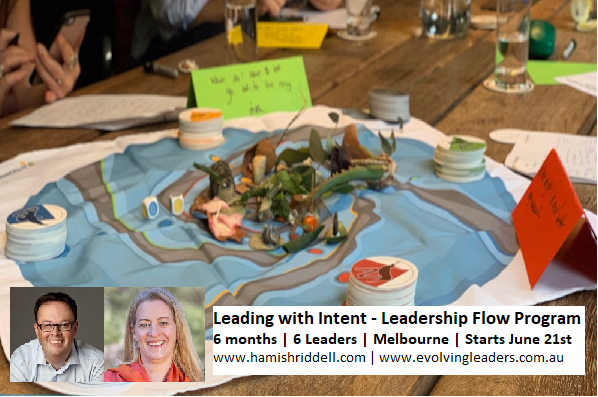
A unique development opportunity. 6 months | 6 Leaders | Melbourne | Starts June 21st 2019
Do you feel like you are out of flow?
Do you sense there is a better version of your leadership just out of reach?
Are you wrestling with questions that don’t have easy answers?
Are you caught in the whirlwind of doing (not being)?
Would you benefit from a having some external support to navigate long over-due changes?
Do you need a regular space to spend time working on being a better version of you?
If this is you then ”Leading with Intent” is for you. The focus of Leading with Intent is on taking your story – your ‘you’ – to the heart of your leadership.
We invite you to join this different and powerful development experience. This exclusive program has been designed for six like- minded leaders and includes:
– five half day development sessions over six months utilising The Flow Game
– two individual development sessions (prior to program start and at the conclusion)
– your own peer support learning group; and
-ongoing guidance from your flow game hosts during the program .
Full program details