
Self-Leadership Series 1 – #4 What’s your personal motivation for attending to self-leadership?
This post invites the reader to reflect on their current experience of life and the deeper motivation that might drive the decision to bring greater attention to self-leadership.
There are many life circumstances and experiences that can precipitate us making a conscious choice to bring greater attention to self-leadership. Perhaps some of these may also apply to you?
- Are you stuck in a rut of reacting to the expectations and demands of others?
- Do you regularly feel overwhelmed with everything work and life demand of you?
- Have you lost connection with what truly matters?
- Do you feel ‘foggy’ in the head and unable to make good decisions and choices?
- Are you falling short of having the level of impact that you want to have as a leader?
- Are you unable to give your time, energy and focus to the things that matter most in your life?
- Do you feel stuck on the ‘doing’ treadmill, not knowing where to begin to make change?
- Do you lack the capacity and ability you need to take your leadership and personal effectiveness to the next level?
While it may not necessarily feel like it, all of these can be symptoms and signs that there is an opportunity for to change your own reality through attending to self- leadership.
These circumstances and experiences, once acknowledged, can be the catalyst that helps us to take positive action on our self-leadership journey. I know this works because I’ve seen it happen on many occasions in the self-leadership work I’ve been privileged to support within a wide range of leaders. One described her personal change journey better than I would be able to:
I was feeling hopeless, helpless, full of misery. This affected my emotional and physical wellbeing. One day my inner self started shouting at me, ‘You need to change; you cannot keep living like this’. Through making a clear decision to no longer accept the status quo, I made a commitment to myself to activate a new level of self-leadership. This enabled me to open to new possibilities and start to make different choices in my life that step by step took me towards a different reality. I am glad I sought support and chose this path … Change is difficult in the beginning, but the end result is beautiful and worth it.
It is also possible that despite our level of dissatisfaction with whatever situation we find ourselves in that it still isn’t enough to convince ourselves to get started!
Enter – Personal Motivation. Taking time to connect with the deeper ‘why’ that is motivating us to create change can be the difference between inertia and action.
What’s your personal motivation for attending to your own self-leadership?
There are four common personal motivations that when leveraged can drive people from inertia to action on their self-leadership journey. Which one/s resonate for you?
Do you wish to:
- Experience greater levels of personal satisfaction, wellbeing and fulfilment?
- Uplift your capability and effectiveness in leading self /others towards creating outcomes that matter?
- Be the best role model that you can be for your children /younger generations/ employees/ colleagues/friends?
- Make your unique and valuable contribution to making the world a better place and recognising that the most powerful way of attending to this is to activate and commit to self-leadership?
Your personal motivation for creating change may also come from acknowledging a little voice inside of you that is telling you that something needs to change such as it did for my client above – perhaps it’s to do with a need to attend to your wellbeing or an unhealthy situation that you find yourself in or having a courageous conversation that you know you need to have?
These are just a few examples. Your specific motivation might be different from all of these and that’s perfect too.
We will be motivated by different things at different times based on the situation and context in which we are operating. Whatever that context is for you- it is worth getting clear on your personal motivation for attending to self-leadership. It can after all, hold the key to moving from inertia to action.
The next post in this series will explore the question: What is self-leadership?
This post is an excerpt from my draft book Activating Self Leadership.
Photo Credit: Bree Hughes 2022 (Taken on a trip to Mt Field National Park with Bree to see the Turning of the Fagus
Self-Leadership Series 1 – #3 Why does self-leadership matter?
This post shares a personal story of a client who made a significant change in her personal and professional life when she decided to focus on self-leadership. It also looks at how focusing on self-leadership equips us with the foundational skills and tools to better navigate being a human!
Emica was a highly capable and well-regarded engineer working in key roles on multiple large and complex projects. However, she was desperately unhappy in her private life, finding herself with full responsibility for the running of her family’s household while also having to generate the family income. She had no support or empowerment to make any of her own life choices. She even had to seek permission from her husband to get her driver’s licence. Emica could see that the issues in her personal life were having an impact on the confidence and presence she had in her role. She knew that something needed to change and made a conscious choice to do something about it.
Emica sought out the support she needed to get started with her self-leadership journey – prioritising herself and her personal learning. This helped her gain the clarity she needed to begin the process of making tiny changes that would move her closer to her personal aspirations and goals. Over time, and with a regular and committed practice, Emica was able to make significant changes in her personal and professional life.
These changes would never have happened if she had let her life simply run its course, without enacting self-leadership through developing a clear intent and the willingness to open herself to different perspectives and new possibilities. Without prioritising this, Emica would likely have remained in the unhappy life she had previously found herself in. Somewhat ironically, getting her driver’s licence ended up being an important part of this process, providing both a boost to her confidence in her ability to back herself and the practical freedom that comes from not relying on others to get around.
Why does enacting self-leadership matter? If you were to ask Emica, she would say it is because it can change your life.
At its essence, the learning that is available to us when we commit to our self-work opens our ability to see different perspectives and new, often not previously conceived, possibilities. Without it, we are limited in our daily actions and interactions by our current beliefs, thoughts, behaviours and ways of being. We can also miss everyday chances to learn about ourselves and others and to grow from this knowledge and experience.
Simply put, if we don’t quarantine a part of our busy schedule for personal learning and wellbeing self-work, then change will usually only happen when it is forced upon us. Often this ends up being through adverse situations: the loss of a job, a new boss, the passing of a loved one, injury or illness, a divorce or separation. And while ‘forced change’ naturally fuels and is often vitally important to our growth, investing time and initiating focus on our self-work helps us to take the lead in our own development.
It’s possible, of course, that you already know this. Perhaps you are a leader who already has in place habits and routines that support your learning and wellbeing? If this is the case, no doubt you will be familiar with the benefits of creating space and slowing down to reconnect with yourself. Keep up the great work. Hopefully these blog posts will give you some ideas for continuing to refine this practice. If this is new for you, there is no time like now to get started.
In summary – why does self-leadership matter?
A focus on self-leadership equips us with skills and tools to better navigate being human. We learn how to navigate our thoughts, behaviours, beliefs and all the richness and complexities that being human inherently brings. I like to think of this as the ‘being a human 101 stuff’ that we should have learned at school but didn’t!
It helps us to access more of our vast inner resources from which we can begin to lead from the inside out. It is from that place that we are better able to nurture our dreams and inner most desires into reality.
The fourth post in this series will invite you to consider your personal motivation for attending to self-leadership.
This post is an excerpt from my draft book Activating Self Leadership
Photo Credit: Bree Hughes 2022 (Taken on a trip to Mt Field National Park with Bree to see the Turning of the Fagus)
Self-Leadership Series 1 – # 2 What I’ve discovered about self-leadership
This post shares some of what I have learned about self-leadership along the way and how it is the foundation for both our wellbeing and making our greatest contribution.
I did not ever set out on a deliberate path to explore and understand self-leadership but alas that’s what much of my personal growing and learning has specifically been about. It has also become, the central focus of much of the leadership development work with my clients.
What I write and share here is the sense-making and clarity about what I have discovered about self- leadership derived from over a decade of intense personal and professional learning and have now practised for many years. I share it here in case what I have learned may act as a signpost or inspiration for wherever you are on your own self-leadership journey. I also share it because when we are consciously practicing self-leadership, by default, we take caring of ourselves, each other, and our precious planet. Is there anything more important than that right now?
What I have discovered about self-leadership
Some of what I have discovered along the way about self-leadership is that:
- We are each responsible for our own evolution and growth. Period;
- Learning about ourselves and growing our effectiveness is a lifelong process that takes focus, commitment, and a choosing in each moment, where we focus our attention;
- Establishing routines and habits that support our ongoing personal learning and wellbeing is vital;
- Unless we are intentional about our own personal learning and development, life will continue to drive us rather than enabling us to shape our own reality;
- When we grow and evolve, we light the path for others; and
- If we want to play our part in contributing to the health of our families, communities, friendships, and the planet then self -leadership is non- negotiable.
My commitment to my own self-leadership is a way of life now as essential as eating, sleeping and breathing. It is never a ‘set and forget’. It requires ongoing attention and conscious action and what that entails in any day or week, morphs and changes as I do.
I know now that there is no destination point to arrive at. Just an invitation to ‘be’ in life as consciously as possible and to discover and leverage our vast and wondrous internal resources (they are waiting patiently for us to call them into action)!
It is only through activating self- leadership that we get closer to the truth of who we are and from that place be truly in service of our greatest contribution.
Wherever you are in life and on your self-leadership journey, this series is as an invitation to gently and courageously move a little closer towards self.
The third post in this series will explore why self-leadership matters.
This post is an excerpt from my draft book Activating Self Leadership.
Photo Credit: Bree Hughes 2022 (Taken on a trip to Mt Field National Park with Bree to see the Turning of the Fagus)
Self Leadership Series – Part 1 #1 Something needs to change
This post explores the idea that when we find ourselves in a ‘stuck’ place that only we can truly be our ‘own rescue’. It also highlights the importance of leaders prioritising and focusing on their own development is the catalyst for change in the broader ‘system’ (team, organisation).
Fourteen years ago (age 36) my external world looked bright, but my internal world was dark and empty. I was unable to see the beauty of the flowers in the garden. I was unable to feel the joy emanating from my three beautiful daughters. I was unable to experience and connect with the magic of life that was all around me. I was a prisoner to my own thoughts. Alive but not living. Surviving but not flourishing. I was so consumed by this experience at the time that I could not really see what was happening and nor did the people that loved me in my life have any idea at the depth of the hollowness I had found myself in. I did know one thing however. I knew that something needed to change.
I realised no-one else could make that change. I had a choice to make and I knew that I needed to be my own rescue. I made a promise to myself to stop focussing on the ‘shoulds’ and the barrage of mental chatter and to follow my heart ( I didn’t even know what that meant at the time). This was a turning point and the start of a commitment to move a little more towards myself.
In the years that followed, I sought out new experiences and people that experienced the world in ways different to what I knew ( & how I had been socialised), I learned to connect with and to express and honour how I was feeling; I got better at regulating my emotions and learned how to become the observer of my thoughts; I practiced meditation and trained as a yoga nidra teacher; I surrounded myself with friends, colleagues and therapists that could really ‘see’ me and support me when I couldn’t do that for myself.
I became a student of art therapy which was perhaps the most transformative part of my evolution to date. It was through the non-verbal language of symbols and exploring and experimenting with art process that I was able to connect with and come into relationship with my own inner landscape.
I finally had accessed some of the ‘felt’ or ‘embodied’ experience of what people meant when they talked about this idea of ‘leading from the inside out’.
Through the mirror that other people held for me ( we all do that for each other), I started to see and begin to own who I really was and to claim the parts of me that I had never known and certainly not owned, celebrated nor leveraged in my life.
Through this time, I continued to work as a leadership, change and culture professional and in 2014, I began my current leadership and culture practice – Evolving Leaders –with the purpose of evolving the consciousness of leaders to make the world a better place.
What I have witnessed repeatedly through my organisational development work is that unless leaders prioritise and focus on their own evolution and growth then change in the system (team, organisation,) will be limited.
The simple fact is that organisations don’t change, people do.
The same applies in life whether we are in a formal leadership ‘role’ or not, doesn’t matter. What does matter is, that when we consciously focus energy and effort towards our own evolution and growth we begin to unpeel the layers of our socialised selves. This is the pathway to getting a little closer to who we truly are. When we choose this path, we ignite change not only in ourselves, but become a source of inspiration for those around us – our families, teams, communities and organisations.
The second post in this series will look some of What I’ve discovered about self-leadership.
This post is an excerpt from my draft book Activating Self Leadership.
Photo Credit: Bree Hughes 2022 (Taken on a trip to Mt Field National Park with Bree to see the Turning of the Fagus)
It’s been a while since I put pen to paper and shared new material. The reality is that I have been moving slowly and quietly in the background working with great clients delivering leadership development programs. I have also been allowing myself space and time for self-care and reset.
During lockdown of 20/21 I drafted a book on self-leadership. I am so glad that I did. At the time, I was rushing to publish it – ‘willing it’ across the line – driven perhaps by the ego part of self that wanted to be an ‘author’ and feeling like that was the next step on my professional journey.
A trusted confidante, at the time, gave me feedback that was hard to hear at the time- the book wasn’t there yet – it needed simplifying. I was shattered- it had been such a labour of love for many months and this wasn’t what the outcome that the ego part of self wanted.
Fortunately, within a few days, I was able to see what a gift this ‘pause’ in the process was. What became clear to me was that not only was there more work to be done on the writing side, but that in my mission to get it published and out into the world, I was not practicing or embodying the very messages that were the foundation of this book on self-leadership. The book needed to pause and most importantly I needed to pause.
Eighteen months or so later, I am so grateful to have put these 40,000 words or so on paper. It has enabled me to capture and share many aspects of my own self leadership journey which by its very nature has been insightful and healing. At a professional level, the writing process has enabled much of my own sense making about self-leadership and positively informs my coaching and leadership development practice.
At this stage, I have no intention of publishing the book. I have decided however, that it doesn’t need to be in a book format for me to share aspects of it with you. So, over the coming weeks and months that’s exactly what I will be doing – sharing excerpts from the book in a series of weekly posts.
In the Self Leadership Series- Part 1, I will share where my own self-leadership journey began and the sense making that I have made along the way about self-leadership. We will look at what self-leadership is, why it matters and introduce the three keys that can be used as a guide to bring greater levels of consciousness to our own self-leadership practice.
I hope you can join me!
With love and gratitude,
Nicola x
As this year comes to a close, I wanted to say a massive thank you to you – the wonderful leaders I have had the privilege of supporting in 2021. I especially want to extend that gratitude to the dedicated health professionals and other leaders in our community at the forefront of the Covid response that we thought might have been a sprint but is turning out to be a marathon.
There have been so many acts of extraordinary leadership – often at great personal sacrifice – and to these people I say thank-you.
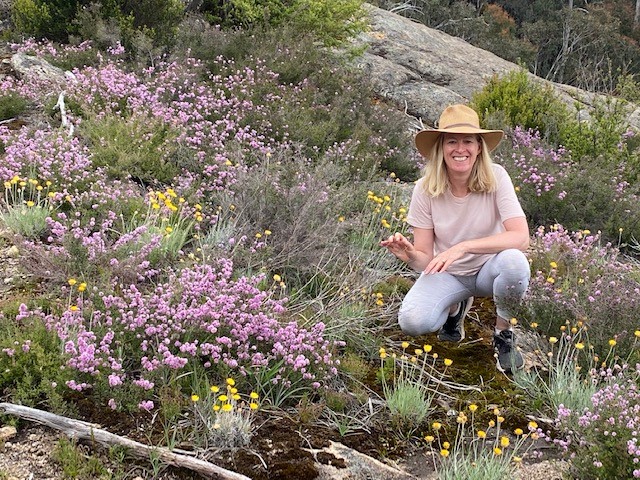
I took a pre-xmas break and spent much of that amidst the magical wildflowers on Taungurang Country – Mount Buffalo in the Victorian Alps. It was a reminder to me of the regeneration and healing that happens when we spend quiet time in nature – something that has been known and practiced by Aboriginal people for thousands of years.
“My people are not threatened by silence, we are completely at home in it. We have lived for thousands of years with Nature’s quietness’’ – Miriam Rose Ungunmerr Baumann 2021 – Renowned Aboriginal artist, Educator and Senior Australian of the year 2021
If we can create habits and practices to spend time in nature and learn to be still and silent in its presence, then we unearth our own special relationship and begin to understand viscerally just how interconnected we are.
When I spend time in nature, I find the clutter and confusion falls away, my busy mind can release and my body relaxes. If I am sharing this experience with another, I find the simple act of walking shifts any energy that is out of alignment in the relationship and opens up greater levels of connection. New insights appear often in a most unexpected way. I return energised, clear and focused and ready to be present with whatever comes next. It is my happy place 😊 The place where I feel most connected to myself and where I feel a powerful connection to something greater.
Amongst the uncertainty, shifting goal posts and intense noise and distraction that has become our new norm, I believe that spending time being present in nature is perhaps the greatest antidote we have available to us.
As you embark upon this festive season, I hope that you too can spend some quiet time in nature – refilling your own cup and honouring mother nature as the great teacher and healer that she is.
Sending love and light for the festive season wherever you are.
See you in 2022.
Nicola x
PS You can read Miriam Rose’s full article here🙁 and it is well worth taking the time to do that)

As we continue to navigate ongoing uncertainty and a need to find a way to live more fluidly in many aspects of life, I wanted to re-share this post that I wrote in August 2020 (Lockdown 2.0 – as it has now come to be known amongst we Melbourne folk).
This post is designed to get you thinking about how you are being with yourself and each. It invites us to consider the benefits of:
– being more real with ourselves and more vulnerable in our sharing,
– listening without judgement and without need to ‘fix’ the other person; and
– safely expressing how we are feeling to help stuck energy move through us so that we can function more effectively.
Much of my current work is focused on supporting leaders to activate greater levels of self-leadership.To begin to do that more effectively we need to develop our capacity to observe our thoughts and feelings, learn to listen without judgement or a ‘need’ to fix anything, and to find health ways to express. I see these as ‘being a human foundational 101 skills’ that mostly we must learn these skills as adults as we were neither taught ‘how’ nor had the benefit of having this way of being modelled to us. Developing these skills are essential to activating greater levels of self-leadership and the myriad of benefits that come with that for both life and leadership.
During this week – a week in which millions of people across Vic, NSW and SA are currently in lockdown, there were over 1600 views of this post on Linked-in. I don’t think this is a coincidence. Perhaps, with the pressure lifted to new levels for many people, the need to know how to navigate our emotional landscape so that we can take care of our mental health and function effectively amidst the constantly shifting landscape – is what we are all needing more of right now?
Enjoy the read and please reach out and let me know if it’s helpful for you.
With love,
Nicola x
PS If you are in the Sydney lockdown – sending extra love and support at this really difficult time.

This post introduces a short process to help you check -in on the health of your relationships so that you can bring back to sharp focus the people and relationships that matter most to you in your life and leadership.
In an earlier post I introduced this idea of how we need to be intentional in how we allocate our ‘mental real estate’ as it a finite and not infinite resource that we must use wisely. Amongst all of the competing demands, sometimes life bolts forward without us. When this happens we can lose focus of the relationships and people in our lives that matter most. Perhaps you can relate to this in your own life?
Part of self-leadership involves us slowing down enough to notice this has happened – and to intentionally check in on the ‘health’ of our relationships so that we can get clear on what needs to change to grow connection.
I want to share with you a process that I use in leadership workshops. It is designed to help you bring focussed attention to acknowledging and better understanding the health of your key relationships. Taking time to do this can be a powerful way of being a little more strategic on where to invest your precious time and effort, and to therefore better allocate your ‘mental real estate’. It can help you to cut out some of the noise and distractions and re-align your efforts to the things and people in your life that matter most.
I invite you to bring your own life circumstances and relationships into the arena here. Take out your notebook and complete the following short process:
1. Select 5-10 key relationships – can be a mix of work/home/other – key is that the relationships that are important for you in your work and life –and that they are ones that you are willing to intentionally focus on to grow and strengthen.
2. Rate the current ‘health’ of each relationship – based on your assessment of the level of trust ( a topic that we have not specifically covered here but one that I am sure you have a good sense of) that exists between you and the overall quality of each of these relationships (in terms of the level of health, transparency, openness and any other factor that you consider as important in your relationships). Allocate a current health rating if between 1 (a disaster) and 10 (couldn’t get any better) to each of the relationships.
3. Set aspirational target for each relationship – goal is not to get each relationship to 10 but determine where you would like/ and or need that relationship to be and a part of that will be factoring in which relationships are the most important to you.
NB. This is like your secret plan – it’s not something you would of course share with the people on here – it is about focusing your energy and attention and being intentional about the relationships that you want to grow.
4. Identify one specific action you will take to grow connection in each of these relationships and commit to a plan to make that happen.
What do you notice? How do you feel?
This exercise may bring up all sorts of things for you. Often people experience a gap between where they thought the ‘health’ of a key relationship was and where they find it actually is.This is not unusual when we move from autopilot to bringing focussed attention.
For one client what he realised is that he had been putting so much every and effort into a particular relationship and that it was not being reciprocated at all. He made a choice as part of this insight to back- off on this relationship and reallocate some of that energy and effort elsewhere.
Another client said she felt sick when she realised what she termed – ‘the sad health state’ of her relationships and felt a compelling need to bring greater energy and focus into immediately rectifying this situation. We explored the broader context around this situation which was connected to the leader being in a job that she was finding to consuming and her struggles with wellbeing. So for this leader, this self-discovery process left her considering what was enabling her and what was limiting her in terms of her current reality more broadly.
Through taking the time to bring awareness to the current ‘health’ of our relationships and connecting with how we would like this relationship to be, we are well positioned to take appropriate action to grow connection and to make better decisions and choices about our lives and leadership.
Wishing you happy, connected and healthy relationships. Please reach out if I can help in any way.