

This post looks at the beliefs we hold through the lens of being like ‘organisms’ that are fuelled from the ‘evidence’ that we feed them. It provides you with a short process to surface the limiting beliefs that are getting in the way of a reality you want to create. It then invites you to identify a possibility-fueled belief to displace the one that is keeping you stuck and to get the structure and support in place to ‘feed’ this healthy belief to so that you can intentionally create the reality you desire.
We all have a set/series of base beliefs that control how we experience ourselves, others and the world around us. These beliefs can be either limiting or enabling and from that place they either take us away from the life we want to live or toward it. They tend to be ‘I am’ declared statements, for example:
- I am a good friend/ I am a bad friend
- I am lovable/ I am not lovable
- I am capable/ I am not very capable
- I am resilient/ I am not a resilient person
- I am worthy/ I am not worthy of (being happy, belonging to this group etc ).
As an example of a limiting belief, if we have a base belief that everything in life is scary, then when events and situations happen we are more likely to react to them from a place of fear. Because this belief that life is scary governs how we see the world, we aren’t able to respond to the same events and situations from a place of possibility.
Living organisms: a metaphor for beliefs
I was recently introduced to the idea of thinking about beliefs as being living organisms. This metaphor really resonated with me, so I wanted to share it with you. Just as organisms seek out and feed off the things that nourish them, our beliefs look for evidence to validate their own viewpoint. When a belief locates evidence to support itself, the belief (as the organism) becomes bigger and stronger. Let’s look at a short example of this.
In 1987, at the age of 17, I had an English teacher say to me, ‘You really don’t write very well, do you?’ Those eight words, almost a throwaway line on the day, stayed with me. They cemented a core belief in me that what she had said was true, that I am not good at writing. She was, after all, a highly qualified and experienced teacher of English (evidence to feed that belief).
Having accepted this belief was true and that there was nothing I could do about it, the belief continued to seek out and gather ‘evidence’ to support itself. It did this for the next 30 years. 30 years: that’s a very long time. I would write a personal message on a birthday card and immediately judge it as not very good. I would take hours and hours, beyond what was reasonable, to write an otherwise straightforward board report or business presentation. I would become annoyed with myself for my seemingly inept attempt to articulate how I was feeling in my own personal journal – something no-one else was ever going to read! All this ‘evidence’ continued to fuel this belief that I was not a good writer.
It took many years for me to really understand how accepting this fear-based belief as true was limiting me in the direction I wanted to head with my life and my business.
In 2017, at the age of 47, I made a clear decision. This belief had had power over me for too long. Sitting on the cusp of a massive growth edge, I nervously yet knowingly chose to put this belief into a metaphorical ‘backpack’. It was time to allow the internal voice of my own wisdom to be truly acknowledged and lead the way. That little voice inside me was telling me that I needed to write and share what I had learned with others. With the support and encouragement of David (a professional editor) by my side, I started my blog in 2018.
It wasn’t all smooth sailing by any measure. I recall a phone call from David after I had drafted my very first blog. Let me just say for various and very legitimate reasons it was scrapped altogether. A total disaster. But I had made a start. What could have been some new evidence to support the belief that I did not write very well, I chose to ignore rather than attach any weight to it. The exciting thing was that very soon I discovered how much joy I felt when I was writing. Before long, the writing was flowing freely and I had released a flow of material and insights that wanted to be shared.
Here we are in the third year of my blog and there’s plenty more to say yet! And there is a book on the way as well.
Turning fear-based beliefs into possibility-fuelled beliefs
Perhaps you have a belief that is getting in the way of a reality you want to create or a project you want to realise or a relationship you want to nurture? Can you pin it down? Can you identify how it’s reinforcing itself with self-fulfilling ‘evidence’?
The first step in a situation like this is to get clear about the reality that you want to create. You then need to understand what you have control over.
I really wanted to share what I had learned with others through writing a blog.
I had control over choosing a different belief. I had control over starting to write anyway. I had control over identifying and engaging the support that I needed.
The next step is to surface the beliefs that are keeping you from moving toward that reality.
I am not good at written expression.
Then choose a more helpful belief:
Possibility-fuelled belief: I am worthy of sharing my experience with others through writing a blog /I am able to be useful to others through my written expression/ I am capable of writing a blog that is worth reading.
Now, there are three things to bring this all to life:
- make a conscious choice to feed the new belief and starve the old belief
- get the support in place that you need to help you create your reality, and
- start to look for evidence to nourish the possibility-fuelled belief to become bigger and stronger
In my case, the old belief – I cannot write – no longer lives within me. As I somewhat nervously published my blog, putting it out into the world, magic started to happen. I received emails and phone calls from people thanking me for something I had written that had resonated for them. This became powerful ‘evidence’ that supported my new belief – I am capable of writing a blog that is worth reading.
Do you have a new reality that you want to create?
What do you have control over in this situation?
What fear-based belief/s are limiting you?
What is the new possibility-fuelled belief that you choose?
What ‘evidence’ do you already have that supports this new belief?
What support do you need to keep growing the ‘evidence’ that makes sure this belief thrives and fuels your desired reality?
______________________________________________________________________________________
Visit www.evolvingleaders.com.au to learn more about our Leadership Development Programs and Coaching.
Well, while it;s fair to say that 2020 has been nothing like any of us anticipated, one of the gifts for many was finding ourselves with a little more time and space on our hands.
What was the favourite thing you created this year?
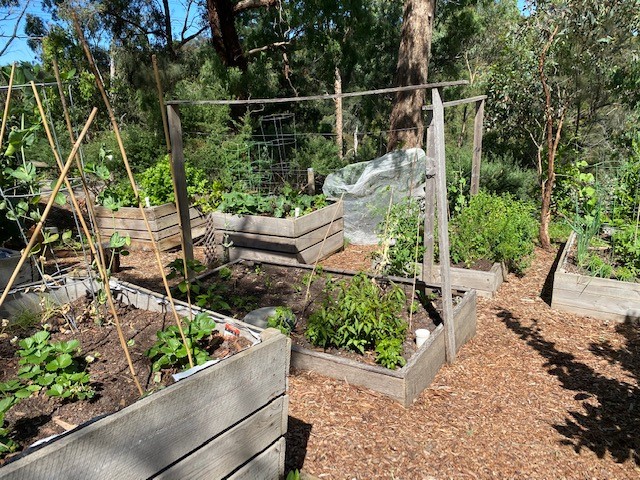
Well for me there were two things: The expanded vegetable patch to now include passionfruit, kiwi fruit and more silver beet and celery than the kids would ideally like; and, the writing of a little book about what I’ve discovered about self- leadership derived from over a decade of personal and professional learning and practice.
As it turns out – both creative projects continue to be works in progress – as I battle with the birds and the possums and slugs, while also enjoying the flowers on the strawberries and tomatoes in the vegetable patch; and, simultaneously re-shaping and renaming of my little book – thanks to a dear friend and colleague who helped me to see a better way forward. I am forever indebted to the creative process with its insights and blocks and lumps and bumps until clarity finally beckons!
I can’t wait to share my little book with you in 2021.
What is clear to you now?
One of the gifts that can also come from tough times, is that we get clearer on what matters to us most and if we listen to that we can make more conscious choices about where we want to put our precious time and energy. Does that resonate for you in any way from your experience of 2020?
During this year, for me, it became even more apparent that we all have a responsibility to listen to that little voice inside of us that is saying ‘something needs to change’; to explore and connect with self around this ‘invitation’; and to take conscious action. Rinse, repeat. This is the practice of self-leadership.
Some of what I have also ‘crystalized’ this year about self-leadership is that;
– We are responsible for our own evolution and growth. Period.
– Learning about ourselves and growing our effectiveness as leaders is a lifelong process that takes focus, commitment, and a clear intention.
– Unless we carve out space to do our own personal learning, life will continue to drive us rather than enabling us to shape our own reality.
Building on all of that, what is super clear to me now is that the number 1 focus of my work in 2021 is bringing The Practice of Self-Leadership to a wider audience. This is work that we all have to do – irrespective of whether we are in a leadership role or not.
The Practice of Self Leadership will be made available to a wider audience in 2021 through:
– 6-month individual coaching programs commencing in February 2021 (I’m opening up six new places only – get in touch soon if one of those is for you),
– Self as Leader – Leadership Development Program – (in house) Continuing to facilitate our 3-month core leadership program
– Self as Leader – Leadership Development Program – (public program) – Dates for 2021 will be posted soon (via remote learning)
The good thing is that it wherever you are in the country (or in the world) The Practice of Self-Leadership – individual coaching and leadership development program can come to you. Please get in touch to register your interest or to find out more.
A moment to pause…
Conscious leadership is not possible without carving out – literally quarantining space to reflect, reset and do our self-work and there is no better time to do this than at the end of this year of 2020! So grab a piece of paper (or audio or video record it on your phone if that’s your thing) and take a few moments to reflect on these questions:
Fill in the blank: This year, I feel proud of myself because ___________.
Which six ‘feeling’ words describe your experience of 2020?
What was the favourite thing you created this year? (a project, a fabulous meal, a garden, space for you….)
Can you remember a time in 2020 when you thought you couldn’t do something (“This is too hard, I’m overwhelmed, I can’t do this”), but then you surprised yourself and you did it?
What is something you want to leave behind in 2020 and not carry into 2021?
What’s your intention for the festive /holiday season? (I wish to experience…….)
Take a big breath out …. you deserve it
A special thanks to the wonderful leaders I have had the privilege of supporting in 2020. It’s been a massive year. To those of you in the world still in the thick of the pandemic sending love and healing to you.
To my fellow Victorians well done – we did it. Sending love and light for the festive season wherever you are.
See you in 2021.
With love
Nicola x
There is a lot to navigate right now isn’t there? How are you holding up?
When Dan Andrews announced extensions of stage 4 restrictions for Melbourne Lockdown 2.0 on Father’s Day 2020, the news wasn’t unexpected. In some ways I let it wash over me that day. That night, however, I tossed and turned and did not sleep well.
Monday came around again and as I was looking down the barrel of another week of what felt at the time like Groundhog Day, I awoke feeling overwhelmed and not knowing how I or anyone else was going to endure several more weeks of lockdown. I felt heavy and stuck and I was unable, in that moment, to focus on anything other than doom and gloom.
To compound how I was feeling, I started to feel guilty about feeling that way. Given all that I have to be grateful for in my life I should be able to just think positive thoughts and get on with it.
How often do we give that advice to ourselves and offer or give that advice to others? It has its place but sometimes it’s not helpful and can even be harmful.
Not surprisingly this harsh inner-critic compounded how I was feeling. Luckily for me, with my husband working from home we had some extra time together over breakfast (one of the many gifts that isolation has given us). He was able to be present with me and just listened as I explained to him how I was feeling in that moment. I didn’t hold back and left no stone unturned. He didn’t try and ‘fix’ anything. He was present and he listened. I cried. He passed the tissues and he listened.
After the 10 minutes it took for me to do the offload, he said, ‘I am sorry that you are feeling that way’ and gave me a big hug.
You know what happened then? The veil of heaviness that had surrounded me began to lift. I felt so much lighter. I mustered up the energy for a walk and reflected on that little bit of ‘magic’ that had just transpired. I felt so much better in myself. I was able to refocus on my day and get on with what I had to get done.
I share this story as a reminder of how important it is that we acknowledge the full spectrum of how we are feeling and find a healthy way to express that. Especially at this time, but this is equally important in our day-to-day interactions, life and leadership.
We need to get rid of the story of judging feelings as being ‘good’ and ‘bad’ and learn to welcome and make space for them all. We need to re-frame this idea that we should always focus on the positive, especially when it is at the expense of putting a lid on our so-called ‘negative’ emotions.
I am not suggesting for a moment that we should wallow in self-pity and stay there. What I am suggesting is that if we simply try and put a lid on the things we don’t want to feel then they will stay stuck somewhere in our bodies, wreaking potential havoc there. And they will get a stronger grip on us and keep us stuck there for even longer.
If we can, on the other hand, give these ‘feelings’ what they need – which is often simply to be acknowledged – they can then move through us and we can regain clarity, calm and the perspective that we need to be able to move forward.
You can read the full poem here.
My questions to you:
Are you making space to express all aspects of how you are feeling?
Is there anything you can do differently in supporting others to help them make space for expressing all of how they are feeling?
Please take care. Look after your emotional landscape and of course at any stage you feel any emotion feels too intense for then please get professional support. https://www.ruok.org.au/findhelp
This post shares a personal story and suggests that every human being on the planet right now, in some shape or form, is facing into their own ‘growth edge’. It invites the reader to reflect on what they are noticing in themselves and others in terms of this personal learning and highlights that perhaps the luckiest people right now have leaders and organisations that are providing development and wellbeing support for their people.
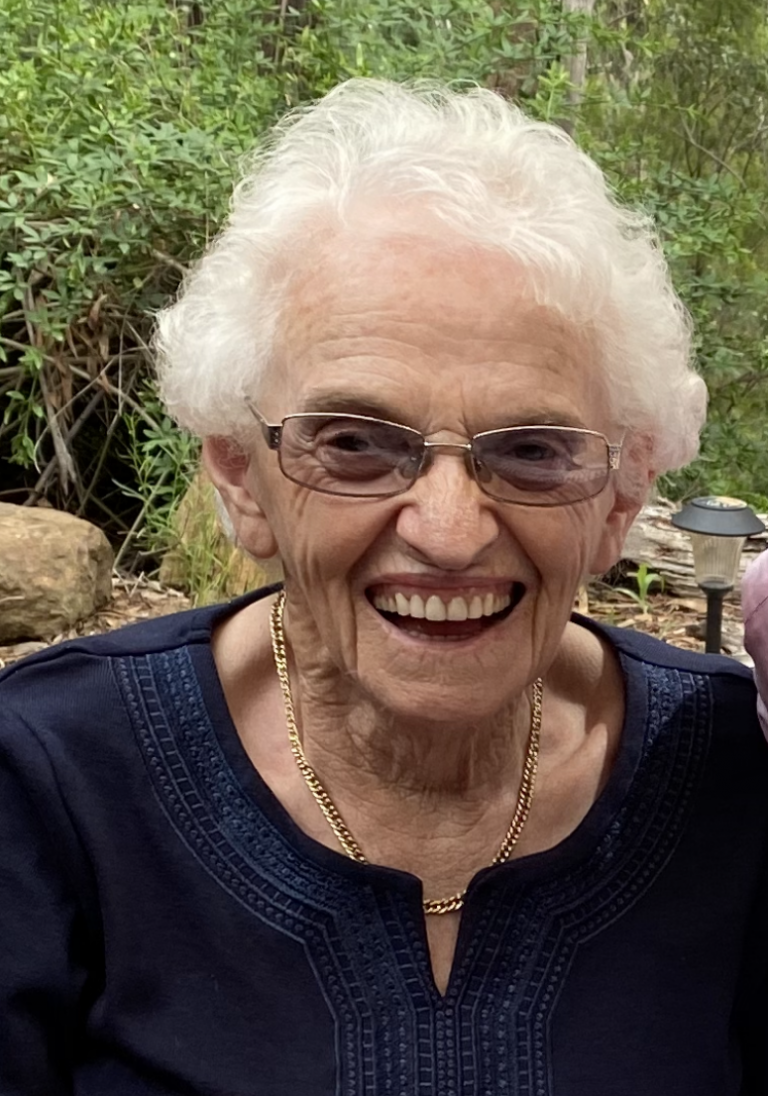
Meet Elaine. She is my delightful 84-year-old mother-in law. Elaine left school at age 15 to help with home duties on the family farm and continued in that role all through motherhood and grandmother-hood.
In her lifetime, she has baked tonnes of lemon slice and the arguably the best chocolate cake ever. When she isn’t baking, she pours all her energy and focus into supporting her community and showering us – the family – with her love.
Throughout her lifetime, Elaine has felt no desire for, nor any reason to, use a computer or a smartphone. And so, in March 2020, as the world felt like it was closing in on all of us, we realised that that Elaine would soon be in total isolation. Without even the stilted connectedness the internet offers the rest of us, she would have very limited contact with her her family and friends, and we were concerned about the flow-on impact this would have on her overall wellbeing.
So, without further thought, we purchased her an iPad. In a curious way, one of the first questions she asked was, ‘Why is the keyboard not in alphabetical order?’ She had never used any sort of keyboard in her life, let alone an email address. How much we take for granted! This was completely uncharted territory for her.
The rest is history.
True to form, with her enthusiastic approach to a new challenge, she was up-and-running in no time. The pure delight we witnessed when Elaine had her whole family (across many geographical locations) in front of her on the first Facetime call is a precious moment that will stay in my heart forever.
If you had said to me six months ago that, in the year 2020, Elaine would be making Facetime calls, ordering her groceries and doing her banking online, I would have broken out in laughter!
But she was soon doing all of that. We are so proud of her.
Elaine’s story got me thinking about what the disruption of this year has meant to all of us in terms of the learning we have been somewhat forced to do or had to do in many ways. What became clear to me is that every human being on the planet right now has had to confront their own fear at some level and learn something new, or make some change that they would not have made without the pandemic.
No one is exempt. It has been, and continues to be, a true ‘growth edge’ experience for us all. (Read more about growth edge here)
Do you agree? Where have you noticed this happening?
What are you being asked to or forced to change at this time?
What is your personal growth edge right now?
Some examples from my own ‘growth edge backyard’ are:
- quickly getting up to speed and proficient at creating connection and engagement online so as to be able to effectively deliver team development via an online platform. Like many, I still really don’t like facilitating groups on Microsoft Teams, but at least I know how to do it.
- taming my voice in our family to allow each person an equal say in shaping the healthy boundaries needed for life in isolation in a household of five people (that is, learning to listen better and not assuming I always have the best answer)
- establishing a healthy and productive work rhythm by creating greater structure around my allocated working hours, which in my case means 90 minute cycles then taking a break (here is a great article on this topic).
Most clients that I am currently working with are struggling with many aspects of work and life – juggling home schooling, too many hours on Zoom and experiencing other financial and social pressures. It’s the norm rather than the exception right now.
What is being demanded of people by this pandemic in terms of growing and changing for many feels heavy and hard. I am also noticing, however, that the luckiest people during this time work in organisations and with leaders that recognise the need for, and are investing in, the wellbeing and development of their people. It is from this support base, that people can begin to make sense of themselves and their own experiences and begin to see some reward and celebration of their efforts on the other side.
The benefits flow on, as when this growth edge can be applied within a broader team context, it is even more powerful. As individuals grow and change and are able to be more vulnerable and courageous with themselves – as 84-year-old Elaine has demonstrated so well, and when they can do this with their teams as well, then team culture can grow in ways that are good for all.
Could you or your team do with support right now? Please get in touch to book your team development – delivered remotely of course.
This blog post introduces readers to a unique individual and team development experience – The Flow Game. The Flow Game gets to the heart of what needs to change in the way the team is operating and in doing so creates clarity, grows connection and grounds action. It is a powerful process for leadership and team evolution as it provides a much-needed space for reflection, expression and connection.
Where did the Flow Game originate?
The Flow Game (www.flowgame.net) has its origins in Denmark back in the 1990’s and is now being played across the globe for individuals and teams as a way of finding clarity together. There are eight stewards of the game across the globe, including three of the original founders (Vanguards) – Toke Paludan Møller, Monica Nissen and Jan Hein Nielsen.
I have been extremely fortunate to be a student of the Flow Game for several years now, and have reaped the rewards both personally and professionally that come with this practice. In 2019, I was formally accredited as a Flow Game host and this coincided with the release of the Team Deck of cards. Since then, the Flow Game has become an integral part of my leadership & team development toolkit.
Why you might ask?
Because quite simply put – The Flow Game surfaces what really needs to change (based on the collective question of the group), creates alignment and before people have even left the room many of the internal barriers to change are no longer there. A new lease of energy, connection and grounded action is available for the team. This is cultural change and leadership in action.
What is the Flow Game?
The Flow Game isn’t a conversational game as you might expect– it is more about reflecting and sharing and listening without the need to interrupt or judge or fix or justify or explain. The process helps us to slow down and fall into our true nature and helps us to learn a very different way of being together and interacting in a conscious way. From that place new awareness and insight is surfaced and the action that we need to take becomes clear. The flow game in its essence helps individuals, teams and groups to:
- Create clarity
- Grow connection (self, others & to vision, values purpose), and
- Define and agree action
- Create (desired) change
The Seven different perspectives in the flow game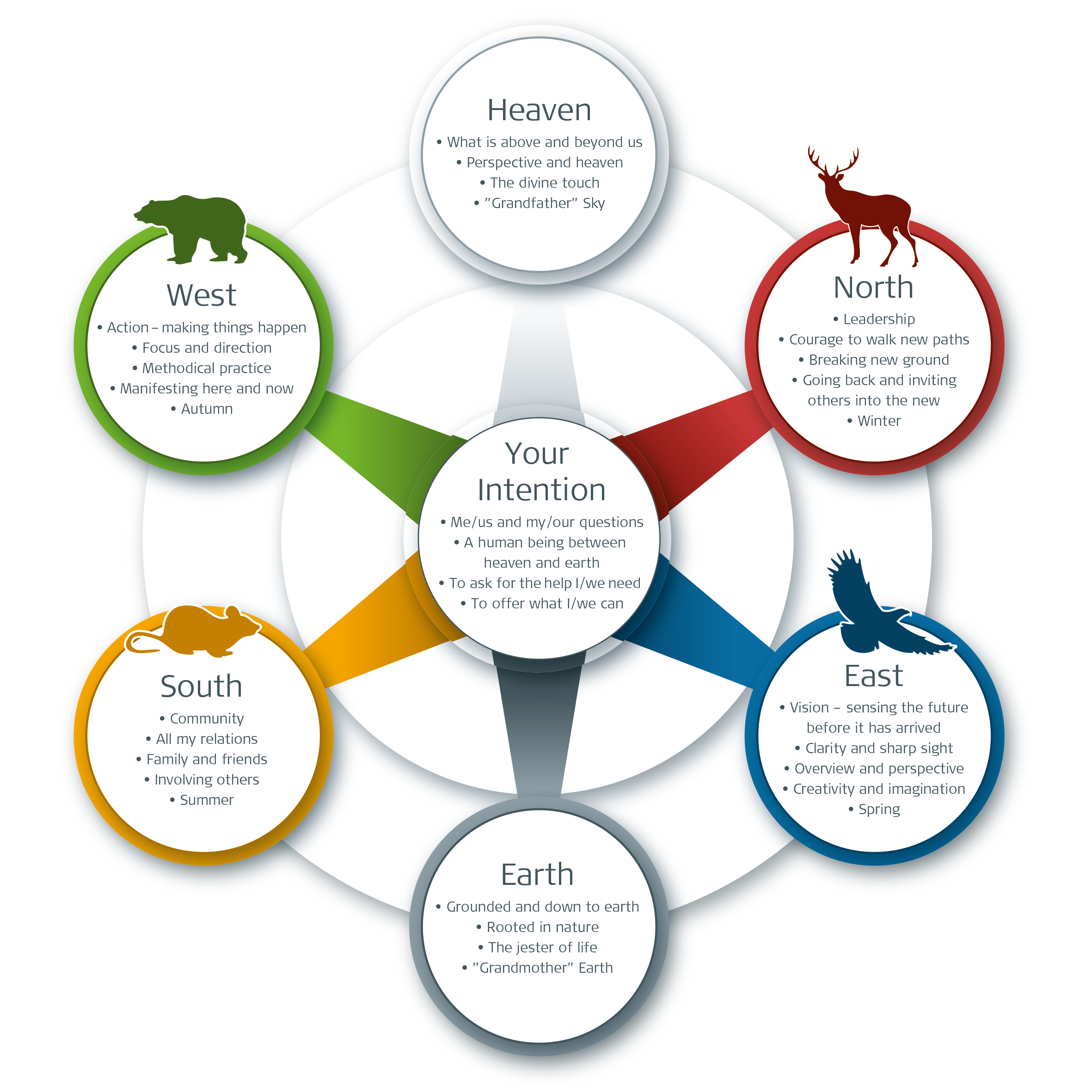
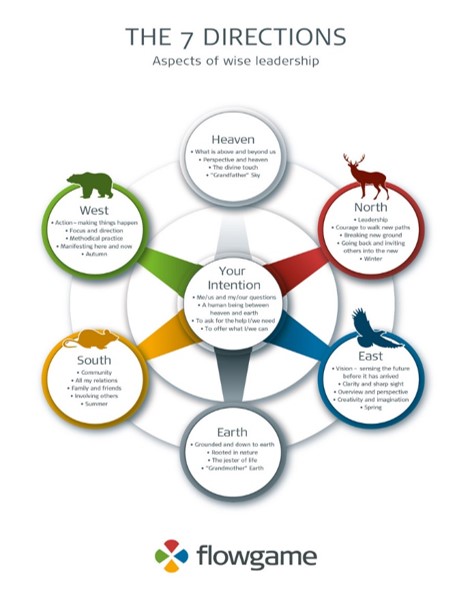
1.Blue River of the EAST – Vision
The creative and visionary side of leadership and seeing the big picture
2.Yellow River of the SOUTH – Community
The ability to empathize, connect, inspire, engage, align and attune
3.Green River of the WEST – Action
The ability to bring vision into meaningful action and ‘get things done’
4.Red River of the NORTH (Red) – Courage
Having the courage to walk new paths, break new ground, lead the way
In addition to the four rivers – dimensions or directions of our personal leadership there are two more aspects to consider:
5. Above (Heaven) – heaven speaks to our highest aspirations and powers that are greater than we are.
6.Below (Earth) – earth below is our ground, the foundation we stand on. It gives us a sense of reality and demands our presence here and now.
7.My/Our Question/Intention –The focus or intention is formulated as a question, which sits in the centre of the game. Together we then explore and illuminate the intention/s from the other six perspectives of the game.
Source: www.flowgame.net
Three Versions
There are three different card decks that are used for different purposes:
- Personal,
- Team &
- Family/community
Within that context, there are multiple possibilities for the way the game can be played as it can be designed around an individual or group intention (question) or a combination of both.
As a flow host community, we are constantly evolving and exploring new ways to design and host the game for varying contexts and needs.
A Burning Question
The flow game is a process – and it’s a powerful one but it is important to note that it’s not the panacea for every presenting issue or challenge. The important thing is that the individual/s or team has a burning question that they are seeking clarity on and that the invitation to, and the design of the game is set up in a way that honors the people, the process and the situation/question.
The need and intent and the membership of the group first must be clear and we then design the game around that.
Different Applications
Three of the ways that The Flow game is currently being used in a business and community context are:
1. Team Development
When working with an intact team, a great place to start is with a shared/collective question or intention. This is where the Team Cards are used. This may progress to a round using the Personal Cards however in this context – a generic question would be applied for each member of the team. For example, “given what we now know about the team, what does that mean me? “would be applied generally. The design will of course depend on the need, intent and membership of the group.
2. Leadership Development
Depending on the need, intent and membership of the group (for example it is often easier to be vulnerable with people we don’t know than with people we do know) ,the flow game can be integrated into an existing Leadership Development Program at the start of the shared learning journey, midway during the experience or as a way of integrating and coming to closure and grounded action at the end of a Leadership Development Program. Team, Personal and Family/Community Cards can all be applied in this context.
In today’s hectic world at a time when it is so easy to fall into the trap of being overwhelmed by feelings of “busy and important”, the Flow Game offers the essential time required to reflect and do the important deep-thinking essential for conscious choice and action – Participant
3. Cultural Evolution
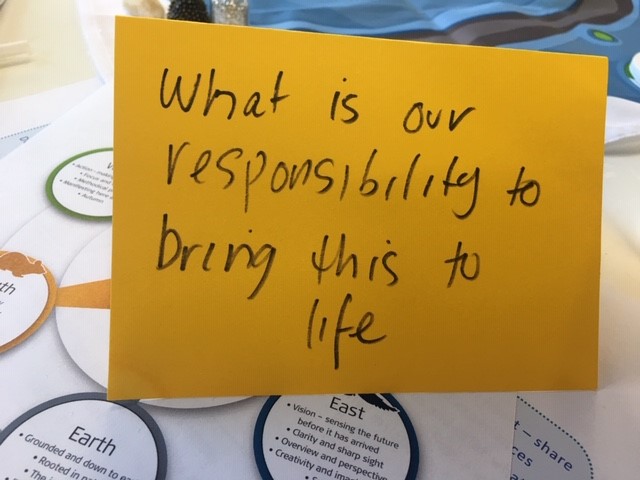
The flow game is a powerful way to create clarity and alignment at an individual and collective level and this is where it fits to support and enable cultural evolution. In one specific application, it is being used in the implementation of the cultural change journey. Stage 1 was one was about defining purpose, vision, values and strategy and stage 2 is about bringing that to life. The Flow game is being leveraged as part of the team and leadership development journey with the collective question: Given our overall direction, “What is our responsibility to bring this to life?. It is also being used with the leaders of this change to create clarity and alignment around leading this change.
How many people can play?
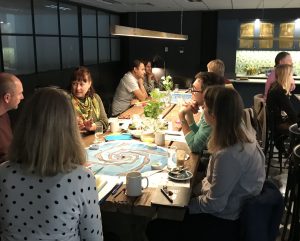
The flow game is typically played with 2-8 players – however that too can be flexible. For example, it can be utilized in an executive coaching session with one person all the way through to a conference with many people. It is possible to have multiple games being played concurrently and has been done with great success in many settings.
While there are many different applications of The Flow Game, the essence of what it delivers at both an individual and team level remains the same:
- Clarity
- Connection
- Action
- Change
It is from this place that we can live, lead and be together consciously and create healthy high-performing teams.
Evolving Leaders was established in 2014 with the purpose of evolving the consciousness of leaders to make the world a better place. The Flow Game is a powerful partner in this work. We are greatly indebted to the founders of the game and the international flow host community that continues to evolve this practice.
Interested in a Team Flow experience? Please get in touch.
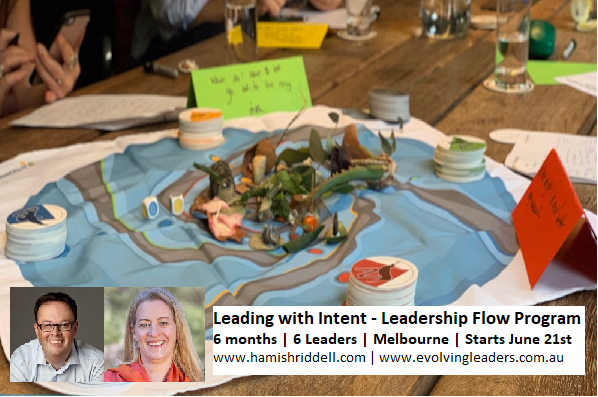
A unique development opportunity. 6 months | 6 Leaders | Melbourne | Starts June 21st 2019
Do you feel like you are out of flow?
Do you sense there is a better version of your leadership just out of reach?
Are you wrestling with questions that don’t have easy answers?
Are you caught in the whirlwind of doing (not being)?
Would you benefit from a having some external support to navigate long over-due changes?
Do you need a regular space to spend time working on being a better version of you?
If this is you then ”Leading with Intent” is for you. The focus of Leading with Intent is on taking your story – your ‘you’ – to the heart of your leadership.
We invite you to join this different and powerful development experience. This exclusive program has been designed for six like- minded leaders and includes:
– five half day development sessions over six months utilising The Flow Game
– two individual development sessions (prior to program start and at the conclusion)
– your own peer support learning group; and
-ongoing guidance from your flow game hosts during the program .
Full program details