

Inspired by Meg Wheatley, this post outlines the personal beliefs that motivate my action these days and invites leaders to consider doing this same.
It is now well understood that our (internal) values and beliefs drive our (external) actions and behaviours. Two well-known models, amongst many others, that demonstrate this are the iceberg culture model and Ken Wilbur’s four quadrant model.
I was recently surprised and delighted reading Margaret Wheatley’s book Turning to One Another in which, early on, she casually and clearly articulates the beliefs that motivate her action these days. It felt refreshing and transparent. It got me wondering how often, if ever, we as leaders take time to stop and capture the beliefs that drive our actions and behaviours? To actually write them down?
When did you last do this?
Given my passion for personal values, I have mapped my personal values over many years. I have observed the growth and shifts and the resulting changes in my behaviour and decisions (which I will leave to another post). But I have never stopped and written my beliefs down. Now is obviously the time!
So taking the lead from Margaret’s fresh approach, I wrote a heading on the page:
What are the beliefs that motivate my actions these days?
In the context of my vision to inspire leaders to do the personal development work they need to become the best possible versions of themselves, and in doing so to build human organisations, here is some of what followed.
- We are out of balance and that is the source of so much illness, disconnection, suffering, poor decision making and performing – within ourselves, our teams, our organisations, families and communities. Starting at a physiological level ( you know – the normal biological functions of our bodies) our automatic nervous system is out of balance with an overactive sympathetic nervous system (tension) and under active parasympathetic nervous system (our relaxation response). You can read more about that here. We spend too much time thinking and doing, responding to the demands of the external world. We are disconnected from our inner wisdom and knowing, feeling and sensation and the people that matter to us. (Perhaps there’s a thesis in here somewhere?)
- Optimal performance and inner peace and happiness are more readily available to us when we restore balance. You can read more about 1 and 2 in this blog post: Mastering thinking and doing AND feeling and being
- We have to learn new ways to access our inner potential and wisdom to respond to the wicked challenges of the time we are in. It’s less about skills and knowledge and traditional leadership development and its and more about building our capacity as human beings. One example of this is that many of us are left brain dominant (the centre that deals with language, logic, ration and reason) and underdeveloped in our right brains (the creative, intuitive side). There is so much untapped potential available to us via our right brain.Two ways I know how to do this are through Art Therapy and Yoga Nidra Meditation. You might also like to read here about the wonderful potential of the mind and why they are important for leaders.
- Developing people is the solution to the problems that confront us. (I share this one with Margaret Wheatley.) It’s not about training. It’s about development. A lifelong commitment to learning and growing is needed, accelerating the normal human developmental journey that is available to us all. ‘Get Connected- Its where change happens Part 3 – Connect to ‘Our Reality, Connect to Our Learning’.
- Wellbeing is a strategic business issue that is not separate from cultural transformation. Wellbeing is so much more than a tactical intervention with a fruit bowl in the kitchen and yoga classes for employees (although these are important in their own right). Achieving wellbeing and transforming culture are one and the same, leading to a healthy, thriving, ‘well’ organisational culture and human organisation. My point is that there is no need to pursue these two things separately. Rather, wellbeing and cultural transformation should be part of the same strategy.
- We are all craving intimacy. I am not referring to sexual intimacy. I am referring to the connection that we need as human beings. Relationships are all we have. It’s essential that we create the space and build the capacity and capability to form real connections with each other in the workplace, in our families and in our communities. This will mean putting down our technology and ‘moving towards’ one another with compassion and deep care. This is what is needed right now. ‘Get Connected- Its where change happens Part 2 – Connect to ‘US’.)
- Fully human organisations are the ones that will thrive in this next decade and beyond. You can read more about my vision for fully human organisation here. I would love to hear your thoughts.
- We have to consciously create space if we want to create change. Change simply does not happen unless we carve out ‘space’ in our lives and guard that space as though our lives depend on it. Space to reflect, to think; space for feeling and being. Space in each day, each week, each month, each year – for ourselves and our teams.
Not an exhaustive list but a solid start.
How about you? What are the top beliefs that are motivating your actions?

These blog posts explore the lens of building ‘connection’ as a model to guide cultural transformation for teams and organisations.
We live in connected times, in which technology allows us to be connected at all times – even in the air now – with virtually everyone in our working and private lives. At the same time, ironically, we are more disconnected than ever before – from ourselves and from each other. We see this in individuals, teams, organisations, families and communities, in which feelings of isolation, mental health issues, relationship breakdowns, stress related illness and dysfunctional team cultures are more common than they’ve ever been. Sound familiar?
Connection – real, human connection – is at the heart of the human organisation. Connection characterises great leadership and therefore is at the heart of any thriving workplace culture.
In much of my work in recent years, I have used the model shown here – adapted from the Barrett Values Centre ‘Get Connected’ model – as a road map to simplify some of the complexity and multi-faceted considerations around connections that exist when navigating cultural change.
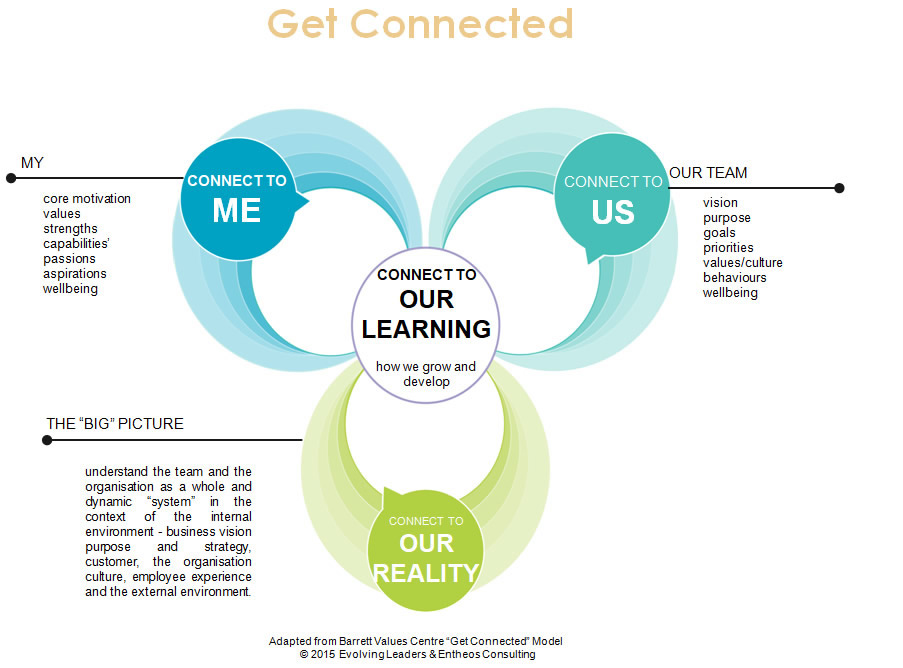
The model guides the discovery and learning journey toward a healthy team culture and a thriving organisation through focus on four cornerstones: ‘Connect to Me’, “Connect to Us’, ‘Connect to our Reality’ and ‘Connect to Our Learning’.
In Part 1 of this post I will focus on the first of the four cornerstones “Connect to Me”.
Connect to Me
This is all about personal leadership. Who am I? What matters to me? What is my core motivation? My passions? My strengths? My preferences? It’s about taking personal responsibility.
What does this mean in the context of living a purposeful life?
What does this mean in the context of my role, the team and organisational culture?
It’s about developing self-awareness, capacity for reflection and developing the confidence to share your whole self at work. It’s about feeling psychologically safe so that you can challenge norms and exhibit new ways of being. It’s about learning to be present with others and to listen without judgement or need to comment. It’s about sharing from a place of realness and vulnerability and having others witness you on your personal discovery journey.
When you undertake this personal development with your manager and team members, you build confidence to bring ‘more of who you really are’ to work and thereby the ability to share your unique gifts in service of the team and organisation. You understand each other at a whole new level and that connection brings healthier ways of working straight back to the workplace.
For a leader, the ability and willingness to bring your real self, warts and all, to your work – to be ‘comfortable in your own skin’ – is powerfully reassuring to others. It gives others permission to do the same, each building their own individual ‘connection to me’. This is great leadership in action.
“When we begin listening to each other and when we talk about the things that matter to us, the world begins to change” (Margaret Wheatley – Turning to one another, page 13)
The movement toward a healthy team culture and a human organisation is built on members of that team taking personal responsibility for expanding their self- awareness and capacity in the context of the role, team and organisation. The Connect to Me model provides a roadmap for this personal learning.
In Part 2 and 3 of this blog post series I explore the other three cornerstones of connection: Connect to Us, Connect to our Reality and Connect to our Learning.

These posts explore the lens of building ‘connection’ as a model to guide cultural transformation for teams and organisations.
In Part 1 of this series, I explored the first cornerstone of connection, ‘Connect to Me’. In this post we will look at the second cornerstone, ‘Connect to Us’.
Where ‘Connect to Me’ was all about personal leadership and having the confidence to bring ‘more of who you really are to work’, ‘Connect to Us’ is about the group. It follows that the more each of us is willing to reveal our ‘warts and all’ self at work, (and there is the leadership and team culture that provides the best conditions for this to happen), then the better we will all understand each other. This connection brings healthier ways of working straight back to the workplace. This in turn creates the right conditions for the pursuit of a truly human organisation.
As I mentioned last time, in much of my work in recent years I have used the model presented here – which is adapted from the Barrett Values Centre ‘Get Connected’ model – as a road map to simplify some of the complexity and the multi-faceted considerations that exist when navigating cultural change.
One of the diagnostic models I like to use when working with teams is the Barrett Small Group Culture and Values Assessment.
It asks three simple questions of each member of the team and elicits rich data about what is important to each member of the group personally, how they currently experience the team culture and where they would like that culture to be.
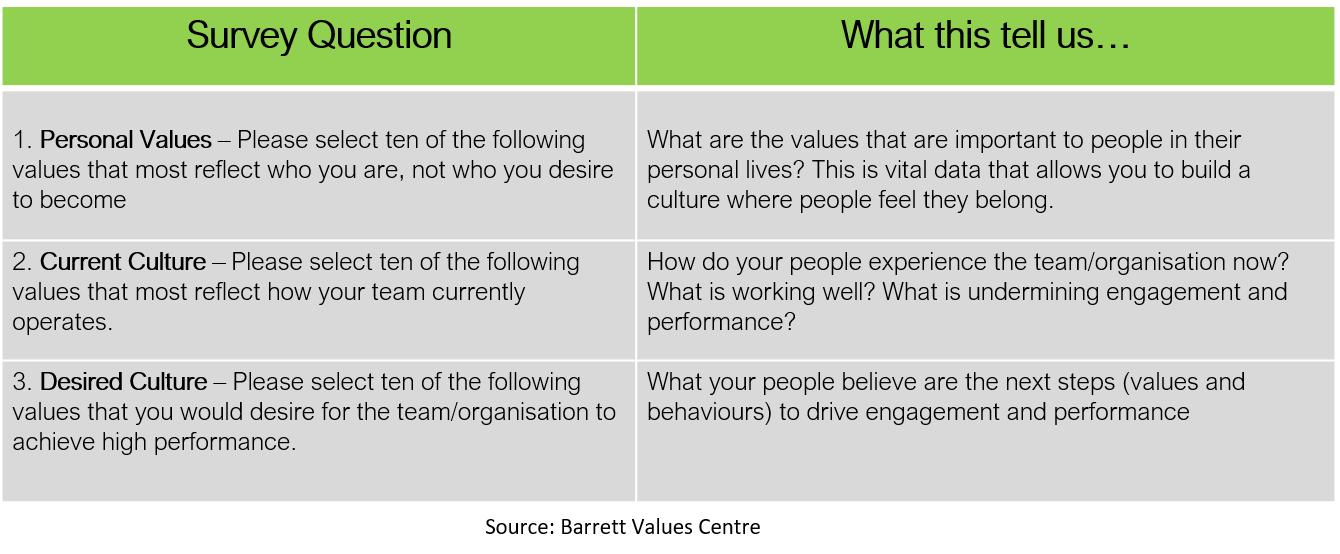
The assessment provides the basis for a different conversation – one where real connection happens and healthy change becomes possible. This provides the context for the broader team exploration which includes the following themes:
- ‘Why do we exist?’ or ‘What is our purpose?’
- How is our team culture contributing to the customer experience and the culture of the wider organisation?
- Given what I now know about myself and others, what does that mean in the context of how we operate as a team and the culture we want to create?
- What matters to us collectively as a group and how can we create a culture where we feel greater alignment?
- What is it about the way we operate that is hindering or helping the personal wellbeing of each of us?
- How are we fulfilling our role to deliver on the business strategy?
- Given what we now know, what are our goals and priorities?
The process enables the group to make choices about ‘the way we want to work together’ and ‘the way we want to be together’ and to take committed action to make that happen. This exercise often reveals ‘blockages’ that are preventing the team/organisation from being their best and identifies the key leverage points to harness the energy and build a healthy culture and thriving team.
The way the learning journey is facilitated and the skills that are practised during the team learning journey build connection, which in turn moves the organisation towards being more human. Where meaningful conversation and deep listening occurs, change happens.
“There is no power for change greater than a community discussing what it cares about” (Margaret Wheatley – Turning to One Another)
In Part 3 I explore Connect to Our Reality and Connect to our Learning.

In this series of blogs posts of I have been exploring the different aspects of ‘connection’ that exist at the heart of a human organisation. In Part 1 I looked at the individual perspective, ‘Connect to Me’ and in Part 2 at the team- or organisation-level perspective, ‘Connect to Us’.
These derive from the model presented here, which is adapted from the Barrett Values Centre ‘Get Connected’ model and which I use in my work as a road map to simplify some of the complexity and multi-faceted considerations that exist when navigating cultural change.
In this post we will explore the third cornerstone, ‘Connect to Our Reality’ and the one that brings it all together, ‘Connect to our Learning’
Connect to Our Reality
In this cornerstone of the ‘Get connected’ model, our focus is on understanding the team, the organisation and the wider environment as a whole and dynamic ‘system’ in the context of:
- Business vision and purpose
- Business strategy
- Business performance
- The customer experiences
- Internal environment (organisation culture and employee experience) and
- External environment (competitors, political, economic, social, legislative etc).
Thinking systemically and holistically and understanding dependencies and the broader context of the overall system is vital to creating a healthy, high-performing team culture.
Building connections means understanding, paradoxically, that everything is already connected. Recognising the interconnectedness of different systems – for instance a team in the context of a business unit, a business unit in the context of an organisation, an organisation in the context of a parent organisation and the external landscape – makes sure that the context for transforming the team culture is aligned.
I once worked with some individual faculties which each formed part of a large educational institution. The team within each faculty had its own subculture, as did every other team. And then there was an overall culture that existed across the organisation. This is quite normal, of course. You’ll see a form of it in every large organisation. The challenge when working with just one faculty is that while you can work on changing the ‘local’ culture, you can’t change the culture at an organisational level. But you can’t ignore that broader context either.
By understanding and accepting the ‘connection to our reality’ we are better able to identify the boundaries in which we operate, which strengthens the team focus and resolve towards their desired culture as an expression of that group of people.
Connect to Our Learning
“If you want a harvest in a year, grow a crop…
If you want a harvest in ten years, grow a tree…
If you want a harvest that will last for a life time, grow people.” -Chinese Proverb
‘Connect to Our Learning’ sits front and centre in our Get Connected model for building team culture and that is rightly where it belongs. Culture transformation doesn’t happen without engaging every single employee on a learning journey to develop self-awareness and the practical skills and behaviours they need to increase their self-mastery, to learn to manage their behavioural triggers, to see different perspectives and to enact self-leadership.
In a healthy team culture, ‘everyone is a leader’. Leadership is a mindset and a behaviour that applies to everyone, not just the anointed few. People are responsible for playing a role in driving their own learning and development and the organisation is responsible for providing the learning opportunities that create engaged employees and healthy, high performing culture.
Our Get Connected approach to building team culture is a learning process designed to ignite new awareness about ‘who we are’ and ‘how we show up’ and to bring to the surface the visible and invisible factors driving engagement and performance. This process is deeply transformational as we delve into what is occurring below the surface and uncover the assumptions that are held about the impact of the different dynamics across the eco-system and on individual and organisational performance and well-being.
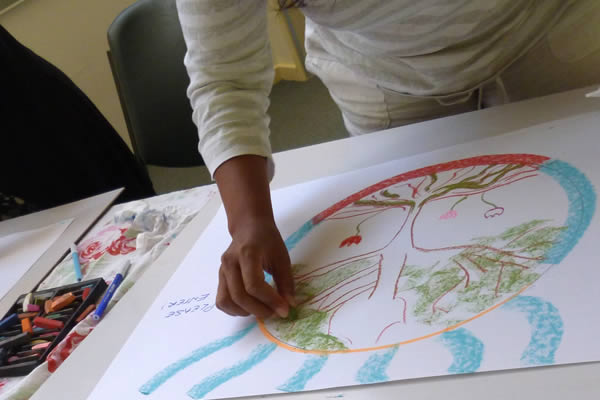
This post takes the reader on a journey into an art therapy experience that I facilitated for colleagues and it shows the power of art process in surfacing unconscious parts of ourselves to enable personal insight and empowered action.
I recently facilitated a workshop for a group of leadership development professionals. This is not necessarily an easy thing to do, effectively facilitating an experience for your peers. However in this case I knew I would be introducing these participants to something that was new to them: the use of art therapy to get guidance on a personal issue or challenge.
I started by leading the group through a meditation and breath awareness exercise. Even those who have not done much meditation can find such an exercise helps them to relax and release the pressures of the day.
The next step was to take them through something an art therapy exercise involving the creation of a ‘two-handed closed eyes scribble drawing’.
Most of us, especially those working in business- or management-type roles, have long lost the ability to create art. As kids we all did it, but as we grew up we developed an inner critic that caused us to stop even picking up a pencil or paint brush. We are simply paralysed by the thought that the end result of our work won’t be ‘good’.
In art therapy, the inner critic is circumvented by making the process the experience rather than the end product.
As I had the participants take up their pastels, beautiful music filled the room, helping to create the ‘container’: a safe space with clear boundaries. This is what allows the magic to unfold.
The exercise involves spontaneous drawing with, as the name suggests, both hands and closed eyes. The imagery that arrives is a gift from our inner knowing. We are recreating a part of ourselves on the page in front of us. As we open our eyes and engage with this, something shifts within us. It may sound far fetched but I have seen the outcome too many times to believe otherwise.
One of the participants during this experience shared that he had had many months of lacking direction and focus and generally feeling stuck in his work and life. This despite the fact that he himself was a leadership expert, with many development tools in his kit and high levels of personal awareness.
Of course, it wasn’t an unusual situation. Many people in our world have had a similar experience of having a grating sense that something is not right, something is unresolved. Perhaps you have too?
This spontaneous scribbling process relaxed this man’s conscious mind. He found himself surprised that the drawing he created brought to the surface imagery that informed him about what he had been experiencing and that previously he had not been able to recognise. It was as if a cloud had lifted. As he engaged with the image, he felt a sense of relief, an unlocking. He later titled his drawing ‘Stuck in the mud’.
From an art therapy perspective, this man’s response was his unconscious communicating with him through his drawing. It provided him with a newfound clarity about what action he needed to take.
Since I developed my interest in art therapy, I’ve seen how something magical can happen when we bring our inner imagery to the surface in this way, having it on a page in front of us. It creates some space between our ‘self’ and that part of us that is feeling stuck or uneasy. We move from overwhelm and a state of feeling frozen into a new world of possibility. The ‘stuckness’ becomes just a part of us, not all of us, and that makes it feel more manageable. There is space around it:
I feel stuck
Something is stuck
I’m sensing something is stuck
From there we are once again empowered and can take committed action from that place of deep knowing.
This particular client was eternally grateful for having been given access to a new way to connect with his inner knowing from which he could emerge out the other side with clear, tangible and empowered action. This is what this client shared after the experience (reproduced here with his kind permission)
“In the first exercise I saw it in a split second – stuck in mud! And then to draw with both hands; firstly symmetrically and then, as it went on, more and more randomly.And then to see within what I called Mr. Magoo and the freedom that was within. It blew me away!!! This process provided me with the ability to see inside myself and see that I was stuck and to come up with something ( Mr. Magoo) that has given me freedom and liberation.” – Evolving Leaders Client
Art process can change lives. It takes us beneath the surface of the story, the concept the idea, the stress-producing thoughts to access and give voice to our inner knowing: the things we know about ourselves but just can’t recognise – the things that just aren’t revealed to us in conventional personal and leadership development experiences.
This is why I believe art therapy has an important role to play in this next era of leadership development.
Interested in having a personal experience of art therapy? Evolving Leaders incorporates art therapy experiences into Urban Retreats for Teams, Managing Stress with Meditation Program and Team Culture and Wellbeing Development.