
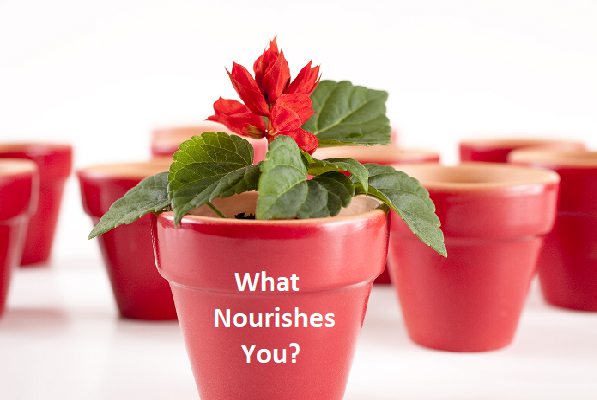
This post explores the power of three simple words: ‘What nourishes you?’ I consider these words in the context of personal reflection, to deepen connection with one’s internal motivation for self-care. I also explore them with an application of symbol cards and as a conversation opener and shifter to a topic that matters and strengthens connection.
At a recent leadership conference themed around connection, we began with a conversation around this question: What nourishes you?
These three simple words quickly bypassed the minds and engaged the hearts of the group as people pondered and shared their responses. Feedback from the group indicated that they loved the question and were delighted at how it offered a fresh internal insight and perspective, taking conversation with their partner into new terrain.
The reaction of this group was the same as that I have seen with many individual leaders and teams who are asked the same question. Which raises a red flag. Why do we not ask ourselves this question? Why do we not ask it of each other?
If we are walking and leading in life without bringing attention to what nourishes us, how can we know what form of self-care is right for us on the path towards wellbeing? How can we know what needs to change?
These three little words – ‘What nourishes you?’ – are a great place to start with your personal enquiry, bringing greater focus to your own self-care.
A case study: the horse, the ocean and the mirror
 I have been successfully using the ‘What nourishes you?’ question in different applications across a decade or more. I want to share an extended version of this application that deepens the individual’s inquiry.
During my training to become an art therapist, I worked with a 20-year-old client who had a history of anxiety and depression. She had spent many years under the care of psychologists and a psychiatrist. She wanted to try a different approach.
Through the use of symbol cards we explored ‘What nourishes you?’. Somewhat surprising to me at the time, it turned out that in over a decade or more of therapy this woman had never been asked a question filled with such possibility. Rather, she had found herself rehashing the problems of her life again and again.
“Symbols evoke profound emotions and memories, often without our making rational or conscious connections. They surround us and they help navigate through life, providing short cuts to understandings, ideas and feelings … the use of visual images can assist a client to get in touch with otherwise inaccessible personal realities” – www.innovativeresources.com
How does it work?
By asking ‘What nourishes you?’ and inviting a spontaneous selection of symbols as a response, we bypass the left logical brain (our verbal language centre) and instead access our right-brain intelligence. This is our creative side, so accessing it invites a deeper knowing – something from our unconscious self – to emerge.
I recall a beautiful moment when this young woman selected three symbol cards: the horse, the ocean and the mirror. She was still. Emotion rising. We sat there together in the magic of this moment. Something shifted within her inner experience and possibility. Life beckoned.
What began as a symbol exercise about ‘What nourishes you?’ turned into a deeper exploration and ultimately deep clarity and insight into how this young woman wanted to be in the world. Standing tall, centred and powerfully on her own feet like the horse; loving who she saw when she looked in the mirror and not shrinking when she met the world; and feeling free like she felt in the ocean.
This young lady experienced a connection with her internal navigation system and connected with how she wanted to be in the world. This was an unlocking of something previously locked so tight it was not available to her.
Application to learning and leadership development
While clearly this specific experience was within a therapeutic situation, I use symbol cards with project teams that are misaligned and off course and as a conversation starter, connector and to bypass mental chatter in leadership development. (NB. the actual question I ask will depend on the specific learning context, for example, in a recent leadership development program in which we were exploring change, the question was “What is Change?”, using the symbol cards to invite a deeper response to this question. Similarly, with project teams that are stuck – I might ask “How do you feel?”, which invites the individual’s experience of what is going right/wrong with the project to surface so that everyone’s voice is heard and the team can navigate next steps from an authentic place.)
This application of symbol cards – as an adjunct to coaching or team development – is broadly available and accessible to coaches and facilitators. I have included the link here to buy your own set of symbol cards if you feel inspired to give symbols a go.
What nourishes you? – getting started
Whether you are a coach, facilitator, leader or person wanting to build connection, I encourage you to ignite this conversation in your team, your family and as a conversation starter in any context:
- Start close in: ask yourself ‘What nourishes me?’; ‘Where is that in my life right now?’; ‘How much time and energy over the past week has been allocated for my own self-care?’; ‘What needs to change?’ Commit to one small step today that will take you a step closer on the path toward wellbeing in life and leadership.
- Ignite the conversation in your team and with the people closest to you in your life by asking the question often: ‘What nourishes you?’ or use the symbol card process to ignite another important question for example, “How do you feel”?
- Coach, therapist or facilitator? Consider incorporating symbol cards into your practice with the ‘What nourishes you?’ question and many more.
To commit to self-care is to value yourself, your relationships, your professional work. Self-care is a choice you make. It starts with you. These three little words – ‘What nourishes you?’ – are a great place to start with your personal inquiry and as a conversation opener and shifter to a topic that matters.
This post explores the importance of knowing and harnessing your personal values as a key navigation system in life and leadership.
Deep down inside what is important to you? What do you want your life to stand for? What sort of qualities do you want to cultivate as a person? How do you want to be in your relationship with others? What matters to you?
In every area of life we make decisions and choices based on what is important to us. This includes what we value as individuals as well as what we absorb of the spoken and unspoken expectations of the communities and organisations of which we are a part.
We are often unaware of the mix and interplay of values that motivate us to act, and that inform our decisions. In organisations, lists of values are more often statements of intent than accurate reflections of how things are really done. Even where the intent is genuine, the greater the gap between words and action the greater the perception of a lack of integrity, resulting in cynicism and disengagement.
Through the process of clarifying our core values – our heart’s deepest desires for how each of us wants to behave as a human being – and using those values to motivate, inspire and guide our ongoing actions, we grow as people and develop our capacity and capability as leaders.
Our bodies know when we act out of alignment from our values
Just as it is within a organisation, it’s critical that our actions are in concert with our core values. Aside from this being important for our integrity, often our bodies will react when we act out of alignment with our personal values. Perhaps you can recall a time when you have felt a pain in the chest or tightness in the belly in such a situation?
I recently coached a senior leader from the professional services sector with the specific brief of developing his capacity and capability to have courageous conversations. He was deeply aware that there was a conversation he needed to have with a member of his team – and should have had months ago – and that the longer he left it the more impact his lack of action was having on the broader team.
However, he felt ill equipped and fearful of having this conversation. He also felt that he was out of integrity with himself in not finding the courage to have it, and that this inner conflict was having a physical and behavioural affect on him.
Limiting values impact how we ‘show up’
As part of our coaching this leader completed a Personal Values Assessment and amongst his list of positive personal values, he had selected a limiting value of ‘being liked’. We explored this value and unpacked the impact that it was having on how he was leading his team overall and specifically with respect to this difficult conversation he had been putting off.
This leader had a good level of personal awareness and he was able to identify that his needing to ‘be liked’ probably stemmed from his childhood place in his family and the wider family dynamics. The power here was for him to see this value written on the page and to directly draw the link to see how the need to be liked was holding him back from having a difficult conversation. More broadly, this value was keeping him from becoming a better version of himself.
Through support and planning for this conversation, this leader was able to lean into his own discomfort (it hadn’t gone away – he just decided to acknowledge it and take action anyway). He had the conversation, and while it was difficult it was ultimately a great gift for both the leader and his team member.
This is an example of how when we want to change behaviour we need to look below the surface to our mindsets, beliefs and values and see what is actually driving our behaviours. From there we can create change.
This leader went a step further and embarked upon a personal values assessment for his direct reports along with a facilitated personal values learning and development session that included him sharing his own journey with the need to ‘be liked’. The group session allowed the team to began to look at the personal values they had in common as a way of building connection and focus and moving toward getting clearer on team values.
Values – based leadership keeps us centered and focused
“Values based leadership and values-based decision making allows us to throw away our rule books. When a group of people espouse an agreed set of values and understand which behaviours support those values, then you no longer need to rely on bureaucratic procedures setting out what people should or should not do in specific situations. All the rules reduce to one—live the values. People can work out for themselves what they need to do, and in so doing become responsible and accountable for their behaviours.” – Richard Barrett
The benefits of becoming a values-driven leader are:
- Leaders become conscious about what drives their decision making and can move towards values-based decision making – a key step in authentic leadership as it transcends personal beliefs.
- Leaders better understand who they are and what’s important to them and why they are motivated or inspired by some things and challenged by others.
- Leaders better understand their people and can design for and create a workplace that maximises engagement and fulfilment.
- Values provide a compass for leaders: a reference point to inform direction, guide how they engage and inspire their teams and how and why they make certain decisions.
Source: Adapted from work of Richard Barrett, Barrett Values Centre
Values have significant power to unite and energise people. Shared values can connect, where race, religion, politics and gender can divide. Becoming a values-driven leader means understanding what is important to you personally and collectively and being committed to acting on those values.
Interested in leveraging values to ignite growth in your organisation? At Evolving Leaders, we support you to unlock the power of values using the Barrett Values Centre Cultural Transformation Tools (CTT) to measure leadership and team values and culture through:
1. Executive Coaching: Leadership Values Assessment and Development
2. Team Culture Assessment and Development: measuring and managing your team’s culture using the Cultural Transformation Tools to surface the invisible factors driving performance and engagement to grow a psychologically safe team culture and strengthen team performance.

This article explores the (not-well-understood) fact that twenty percent of the population have a high sensitivity personality trait. It invites a call to action for leaders and diversity and inclusion practitioners to get on-board with this, and to help these people better understand themselves and to work alongside them to make changes to the work environment to serve individual well-being and to harness this untapped potential.
Last year I ran a particularly engaging and heart-opening workshop as part of a company’s diversity strategy. The workshop turned what was normally a very dour, windowless boardroom into a place infused with energy.
At the end of the day, after all the participants had left, I was still on a high from the experience when the managing director (who was very supportive of our work) popped into the room. He asked how the session went and I shared the excitement and outcomes of the day. I then said to him, ‘Can you feel the energy in the room?’
He looked at me with deep respect (knowing that I could in fact feel the energy in the room) and said, ‘No, Nicola. I can’t feel the energy in the room.’
We both paused and smiled. It was a moment of acknowledging diversity, in the true spirit of the workshop that had been just been held.
That day was a reminder for me of a gift that I have come to take for granted given that I live with it every day. The gift relates to my high sensitivity, which gives me access into so much of what remains invisible to many others.
I had long recognised my high sensitivity but didn’t really give it a name until I came across a book titled The Highly Sensitive Person by clinical psychologist and researcher Elaine N. Aron. My discovery of this book was one of those life changing moments. Reading it helped me to own more of who I am and to stand taller in the world, recognising that my need for self-care – including having time and space alone and avoiding caffeine (one coffee keeps me awake for 24 hours) – is as essential to me as eating, sleeping, and breathing.
20 per cent of the population are born with a highly sensitive personality trait
Highly sensitive herself, Elaine Aron has done years of research and has discovered that ‘sensory processing sensitivity’ is a personality trait that 15 to 20 per cent of the population are born with. Twenty per cent! This means that up to one fifth of the population (and therefore the workforce) has this gift.
What are the traits of a highly sensitive person?
Biologically, highly sensitive people (HSPs) are different to the rest of the population. Their minds work differently. HSPs react more to stimulation: they notice levels of stimulation that go unnoticed by others. They are more easily overwhelmed, need more down time and more time alone and are prone to illness when they ignore their HSP trait.
A common misunderstanding is that HSPs are all introverts, where in fact 30 per cent of all HSPs are extraverts. HSPs have access to what is known as the ‘sixth sense’, which gives access to intuition where they just ‘know’ what a particular outcome of a situation will be ahead of time. They will often know intuitively what decision to make without the need to process it logically or rationally.
Aron uses the acronym DOES to summarise the key facets of this trait:
D: depth of processing – a fundamental characteristic is that HSPs observe and reflect before they act.
“Like those machines that grade fruit by size, we (HSPs) sort the fruit into 10 sizes while others sort it into 2 or 3.” (page 7)
O: easily over stimulated – if you are going to pay more attention to everything, you are bound to tire sooner. Moderate arousal for the rest of the population equals high arousal for a HSP. High arousal for the rest of the population equates to overwhelm and can cause shut down for a highly sensitive person.
E: giving emphasis to our emotional reactions and having strong empathy which, amongst other things, helps us to connect with others, to notice and to learn.
S: sensitive to all the subtleties around them which is often what it most apparent to the HSP – the little things they notice that other miss.
Wondering if you are HSP?
You can do a self-test on Aron’s website based on her work. It will indicate whether you may have the high sensitivity trait. If you find that you could be, I would encourage you to reach out and get the support of a coach or therapist if you feel that would help you to integrate your new insights about yourself.
My intention for sharing
I wanted to share this brilliant work in the hope that if you too feel that you are different (in this highly sensitive way) to many of the people around you, that by understanding this trait you can more fully appreciate yourself. Celebrate your gifts and give yourself the self-care that you need to flourish. Read more about this trait and begin to help others to understand and appreciate your sensitivities. If you are a leader, parent, spouse, or friend of someone who is highly sensitive, the resources can be tools for you too, helping you to start a different conversation and to invite a new level of appreciation and respect.
The implications for diversity and inclusion, leadership and organisations
Aron’s work has got me thinking about HSPs and the need for organisations to bring focus to this area as part of their diversity and inclusion agenda. This is clearly a diversity and inclusion issue and an opportunity for leaders to bring to the surface the gifts and needs of this currently unidentified group of people that make up 20 per cent of the population.
>>>>>>>>>>>>>>>>>>>>>>>>>>>>>>>>>>>>>>>>>>>>>>>>>>>>>>>>>>>>>>>>>>>>>>>>>>>>>>>>>>
Interested in a presentation on this topic for leaders in your organisation? Contact Nicola

There was a period in my life when I found myself in a state of overwhelm – the type of overwhelm that everyone else can see except the person being overwhelmed (i.e. myself). I wouldn’t recognise it until some time later. During this time, a leadership coach introduced me to the concept of ‘mental real estate’. It was a classic ‘light bulb’ moment.
Our mental real estate is the capacity we have to hold onto, manage and navigate everything in our lives. Our work, our relationships, our family. Our day-to-day responsibilities in the many roles that each of us have: leader, partner, parent, sibling, child, friend, colleague etc. Perhaps our community work or volunteer work at school or elsewhere.
Mental real estate is not an infinite resource
The thing about mental real estate is that it’s not an infinite resource. The amount each of us has is finite.
Just like ‘real’ real estate, mental real estate has boundaries that can’t be expanded. The more we commit to extra things in our lives – the more we say ‘yes’ to every request or offer – the more our mind starts to push up against those boundaries.
Eventually it becomes like overpacking a suitcase and then still trying to get more in: something has to give. This is where we are over committed.
The impact of this situation will be familiar to many leaders and other busy people. We start to lose focus on the things that really matter to us. We get locked into ‘thinking and doing’; we lose the ability to ‘feel and be’. We become overwhelmed, as I was. Stuck on a treadmill, we become overly stressed – certainly stressed beyond a healthy level – and start making poor decisions. This diminishes our wellbeing and starts to affect our happiness, relationships and overall performance.
It’s important to realise that, just like the real estate we live in, a lot of what is crowding our minds in these situations is clutter we don’t really need. As many as 80 per cent of the thoughts we have each day can be unhelpful in the sense that they aren’t moving us toward the life we want to lead. All this mental clutter gets in the way of our ability to thinking clearly and making good decisions and can lead to unnecessary overwhelm. Reserving as much mental real estate as you can for the stuff that actually matters is the key here.
Take a moment to reflect on your own mental real estate
I invite you to take a moment to reflect on the three things that matter most to you in your life: the things that make you feel full, happy and satisfied.
Now ‘zoom out’ to take in everything that you have on your plate right now. All the tasks and roles that you are (or feel) responsible for right now.
Is there an alignment? Is the stuff that is keeping you busy, and therefore occupying most of your mental real estate, contributing to those things that are most important to you? Are you making a concerted effort to ensure that some of your mental real estate is reserved for those important aspects of your life?
Or is this exercise simply too hard due to your mental real estate being overcrowded?
What do you notice?
Does something need to change?
When I did this exercise some years back, I noticed that I the things that my focus was definitely no on those things that mattered the most to me. They were struggling for a place in my mental real estate, and as a result I had little clarity of thought and was making poor decisions. To help get me back on track, I called upon a personal values assessment.
Taking the time to explore your personal values and beliefs is a great way to get started on an ‘audit’ of your mental real estate. This process can guide you back to what is most important to you, and from that place you will be better equipped to make conscious choices about what needs to be let go of to clear a bit of space in your mental real estate.
You also might like to consider the completion of a Global Leadership Wellbeing Survey (GLWS). This survey will help you understand your state of wellbeing at work and at home. It will help check in on your available mental real estate. The survey is supported through a debrief and development conversation to help you ‘tidy up’ your mental real estate, establish a sustainable self-care rhythm and show up as a better version of you.
Our mental real estate is a precious commodity. Do what you can to keep yours tidy, ordered and not too cluttered.

Through the lens of a client case study, this post explores why we must look beneath the presenting problem in any team or organisational challenge to surface the invisible aspects of the system that are driving what we see on the surface. This is the key to unlocking previously unavailable energy in the system to drive performance and engagement and grow a healthy team culture.
I recently had a call from a small business owner in the healthcare sector whose enterprise was expanding at quite a rapid pace. He told me that one of his managers was not communicating effectively with the team and that this was causing lots of unrest and dissatisfaction.
We explored various approaches to the situation, including individual coaching for the manager in question. However there had been no previous investment in employee development in the company. I was concerned about the possibility of broader ‘invisible’ issues that might have been contributing to what was going on.
I suggested that rather than focusing on this one manager, this was a great opportunity to do an engagement survey and culture and values assessment across the business. This would help identify any such invisible components of what was playing out in the organisation’s culture. It would also take the whole team on a collaborative learning journey which would help them over the next phase of growth.
The Team Culture Assessment
The assessment we carried out used the Barrett Values Centre Team Culture Assessment along with a simple engagement survey (underpinned by our version of the Get Connected Model as a broader framework).
After these assessments, we work-shopped the results as a group. The data provided the basis for the team to come together, to learn about each other and to engage in dialogue that surfaced how people were feeling and what they were experiencing. This allowed discussion about what was working well and what was getting in the way of performance and engagement. It enabled the group to collectively discover what needed to change and how to go about that.
A significant issue raised by the data was a level of cultural entropy of 25%. Cultural entropy indicates the amount of dysfunction in the organisation system, and this level reflected significant issues requiring immediate attention.
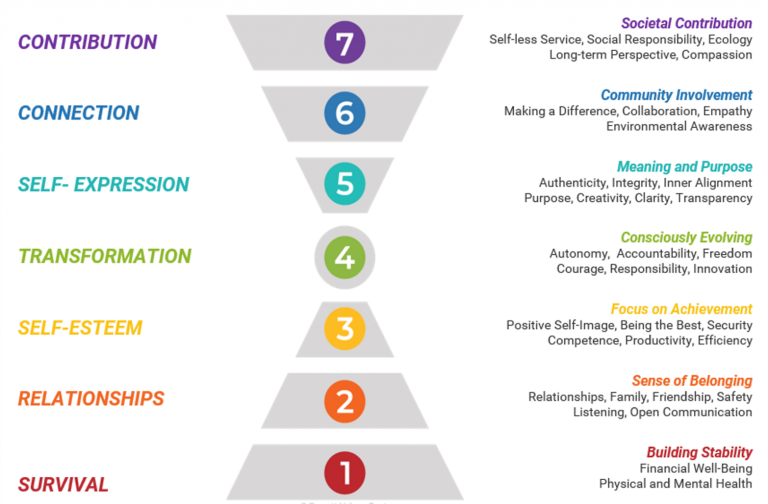
The top collective personal values of the group included caring, honesty, fairness, respect and humour/fun. Personal values tell us what is important to people in their personal lives. This is vital data that allows you to build a culture in which people feel they belong. This group loved learning about what mattered to each other, while the opportunity to share new things about themselves built stronger connection between them all.
Another aspect of culture measured in our assessment are the current culture values. These provide a picture of how people are experiencing the team or organisation at the moment. They show us what is working well and what is undermining engagement and performance. The strengths of the current culture for this group were humour/fun and teamwork, competence, cost effectiveness and efficiency. The limiting values were blame, control and hierarchy.
Unsurprisingly, given the personal values of this group, their desired culture included fairness and honesty along with maintaining the humour/fun that already played an important role in the workplace. Values of ‘blame-free’, compassion and teamwork were also important.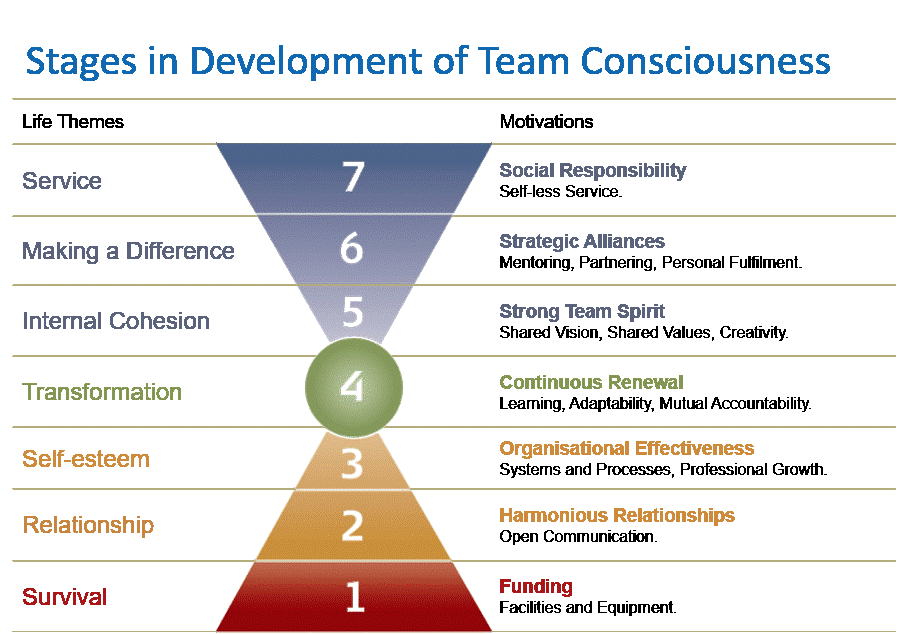
Surfacing the invisible to solve the visible
All these discussions allowed us to surface the invisible forces that were contributing to the original problem: the manager who it was felt was not communicating effectively. Without directly blaming or judging any one person, we were able to engage in dialogue and facilitate personal learning towards the desired culture. Subsequent leadership coaching supported the senior leaders to deepen their personal insights into how they were contributing to the current culture and how they could make changes to their own behaviour towards that desired culture.
During this process one of the key people in the business resigned. Change happens when we engage in dialogue and set a new level of expectations, but unfortunately for some this journey is uncomfortable and they make a personal choice to leave. In my experience, when that happens it is often the best outcome for both the individual and the team.
The immediate changes that resulted from our work with this group (over a three-month period) included:
- regular team meetings were established in which people could all receive the same message
- the ISO accreditation process, which had been dependant on a key individual, was re-scoped into a team project, including participants who were front line employees
- front line employees were given new responsibilities as part of their development
- regular performance conversations were established.
Comments from some of the participants included:
‘I feel relieved that [the tensions] are out in the open and that we can now talk about the issues.’
‘I feel a closeness, a coming together, through talking and taking time with one another. It feels more like a team.’
‘I feel happy that we are getting somewhere and that it feels like a good direction.’
Culture transformation is a dynamic journey. The commitment by the leader in this case to invest in this work was a powerful step towards improving the workplace culture, as was working towards a values-based organisation. A values-based organisation builds trust, while values-based decision making is the best approach to navigating complexity and dealing with uncertainty. It makes us focus on our human needs.
Do you understand the invisible factors that driving performance, engagement and wellbeing in your team or organisation?
For more information on our culture and values assessments, visit this page or contact us?

This article is a resource for anyone who has signed up for Mindful in May 2018 ( and equally applies to any other similar self-care challenge). It outlines 8 key steps for you to consider to set yourself up for success.
I was preparing this “Setting yourself up for success” handout to provide at a launch of Mindful in May at corporate client in Melbourne this week and it struck me that this information might be useful to a broader audience involved in Mindful in May- so here it is hopefully with a gem or two for you to get the most out of this challenge.(NB. It equally applies to any new self-care program that you might be considering too)
1. Be clear about what you are committing to upfront – Setting an Intention and Goals
I recommend setting an intention for the whole month and a goal for each week. Intentions are more about deciding ‘who’ you want to be and ‘how’ you want to show up, for example: your intention might be to keep showing up with the practice even when you don’t feel like it / or your intention might be to act with self-compassion throughout this experience.
Goals are about what you want to ‘do’ or accomplish. You might be better to start small. For example, maybe you set a goal for the first week to do four out of seven days and then review at the end of the week. If you end up doing it each day, then that’s a bonus. Repeat this each week. Review your intention and goals each week and refine so it feels right for you.
2. Decide on a regular time to do the practice.
Block it out in your calendar just as you would any other meeting. This is time for you to be with you. Block out half an hour so you have time to arrive get set up and space at the end to reflect or journal.
3. Attach it to an existing habit.
For example, if you get up each morning and the first thing you do is make a cup of tea, add your new step ‘do my meditation’ right before that one. So now you get up and sit in a chair in the lounge room and do your meditation, then have your cup of tea. Or in the evening, this time linking the new habit (the daily meditation) to cleaning your teeth, for example. (Charles Duhrigg’s book The Power of Habits is a great read on this topic.)
4. Set up the physical environment.
Where will you do your practice? Setting it up in the same location is the best way to establish a habit. What do you need to be supremely comfortable? A chair? Cushions? A blanket? A sign on the door to let others know not to interrupt is a great idea. What other distractions need to be removed from the space? If you are doing it at home let your family/kids know the what and how long you will be. (Pets and kids will be drawn to you when you meditate as they love how it feels).
5. Make sure your technology is working.
So you’ve set your intention and goals, your feeling mentally prepared and physically prepared and then your technology doesn’t work! Get your technology sorted ahead of time – what device will you use? Check that it is working ahead of time. Make sure your calls, messages and any other beeps and blips can be turned off during your practice. I recall running a group session last year for mindful in may and my computer froze all together five minutes into the meditation! It was not ideal. Please avoid that for yourself!
6. Holding yourself to account.
Decide if this is a solo adventure for you or if you would benefit from a buddy or buddies to share the experience with and help hold each to account. It’s your choice – make a conscious choice and set your self up with the support that you know that you need. If you do decide the buddy option decide whether you will meet each day to do the challenge (or not) but be sure to then schedule a weekly check in time to share your experience and to re-visit and refine your goals and intentions.
7. Keep a journal
Buy yourself a cheap notebook, nothing fancy and at the end of each 10 min session, take a few moments to reflect on how you felt before the session, how you feel now, how you found the practice today, what you noticed in your body and any other observations.
8. Sharing the love.
During the challenge share with others (your family, friends work colleagues) how you are finding the experience, what you are learning, which teachers are most inspiring etc. The world will be a better place when more and more people start to prioritise their own self-care needs. Mindfulness is a great way to begin that journey. If your kids are keen to get involved – that is fantastic – as a mother of three teenage daughters, I know more than ever how much kids need to add this skill to their ‘life toolkit’ too. In terms of the best way to approach, this I recommend still doing your practice AND then making a separate time to repeat one or more of the experiences that you have had with your child/children. (An important part of this process is this is about you claiming your own self-care space so its important to keep that healthy boundary).
Congratulations on taking this journey to take better care of you. I would love to hear how you go!
Has this been helpful? Are you interested in something more?
Perhaps you are needing an overall wellbeing health check? You might like to consider the completion of a Global Leadership Wellbeing Survey (GLWS) . Designed for senior leaders, this survey will help you understand your state of wellbeing at work and at home and is supported through a debrief and development coaching conversation to help you establish a sustainable self-care rhythm and show up as a better version of you. An eight week Wellbeing Assessment and Development Program (WADP) is also available for senior leadership teams to shift the dial on wellbeing and performance to drive cultural change.

This post outlines our 5S Leadership Self-Care Model focusing on the practice of ‘selfcare’ to bring yourself out of your head and into your body, connecting more with ‘feeling and being’ and reconnecting with what matters to you. The 5S Leadership Self-Care model provides a roadmap to explore and experiment with establishing or refining the practice of self-care to restore wellbeing and help you to find a sustainable self-care rhythm that works for you.
Continuing on the theme of my last post about being stuck on the ‘thinking and doing’ treadmill, this time I want to outline our 5S Leadership Self-Care Model.
Self-care refers to the practices, habits and routines that we engage in on a regular basis to reduce stress and maintain and enhance our short- and longer-term health and well-being (social, emotional, physical, psychological). Optimal wellbeing and high levels of personal resilience are not possible without an intentional focus on self-care. Source
- It doesn’t come easily for most people.
- Optimal wellbeing* isn’t possible without self-care.
- Wellbeing is one of the outcomes of the practice of self-care.
- Your ‘sustainable self-care’ needs and practices will be unique for you
- Self-care is a choice that you make. It starts with you.
- It’s a practice – like learning a new skill, it takes time and commitment
*“Wellbeing is so much more than the absence of illness. It implies flourishing, thriving, being fully alive. balanced and calm & contented and at ease with life.” – GLWS
5S Leadership Self-Care Model
1.Space
Carve out the space in work and life to focus on your personal development. In just the same way that you schedule meetings with others, schedule ‘personal development/self-care’ ‘meetings with yourself’ in your calendar.
Give these ‘appointments’ the same priority you would if they were meetings, which may involve setting some healthy boundaries. You might need to say ‘no’ to some requests or things that feel like ‘shoulds’. You may need to more assertively express your needs to your partner, colleagues or team. It may require taking yourself away, perhaps booking into a retreat or a place in the country for a couple of days by yourself. During these personal development sessions, turn off your phone, find an inviting location where you won’t be interrupted, remove all distractions and show up fully by yourself for yourself.
Creating space is where it all begins. It allows the external ‘noise’ of life to quieten down enough so that you can hear your own breath and feel your own heartbeat.
This post outlines a personal story as a great example of the need to carve out pockets of space in our lives and/or moments to take a balcony perspective. Unless we do that, it can be difficult to see what is right under our nose.
I choose to let go – Why we need space to reflect
2. Stillness
Within the space you have carved out, welcome stillness. You may experience some resistance and an urge to be distracted away from stillness – that’s normal. Stay with it. You can use some of the tips in these two previous posts to begin to notice your breath, quieten your mind, etc.
7 ways to access deeper levels of consciousness
Stuck-on the doing treadmill. This might-help
The idea here is to shift away from your racing thoughts and begin to access how you are feeling and what you are noticing in your body. Given the pace at which most of us operate, this definitely requires a transition of some sort, so be kind to yourself and keep it short at first – even five minutes is a great place to start. It’s only through stillness that we can get beyond the mental chatter that doesn’t serve us and bring our focus and attention back to the things that really matter.
3.Self- expression
Whether it is by writing, singing, drawing, sharing openly and honestly with a trusted other or by some other means, you need to be expressing how you are feeling. When we express how we are feeling and what is happening for us, we learn about ourselves and the world around us. The very act of expressing how we are feeling helps energy stuck within us to move through us, enabling us to reflect. It helps us gain clarity about where to next place our energy and attention. It strengthens our connection to self and, when we share openly with a trusted other, it builds connection.
There are so many possible ways of expressing how you are feeling, but here are a three examples:
Start a Journal. One of the most time-honoured, simplest and most powerful ways of capturing your thoughts and feelings. Set a time each day to write in your journal. Until it becomes a habit in its own right, it’s a good idea to attach your journal time to an existing habit, for instance while having your morning coffee.
Your task is to simply write about anything that wants to be written about. Just get out of the way of yourself, ignore the internal critic and put pen to paper. Remember that you’re only writing for yourself. You may write about how you are feeling or what is present for you. Reflect on what is going well for you and explore anything that you have been triggered by. Anything that has an emotional charge for us is a gift – if we can take the time to understand why it has that charge. Writing helps us to open different perspectives. It clears the mind and opens the heart.
One way to get started, or change things up, might be to try the Morning Pages practice as outlined by Julia Cameron.
I use a cheap A4 notebook for my journal as I feel freer just to write without having to produce a work of art. I rarely ever read my journal again – it’s about a download and a tool to process and make sense of what’s happening in life rather than recording my life.
New Experiences. Seek out different people, places and experiences, bringing an attitude of curiosity into all that you do. Our senses are an important way of connecting our external experiences with our internal world of ‘feeling and being’, and new experiences bring our senses to life. If you’ve never tried art, perhaps now’s the time.
Start close to home. Expression doesn’t always need to be in words. Why not trying having a long-held hug with someone that you love. Count to 20 seconds; you can’t help but melt into each other. It’s magic.
Self – expression goes hand in hand with the first of our Leadership Super Power practices – Reflection. These posts offer some great tips and reflective questions that can kick-start your process of self-expression:
Reflective practice: a leadership super power
Making reflective practice a reality – no matter how busy you are!
4. Self-compassion
Self-compassion is a measurable trait. In 2003 no-one had defined or measured it. In 2017 there were 1340 studies on self-compassion. Self-compassion is strongly linked to wellbeing.’ Source: Neff 2018
Self – compassion is about learning to becoming your own best friend. This is about turning the compassion that you undoubtedly make readily available for others into watering and nourishing yourself. Kristin Neff, is world expert on self-compassion. Part of what she offers in her work is a radical shift to ‘relate to self’ in new ways.
Kristin defines self-compassion as:
- being a good friend to yourself
- treating yourself the way you would treat a good friend; and
- holding pain with love.
The first step is develop self compassion is to learn about self-compassion. This blog post –“Are you being a good friend to yourself” is a great place to start.
5. Support
Find the right support for you. It may be friends, your manager, a leadership development workshop or program. It’s often challenging to go this alone and having someone to ‘walk’ alongside you can accelerate the process. Engage an leadership coach if you feel you would benefit from non-biased, professional support to help you reach your self-care goals and to hold you to account. Or if you are a senior woman you might be interested in Cultivating Well 1:1 Coaching Program.
Summary
By taking committed action to the elements that make up our Leadership Self-Care Model you will be taking a major leap forward with your own self-care.
To commit to self-care is to value yourself, your relationships, your professional work. That’s simply too important to ignore.
Please reach out if we can help.
____________________________________________________________________________________________
Needing an overall wellbeing health check? You might like to consider the completion of a Global Leadership Wellbeing Survey (GLWS) . Designed for senior leaders, this survey will help you understand your state of wellbeing at work and at home and is supported through a debrief and development coaching conversation. It can be a great way of beginning your journey towards greater self-care and provide key inputs to help you establish a sustainable self-care rhythm. Contact us for details.