This post shares a personal story and suggests that every human being on the planet right now, in some shape or form, is facing into their own ‘growth edge’. It invites the reader to reflect on what they are noticing in themselves and others in terms of this personal learning and highlights that perhaps the luckiest people right now have leaders and organisations that are providing development and wellbeing support for their people.
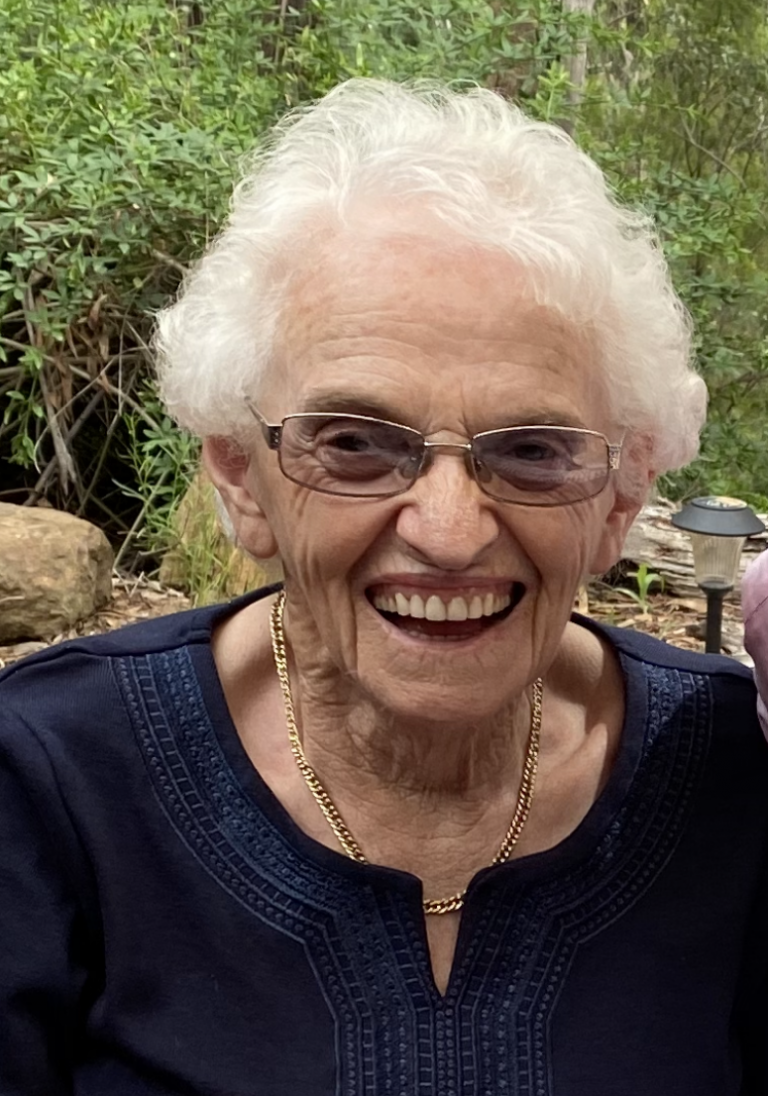
Meet Elaine. She is my delightful 84-year-old mother-in law. Elaine left school at age 15 to help with home duties on the family farm and continued in that role all through motherhood and grandmother-hood.
In her lifetime, she has baked tonnes of lemon slice and the arguably the best chocolate cake ever. When she isn’t baking, she pours all her energy and focus into supporting her community and showering us – the family – with her love.
Throughout her lifetime, Elaine has felt no desire for, nor any reason to, use a computer or a smartphone. And so, in March 2020, as the world felt like it was closing in on all of us, we realised that that Elaine would soon be in total isolation. Without even the stilted connectedness the internet offers the rest of us, she would have very limited contact with her her family and friends, and we were concerned about the flow-on impact this would have on her overall wellbeing.
So, without further thought, we purchased her an iPad. In a curious way, one of the first questions she asked was, ‘Why is the keyboard not in alphabetical order?’ She had never used any sort of keyboard in her life, let alone an email address. How much we take for granted! This was completely uncharted territory for her.
The rest is history.
True to form, with her enthusiastic approach to a new challenge, she was up-and-running in no time. The pure delight we witnessed when Elaine had her whole family (across many geographical locations) in front of her on the first Facetime call is a precious moment that will stay in my heart forever.
If you had said to me six months ago that, in the year 2020, Elaine would be making Facetime calls, ordering her groceries and doing her banking online, I would have broken out in laughter!
But she was soon doing all of that. We are so proud of her.
Elaine’s story got me thinking about what the disruption of this year has meant to all of us in terms of the learning we have been somewhat forced to do or had to do in many ways. What became clear to me is that every human being on the planet right now has had to confront their own fear at some level and learn something new, or make some change that they would not have made without the pandemic.
No one is exempt. It has been, and continues to be, a true ‘growth edge’ experience for us all. (Read more about growth edge here)
Do you agree? Where have you noticed this happening?
What are you being asked to or forced to change at this time?
What is your personal growth edge right now?
Some examples from my own ‘growth edge backyard’ are:
- quickly getting up to speed and proficient at creating connection and engagement online so as to be able to effectively deliver team development via an online platform. Like many, I still really don’t like facilitating groups on Microsoft Teams, but at least I know how to do it.
- taming my voice in our family to allow each person an equal say in shaping the healthy boundaries needed for life in isolation in a household of five people (that is, learning to listen better and not assuming I always have the best answer)
- establishing a healthy and productive work rhythm by creating greater structure around my allocated working hours, which in my case means 90 minute cycles then taking a break (here is a great article on this topic).
Most clients that I am currently working with are struggling with many aspects of work and life – juggling home schooling, too many hours on Zoom and experiencing other financial and social pressures. It’s the norm rather than the exception right now.
What is being demanded of people by this pandemic in terms of growing and changing for many feels heavy and hard. I am also noticing, however, that the luckiest people during this time work in organisations and with leaders that recognise the need for, and are investing in, the wellbeing and development of their people. It is from this support base, that people can begin to make sense of themselves and their own experiences and begin to see some reward and celebration of their efforts on the other side.
The benefits flow on, as when this growth edge can be applied within a broader team context, it is even more powerful. As individuals grow and change and are able to be more vulnerable and courageous with themselves – as 84-year-old Elaine has demonstrated so well, and when they can do this with their teams as well, then team culture can grow in ways that are good for all.
Could you or your team do with support right now? Please get in touch to book your team development – delivered remotely of course.
This blog post introduces readers to a unique individual and team development experience – The Flow Game. The Flow Game gets to the heart of what needs to change in the way the team is operating and in doing so creates clarity, grows connection and grounds action. It is a powerful process for leadership and team evolution as it provides a much-needed space for reflection, expression and connection.
Where did the Flow Game originate?
The Flow Game (www.flowgame.net) has its origins in Denmark back in the 1990’s and is now being played across the globe for individuals and teams as a way of finding clarity together. There are eight stewards of the game across the globe, including three of the original founders (Vanguards) – Toke Paludan Møller, Monica Nissen and Jan Hein Nielsen.
I have been extremely fortunate to be a student of the Flow Game for several years now, and have reaped the rewards both personally and professionally that come with this practice. In 2019, I was formally accredited as a Flow Game host and this coincided with the release of the Team Deck of cards. Since then, the Flow Game has become an integral part of my leadership & team development toolkit.
Why you might ask?
Because quite simply put – The Flow Game surfaces what really needs to change (based on the collective question of the group), creates alignment and before people have even left the room many of the internal barriers to change are no longer there. A new lease of energy, connection and grounded action is available for the team. This is cultural change and leadership in action.
What is the Flow Game?
The Flow Game isn’t a conversational game as you might expect– it is more about reflecting and sharing and listening without the need to interrupt or judge or fix or justify or explain. The process helps us to slow down and fall into our true nature and helps us to learn a very different way of being together and interacting in a conscious way. From that place new awareness and insight is surfaced and the action that we need to take becomes clear. The flow game in its essence helps individuals, teams and groups to:
- Create clarity
- Grow connection (self, others & to vision, values purpose), and
- Define and agree action
- Create (desired) change
The Seven different perspectives in the flow game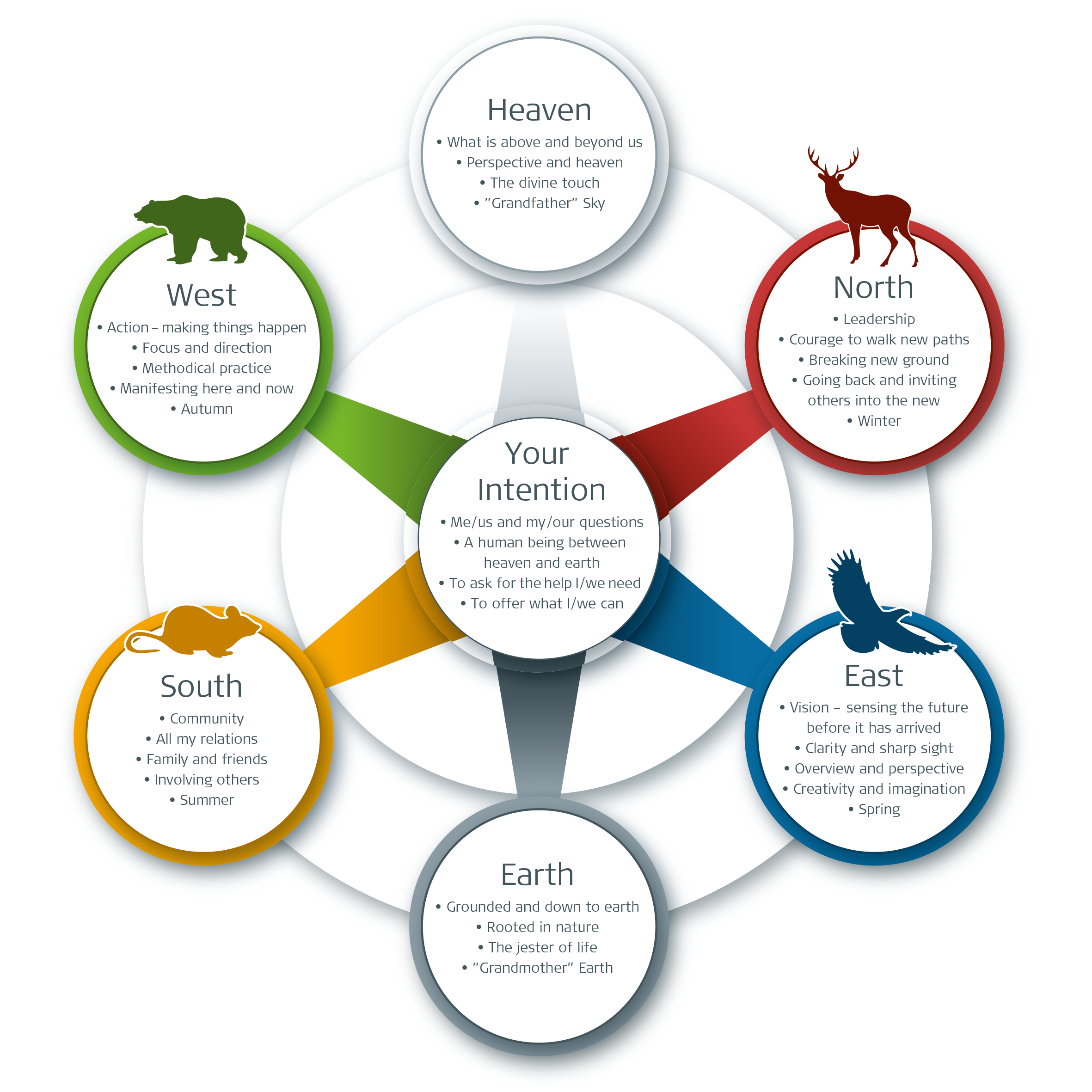
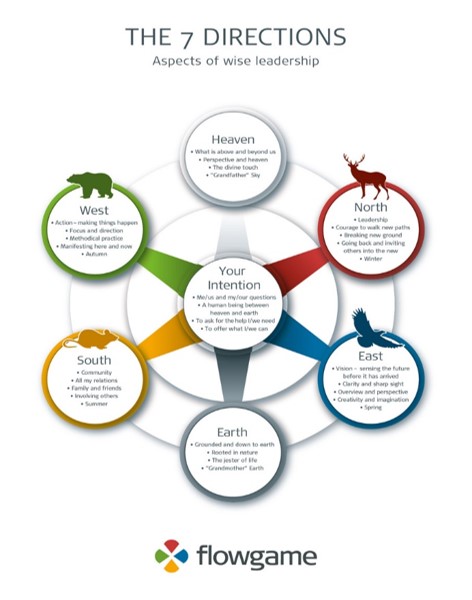
1.Blue River of the EAST – Vision
The creative and visionary side of leadership and seeing the big picture
2.Yellow River of the SOUTH – Community
The ability to empathize, connect, inspire, engage, align and attune
3.Green River of the WEST – Action
The ability to bring vision into meaningful action and ‘get things done’
4.Red River of the NORTH (Red) – Courage
Having the courage to walk new paths, break new ground, lead the way
In addition to the four rivers – dimensions or directions of our personal leadership there are two more aspects to consider:
5. Above (Heaven) – heaven speaks to our highest aspirations and powers that are greater than we are.
6.Below (Earth) – earth below is our ground, the foundation we stand on. It gives us a sense of reality and demands our presence here and now.
7.My/Our Question/Intention –The focus or intention is formulated as a question, which sits in the centre of the game. Together we then explore and illuminate the intention/s from the other six perspectives of the game.
Source: www.flowgame.net
Three Versions
There are three different card decks that are used for different purposes:
- Personal,
- Team &
- Family/community
Within that context, there are multiple possibilities for the way the game can be played as it can be designed around an individual or group intention (question) or a combination of both.
As a flow host community, we are constantly evolving and exploring new ways to design and host the game for varying contexts and needs.
A Burning Question
The flow game is a process – and it’s a powerful one but it is important to note that it’s not the panacea for every presenting issue or challenge. The important thing is that the individual/s or team has a burning question that they are seeking clarity on and that the invitation to, and the design of the game is set up in a way that honors the people, the process and the situation/question.
The need and intent and the membership of the group first must be clear and we then design the game around that.
Different Applications
Three of the ways that The Flow game is currently being used in a business and community context are:
1. Team Development
When working with an intact team, a great place to start is with a shared/collective question or intention. This is where the Team Cards are used. This may progress to a round using the Personal Cards however in this context – a generic question would be applied for each member of the team. For example, “given what we now know about the team, what does that mean me? “would be applied generally. The design will of course depend on the need, intent and membership of the group.
2. Leadership Development
Depending on the need, intent and membership of the group (for example it is often easier to be vulnerable with people we don’t know than with people we do know) ,the flow game can be integrated into an existing Leadership Development Program at the start of the shared learning journey, midway during the experience or as a way of integrating and coming to closure and grounded action at the end of a Leadership Development Program. Team, Personal and Family/Community Cards can all be applied in this context.
In today’s hectic world at a time when it is so easy to fall into the trap of being overwhelmed by feelings of “busy and important”, the Flow Game offers the essential time required to reflect and do the important deep-thinking essential for conscious choice and action – Participant
3. Cultural Evolution
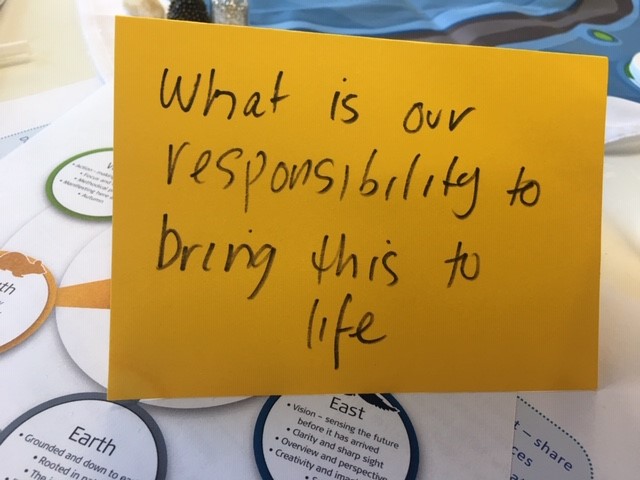
The flow game is a powerful way to create clarity and alignment at an individual and collective level and this is where it fits to support and enable cultural evolution. In one specific application, it is being used in the implementation of the cultural change journey. Stage 1 was one was about defining purpose, vision, values and strategy and stage 2 is about bringing that to life. The Flow game is being leveraged as part of the team and leadership development journey with the collective question: Given our overall direction, “What is our responsibility to bring this to life?. It is also being used with the leaders of this change to create clarity and alignment around leading this change.
How many people can play?
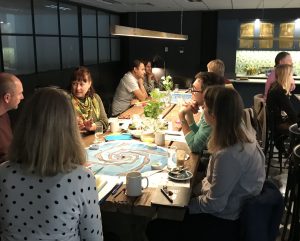
The flow game is typically played with 2-8 players – however that too can be flexible. For example, it can be utilized in an executive coaching session with one person all the way through to a conference with many people. It is possible to have multiple games being played concurrently and has been done with great success in many settings.
While there are many different applications of The Flow Game, the essence of what it delivers at both an individual and team level remains the same:
- Clarity
- Connection
- Action
- Change
It is from this place that we can live, lead and be together consciously and create healthy high-performing teams.
Evolving Leaders was established in 2014 with the purpose of evolving the consciousness of leaders to make the world a better place. The Flow Game is a powerful partner in this work. We are greatly indebted to the founders of the game and the international flow host community that continues to evolve this practice.
Interested in a Team Flow experience? Please get in touch.
These blog posts explore the lens of building ‘connection’ as a model to guide cultural transformation for teams and organisations.
We live in connected times, in which technology allows us to be connected at all times – even in the air now – with virtually everyone in our working and private lives. At the same time, ironically, we are more disconnected than ever before – from ourselves and from each other. We see this in individuals, teams, organisations, families and communities, in which feelings of isolation, mental health issues, relationship breakdowns, stress related illness and dysfunctional team cultures are more common than they’ve ever been. Sound familiar?
Connection – real, human connection – is at the heart of the human organisation. Connection characterises great leadership and therefore is at the heart of any thriving workplace culture.
In much of my work in recent years, I have used the model shown here – adapted from the Barrett Values Centre ‘Get Connected’ model – as a road map to simplify some of the complexity and multi-faceted considerations around connections that exist when navigating cultural change.
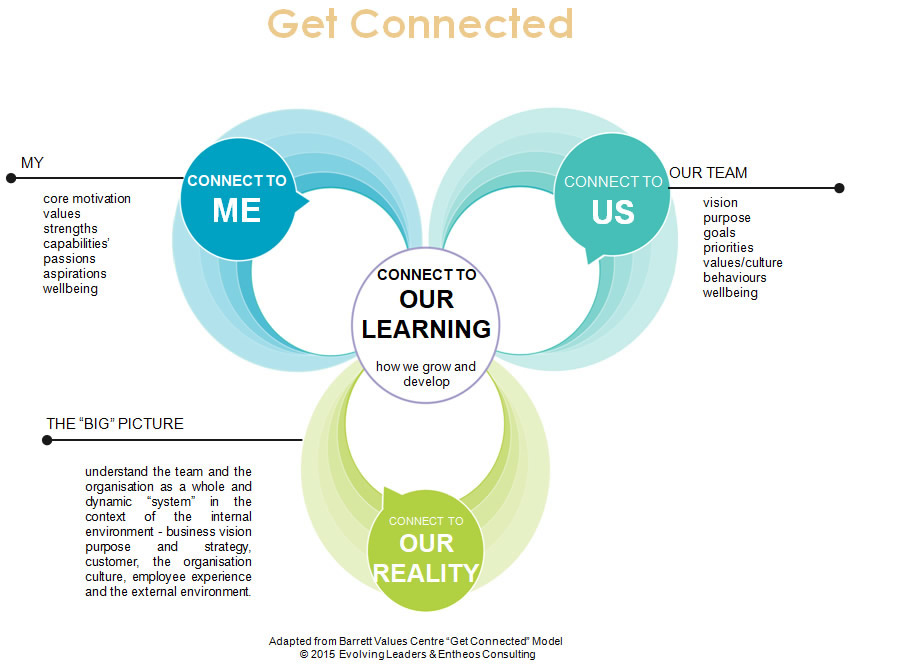
The model guides the discovery and learning journey toward a healthy team culture and a thriving organisation through focus on four cornerstones: ‘Connect to Me’, “Connect to Us’, ‘Connect to our Reality’ and ‘Connect to Our Learning’.
In Part 1 of this post I will focus on the first of the four cornerstones “Connect to Me”.
Connect to Me
This is all about personal leadership. Who am I? What matters to me? What is my core motivation? My passions? My strengths? My preferences? It’s about taking personal responsibility.
What does this mean in the context of living a purposeful life?
What does this mean in the context of my role, the team and organisational culture?
It’s about developing self-awareness, capacity for reflection and developing the confidence to share your whole self at work. It’s about feeling psychologically safe so that you can challenge norms and exhibit new ways of being. It’s about learning to be present with others and to listen without judgement or need to comment. It’s about sharing from a place of realness and vulnerability and having others witness you on your personal discovery journey.
When you undertake this personal development with your manager and team members, you build confidence to bring ‘more of who you really are’ to work and thereby the ability to share your unique gifts in service of the team and organisation. You understand each other at a whole new level and that connection brings healthier ways of working straight back to the workplace.
For a leader, the ability and willingness to bring your real self, warts and all, to your work – to be ‘comfortable in your own skin’ – is powerfully reassuring to others. It gives others permission to do the same, each building their own individual ‘connection to me’. This is great leadership in action.
“When we begin listening to each other and when we talk about the things that matter to us, the world begins to change” (Margaret Wheatley – Turning to one another, page 13)
The movement toward a healthy team culture and a human organisation is built on members of that team taking personal responsibility for expanding their self- awareness and capacity in the context of the role, team and organisation. The Connect to Me model provides a roadmap for this personal learning.
In Part 2 and 3 of this blog post series I explore the other three cornerstones of connection: Connect to Us, Connect to our Reality and Connect to our Learning.