

The second of three stories from the mountains – about what often happens when grief is spoken aloud, and why it isn’t unkindness.
Before I ever set foot on the Tour du Mont Blanc, there was Croatia and Slovenia.
It was the first, solo leg of nine weeks I spent in Europe in 2025, hiking my way through grief, or so I thought at the time. My husband Jeff had died the previous October. It was a real leap of faith, the courage to walk that part of my own grief path, alone. It wasn’t only the boldness of venturing out alone. It was doing so without knowing what emotional state I might find myself in from one moment to the next and, doing it without Jeff, when every holiday we’d ever taken had been together or with our family. It brought its own anxieties. (That courage, and what grief does to us on the inside, is a story for another day.)
My first contact in the country was a young Croatian man who collected me from a pre-arranged taxi pick-up. He was generous with his stories, told me about his culture, and offered to be available if I needed transport elsewhere during my stay. He reassured me how safe Croatia was, and that I had nothing to worry about as a woman travelling on her own. My anxieties quickly eased.
He had no idea I was grieving. I hadn’t told him, and he didn’t ask why I was travelling alone. He was simply being kind to a traveller.
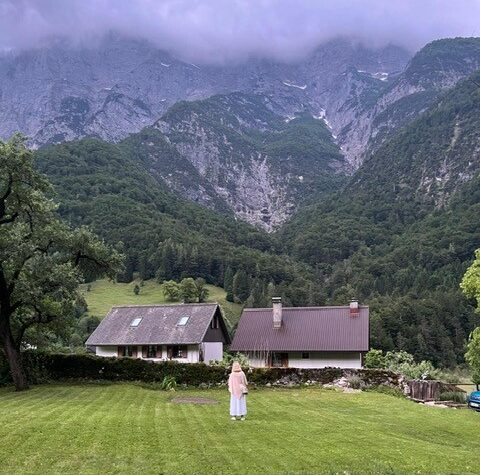
I spent that first week touring on my own, through Split and Zagreb, before making my way to Ljubljana, where the walking would begin. Slovenia stole my heart. The mountains were like no other, exquisite, almost too beautiful to be real. In the photo above I had a full “the hills are alive with the sound of music” moment, surrounded by mountains on every side. (Wrong country, I know, but the feeling was pure Julie Andrews.)
There is a particular kind of grace in walking through beauty like that while carrying grief; the two don’t cancel each other out, they sit side by side, and somehow the landscape made room for both. I would soon learn that not everyone could.
Over the eleven days that followed which was a long time to spend in the company of the same twelve people, the conversation turned, as it does among hiking companions, to who we are and why we’ve come. Jeff’s death was so central to my story then that I couldn’t avoid it when people asked about my life and I certainly didn’t want to. Yet it was never easy to say. Each time, I felt it afresh, often keeping tears at bay as I spoke his name to someone new. And each time I shared that my husband had died, I watched something happen.
Ten people looked away.
Not cruelly. Not obviously. It was subtler than that – a change of subject, a chosen seat further down the table when the group sat down to eat, a slight increase in the distance between us on the trail the next day. The warmth that had been there a moment before quietly cooled. The landscape had made room for my grief; these fellow walkers could not.
Two, though, did.
One was a GP. The other was a nurse who was, herself, a widow. They stayed. They asked. They let me speak about Jeff, and when the tears came, they didn’t look away.
There was a flow-on effect I only noticed later. When I asked the ten about their own lives and journeys, they stayed a little guarded as though closing the door on my grief had closed something in them too. I sensed that if they let their own guard down, if they were vulnerable with me, it might invite me to be vulnerable in return and that could bring Jeff’s death back into the room, the very thing they were trying to avoid. So, they kept themselves at a distance, and in doing so kept me there too. But the two who could meet me shared just as openly in return, about their own lives and losses. Real connection formed. It turns out that meeting someone in their grief doesn’t only help the griever; it can be powerful medicine for deepening human connection.
The ten who looked away were not unkind people. They were ten people with their own stories, their own lives, their own hearts and minds – each carrying who knows what themselves. I had already met that same ordinary human warmth in a taxi driver in Split, from a stranger who knew nothing about me. That warmth exists in almost everyone, or that’s how I choose to see people, anyway. It can however simply stop at the edge of grief because grief is the one thing most of us have never been taught how to meet, let alone hold.
When someone tells you they’ve lost a person they love and you have no idea what to say, the fear of getting it wrong can be overwhelming. So, people change the subject, thinking they are protecting you but really it is their own fear at work, and a quiet belief that saying the wrong thing is worse than saying nothing at all. They can avoid mentioning your loss so as not to remind you as though your grief were somewhere in the background and mentioning it would be what brings it forward again. They give you the space they imagine you want, and what you actually receive is isolation stacked on top of loss.
Grief can only be integrated through connection, never in isolation.
And the two who could stay? Look at who they were. Both had been trained by their work to sit with people at the hardest moments of their lives – one a GP, the other a nurse. And the nurse had been trained twice over: she knew the loss of a husband herself.
And here is the part worth pausing on – in a group of twelve, over eleven days, only two could meet grief with any ease and both had been trained to, one by her work, the other by her work and her own loss.
It should not take a medical career or a bereavement of your own to know how to be present with someone who is grieving.
This is what I mean when I say we live in a grief-illiterate world. Not unkind. Illiterate, untaught.
What I saw on that trip, I now see everywhere. It plays out every day in workplaces and communities.
Grief First Aid training points to a striking figure: on any given day, around one in four people in Australian workplaces is carrying grief or loss of some kind. Yet when a grieving colleague returns, whether from a death, a diagnosis, a separation, or any of the countless losses being human can bring, even those who deeply care might find themselves avoiding the desk, the topic, the name of whoever or whatever has been lost. And so, the griever carries it alone, unspoken, through the working day.
The good news is that grief literacy can be taught. These two kind humans didn’t get there overnight, one had years in medicine, the other had her own loss alongside it. I’m not claiming Grief First Aid training hands you that. What it does teach is the starting point: how to stay, how to ask, how to not look away. That’s the part most of us were never shown and it’s the part that makes the difference between someone carrying grief alone, and someone who isn’t.
_________________________________________________________________________________
I kept walking. And a few weeks later, on another mountain, a stranger at a bus stop asked me my husband’s name.
The final story from the mountains is coming soon.
This is why I now do the work I do. Through Evolving Leaders, I guide people through life’s hardest transitions with 1:1 coaching, and Grief First Aid education for workplaces is now available so that meeting grief well becomes something we all know how to do, not a matter of luck. My first public Grief First Aider program is starting soon and bookings are now open to bring Grief First Aid training into your workplace starting in a few weeks.
I would love for you to be there. You can find out more here, lets talk or drop me an email nicola@evolvingleaders.com.au
Photo: Nicola in Slovenia June 2025 having a ‘hills are alive moment’ after a special dinner when we were invited out the back of the restaurant to find oursleves fully immersed in mountains on all sides
www.evolvingleaders.com.au
The first of three stories from the mountains about grief, loss, and what it means to truly meet someone in theirs.
Never underestimate the powerful impact you can have on someone who is grieving simply by being curious and asking a few gentle questions.
I want to share a personal story.
After my husband of 33 years died in October 2024, I took my hiking to a whole new level — a level I never thought I was capable of. It was a grief response: nothing else made sense in those months, but putting one foot in front of the other did. Alongside many hikes here in Australia, I was fortunate enough to travel to Europe to hike the Tour du Mont Blanc.
As I sat waiting for the bus transfer from Geneva to Chamonix, I started talking with the woman next to me. It turned out that she and her partner would be my walking companions on the very same trip. Rita asked why I was travelling on my own. I immediately dissolved into tears and shared that my husband had died seven months earlier.
Rather than turn away or shift to another topic, Rita stayed right there with me. She asked:
“What was your husband’s name?”
I was taken aback. Here was a complete stranger who cared enough not to shy away from my pain, but was prepared to witness me in my grief. Rita continued with other questions about Jeff’s life.
Over the next seven days, as we traversed massive elevations amid awe-inspiring, iconic scenery, held by those incredible mountains, Rita would find moments to ask me more about Jeff. She kept referring to him by his name.
And as we navigated our final descent, she looked at me and said, “Nicola, Jeff would be so proud of you.”
Rita, without even knowing it, was a natural Grief First Aider.
She didn’t try to fix me or rescue me. She offered genuine compassion, care, concern and interest. She asked gentle, curious questions that invited me to speak about who Jeff was. She validated my feelings and reflected them back to me. I felt actively attended to.
And Rita’s care didn’t end at the mountains — she followed up more than once after the walk finished and I had returned home.
Rita wasn’t the only one who held me on that mountain — but that’s a story for another post.
Rita became my teacher as well as a caring human. I have continued to pay this forward to others, and I can tell you the reaction is often the same: people are initially a little taken aback — and then they quickly soften and open, knowing it is safe to talk about their loved one.
Never underestimate the impact you can have by meeting someone in their grief. If you ever find yourself in that moment of not knowing what to do or say, I hope Rita’s story will give you a place to start.
This story is why I now do the work I do. Through Evolving Leaders, I guide people through life’s hardest transitions with 1:1 coaching, and deliver Grief First Aid education for workplaces — helping people learn to meet grief the way Rita met mine. If either of these speaks to you, I’d love to hear from you: nicola@evolvingleaders.com.au
The second story from the mountains is coming soon.
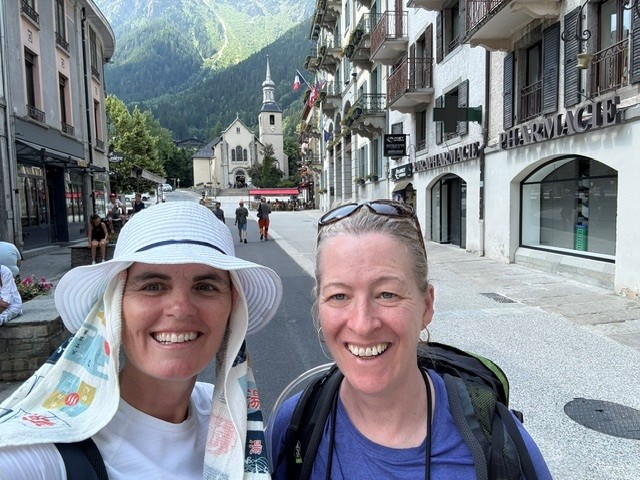
Photo: Nicola and Rita in Chamonix at the end of the Tour Du Mont Blanc hike about to have a celebratory drink!
www.evolvingleaders.com.au
The generous response to ‘Coming back, changed‘ touched me deeply. I am grateful for your caring words and gentle encouragement to get on with this important work. Thank you.
In the three weeks since, I’ve been walking through the Kimberley, where every sunrise and sunset seemed to bring a new colour and new experience, and the landscape quietly got under my skin. I’ve returned home refreshed, inspired, and ready.
So today, I begin.
While I was caring for my husband, I undertook a Diploma of Developmental Coaching through the Vertical Development Institute. If you don’t know Alis Anagnostakis’s work yet, do yourself a favour and check it out. It sharpened my coaching practice, and it’s deepened how I work in ways I’m still discovering. While I have been coaching leaders for many years, to attain my ICF accreditation on the other side of this diploma, I need to complete 100 hours of coaching practice. This is a milestone I want to approach very intentionally.
So, as I refocus my coaching offering into guiding people through transitions, I’m bringing the two together: deepening my own practice and attaining my ICF accreditation while walking alongside you through yours. I’d love for you to be part of it. And I’d like to mark the beginning with something:
Book a “Let’s Talk” conversation in July to receive 50% off 1:1 Transition Guidance & Coaching (6 session package).
Every engagement begins with a no-pressure Let’s Talk conversation, so we can explore what you’re navigating and whether this is the right fit.
You can book yours here.
If you’re in the messy middle of a transition, or you know someone who is, I’d welcome a conversation.
With warmth and gratitude,
Nicola x
Nicola Vague is a leadership coach and transition guide, and the founder of Evolving Leaders. She walks alongside leaders navigating unexpected life events, and helps organisations support their people through the line-in-the-sand moments that turn life upside down.
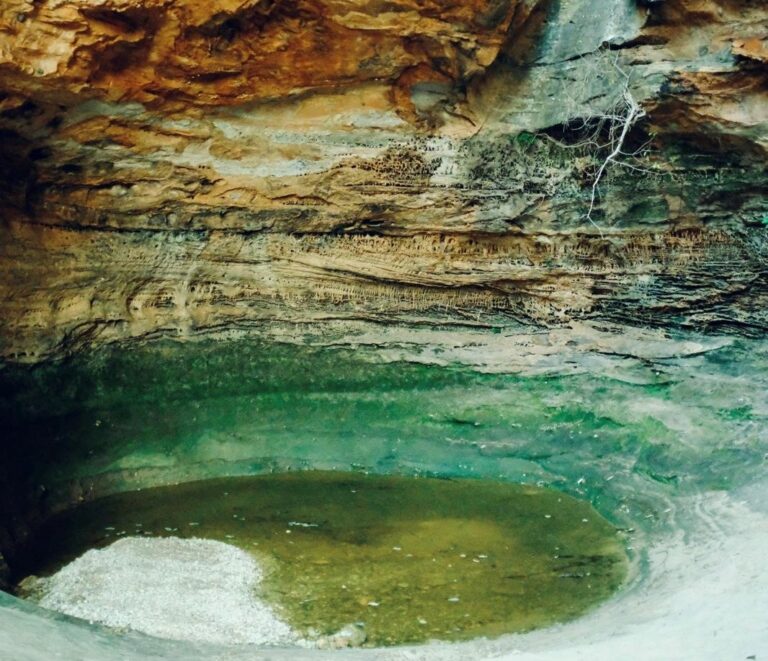
Photo credit: Martin from my Intrepid tour, July 2026. Indigenous birthing pool (no longer used, photographed with permission of a local Elder), Purnululu National Park, The Kimberley, Western Australia
www.evolvingleaders.com.au