

This isn’t the next post I’d planned in the transition series. It arrived this morning before my first cuppa, and since I’m learning to go with the flow, I’m sharing it with you fresh. The others in the series are coming soon.
This post is about what happens beyond liminal space, when you’ve stepped onto the new shore and you’re back in the driver’s seat of life. Grief doesn’t stay behind. It comes along as a passenger, mostly quiet, until a conversation, an anniversary or a Grand Final brings the little losses rushing back. And it’s about what I’m finding alongside the pain this time: gratitude, and the lessons Jeff left us.
Yesterday I paced the chocolate aisle at the supermarket, unable to decide which one to choose, and then the tears came. Inconsolable tears. No sunglasses, no tissues. (Chocolate is very much an emotional crutch for me, so it makes sense I was standing there and not in fruit and veg.)
It caught me by surprise. I’ve been feeling stable and strong for about four months now, a far cry from the extensive period before, when I was traversing the depths of grief, lost in the liminal space. It has been such a relief to feel aliveness again, to pop up from those depths into the seeds of a new beginning.
It seems there is a distinct point when you move out of the liminal space and arrive on the new shore. That doesn’t mean everything is settled and the grief goes away. The jigsaw puzzle my life shattered into when Jeff died still has a lot of forming to do. For me, the switch came when I’d had enough time (and therapy) to integrate the loss and could begin to contemplate the possibility of living fully again. I had grown around the grief to the point where it was no longer the lens through which I experienced all of life.
Lois Tonkin’s work on growing around grief describes this well. The grief doesn’t go away. It comes with you. But as your capacity grows around it, you’re no longer held hostage by it 24/7. There’s more mental clarity, and a desire to move forward. There’s an interest in bringing the gifts from the life that’s been and in birthing a new chapter. That starts to buoy you along. For me, amongst other things it was a knowing that it was time to get back to work, it’s as though life itself pops into the driver’s seat, and grief takes its place as a passenger.
But even with grief as the passenger, it can still cry out like an upset child in the back seat and send you swerving.
Over the past few days, I’ve felt emotion surfacing and had been curious about it. The second anniversary of Jeff’s passing is fast approaching, and I’ve been present to how this might be for me this time around. Then that morning, I’d had a conversation with a friend.
Several years ago, my friend separated after a loving thirty-year marriage. The night before, for the first time, he’d gathered with his ex-wife and their three adult children for dinner, the five of them finding their new way forward as a family. The evening went well, and I was genuinely delighted for them all. It takes relationships that are sufficiently intact, and egos and self-interest stepping aside, to make that happen. Sadly, from what I’ve observed from the sidelines, it often not the case.
As he shared his experience, something landed starkly in front of me: our band will never be back together again. Being a family of musicians, we playfully called ourselves the von Vagues (as in the von Trapps), and nothing made us happier than when the band was together. Of course, I’ve known this for nearly two years, but yesterday it arrived like fresh news. While everyone is still living, there’s a choice to come back together. When one of you dies, that choice dies too. Jeff has gone and so has our family unit in that form.
I don’t regret the conversation. In fact, I’m grateful for it. It helped me attend to a micro-loss my mind hadn’t yet caught up with, and it sparked this reflection. What matters is that it’s possible for his family, and that, through choosing love, they’ve created a new ritual to come together, simply because they can. We can all learn from that.
And then there was the day itself. Yesterday was AFL Grand Final Day 2026, and Grand Final Day will always mark one of those harder days in our lives.
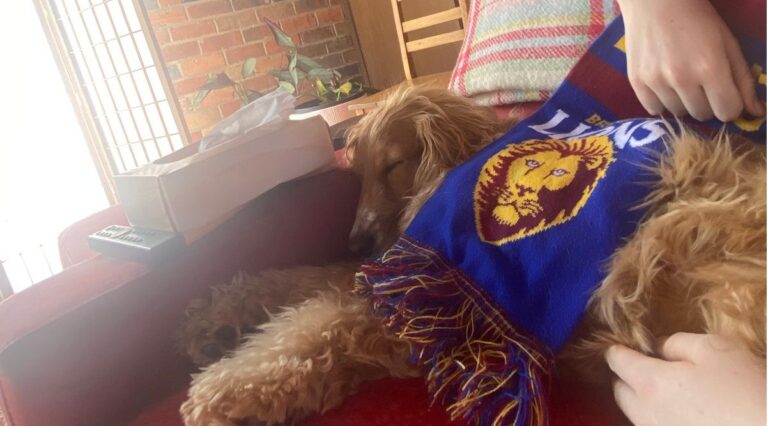
Jeff was an avid football follower. His big brother cultivated that love, taking him to games and talking all things Fitzroy (now the Brisbane Lions) from when he was a small boy.
In 2023, not long after we nearly lost Jeff to a severe reaction to a clinical trial drug, he miraculously made it to the Grand Final in person. It wasn’t a win for his team, but he loved every minute.
In 2024, on the last Saturday in September, my dear sister and her husband helped us bring Jeff home from palliative care for the day. It would be his last time at home. He had been slowly drifting away for weeks by then, his mind and soul beginning their journey of departing his body. I now understand this is often the way. It’s another of life’s transitions, as perfectly designed as birth: a process, not a single moment.
The Lions won that day. What stays with us most is watching Jeff muster everything he could to celebrate, when really a football match matters so little when you’re about to leave this earth. All the things that were so much a part of who you were simply fall away. His vacant expression and half-hearted wave of the flag as the siren sounded broke our already broken hearts a little more. And still, I’m so grateful we had that final day together at home as a family.
In 2025, eleven months after Jeff died and in the deepest part of my grief, I prayed the Lions would bomb out before the Grand Final. I didn’t know how we would get through reliving our 2024 experience. They made it, and they won. Jeff would have been delighted. Somehow, we navigated that difficult day, and two of our daughters even made it to the Grand Final in person, because that’s what you do: you get up and keep going.
I thought that another year down the track, yesterday’s Grand Final would be easier. But it’s amazing how our bodies know and our minds remember. Those same heart-wrenching scenes from 2024 replayed in my mind’s eye, and today I feel emotionally hungover without having touched a drop.
But something has shifted. Alongside the pain in the memories, I can now feel immense gratitude too. I’m grateful Jeff came home that last day to sit in his favourite chair with a bowl of Haigh’s chocolate caramels, hot chips and sausage rolls, as was always the way on Grand Final Day. I’m grateful for the people who held us so we could make it happen. And I’m grateful for what Jeff taught us through his courage over those 15 months.
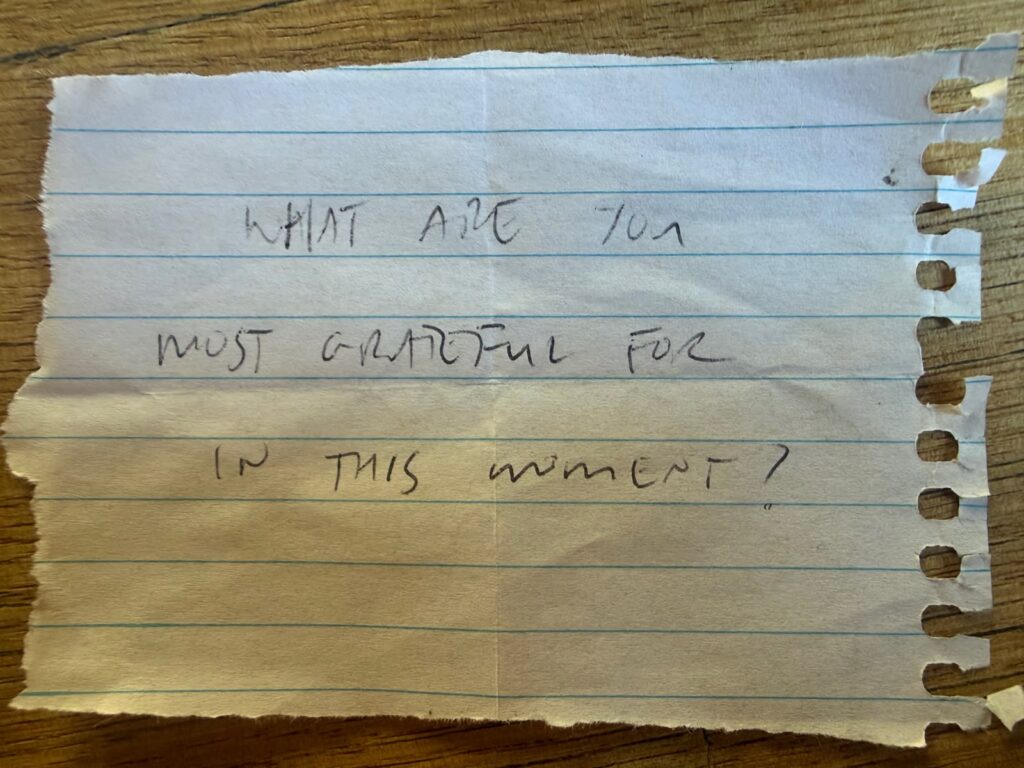
Gratitude was one of Jeff’s greatest qualities, and he never stopped expressing it. On our fridge there’s still a torn scrap of paper in his handwriting, from a family practice we started during the COVID pandemic to lift each other’s spirits. It simply asks: What are you most grateful for in this moment? Even as the effects of the brain tumour took so much of his understanding, and amid his intense suffering as he faced his own mortality, he would tell us each day that he felt loved and held, and how thankful he was. He extended that gratitude to everyone in his path, and to this day I borrow his words that he would always use to thank the cleaner, the doctor or anyone else helping him: “Thank you for your work.”
So, the tears in the chocolate aisle weren’t a step backwards. This is what grief does, even after you’ve stepped onto the new shore. As you engage with life, you’re reminded of the thousands of little losses, the things no longer possible because they ended when your person died. I recognise this will happen forever more. We grow around grief, and it comes with us. That’s the nature of loss, because that’s the nature of love.
We only feel the depth of the loss because of the depth of the love. Fortunately, love doesn’t leave when the person dies. We feel Jeff’s love with us every day. He taught us what truly matters when everything is stripped away. That wisdom guides our choices still, and it is shaping our daughters into three young women he would be so enormously proud of.
Great work from above, Jeff, helping your team to three in a row. Go Lions. They’ll be counting on you for the fourth victory next year.
We miss you more than words can ever hold. Thank you for being our teacher, for being the bass in our band, and for your eternal love. We will love you forever x
And in Jeff’s words, from our fridge to yours: what are you most grateful for in this moment?
www.evolvingleaders.com.au
Photo: 28th September 2024. The von Vagues, Grand Final Day 2024. Jeff’s last day at home.
As humans, our tendancy is to focus the external changes in our lives, and rarely on what they ask of us inside. In this post I explore the difference between change and transition, why grief and loss are part of every transition, and why the in-between is where so much of our growth quietly happens.
Change is what happens to us. Transition is what happens within us.
I’ve spent three decades working with humans and the systems they gather in, and I’ve come to believe that much of the unsettledness we feel around change lives in the gap between those two sentences. We plan carefully for the first. We barely notice the second.
Perhaps something in your life has changed: a job ending, children leaving home, a separation, a diagnosis, or the death of someone you love. Or perhaps nothing obvious has happened, and you simply feel off, not quite yourself. There can be many reasons for that. But when the feeling follows a change or arrives with a quiet sense that who you’ve been no longer fits, it may be an internal transition asking to be noticed.
We mostly turn away from our life transitions. We ignore them, or we don’t recognise them. We rarely name or acknowledge them, and sometimes we don’t even know they’re happening. We just experience and grapple with the symptoms without understanding the cause.
This isn’t anyone’s fault. Most of us never think beyond the change itself, so the transition it asks of us goes unnoticed. It’s rarely something we consider for ourselves or support each other through. We simply have no map for it.
Transition is part of being human. So are grief and loss. And yet we were never taught how to notice or attend to either. We learn to read and write, to drive a car and to perform CPR. But when life changes, no one shows us how to grieve what we’ve lost, or how to navigate the internal experience of transition. It’s not a failing on our part. We have simply never been taught.
William Bridges, who spent his life studying how people experience change and transition, made the distinction that has shaped my work.
Change is the external event: the diagnosis, the ending, the restructure, the unexpected news. We can be the initiators of change, and we can also be the recipients of change that is desirable and change that is devastating.
Transition is the internal process we go through to integrate it. It’s the messy, disorienting, confusing, discombobulating, non-linear part that is so often brushed over. It throws us into disarray. It can leave us drifting through our days on autopilot with little to hold on to. It challenges our identity. And, well supported, it fuels our evolution and strengthens our resolve.
Change can happen in a moment. Transition takes as long as it takes.
We can let transition simply happen to us. Or we can turn towards it, listen to what it’s asking, and let that guide us forward. That is the work of transition.
From first breath to last (and beyond)
Transition begins before we even take our first breath. Perhaps the first great transition of all is the soul’s journey into physical form. From conception to embryo to human baby, we arrive carrying so much capacity and potential.
Life, by its very nature, is a series of thousands of tiny transitions. Together they map the path of our growth and evolution, all the way to our final transition for this lifetime: the end of life itself, and whatever lies beyond it.
Then there are the macro transitions. Some we consciously choose to enact, like the decision to leave a marriage or walk away from a friendship that no longer serves us. Others are inevitable at various life stages: becoming an adult, becoming a parent, losing a parent, traversing menopause, to name a few. And others are simply thrust upon us.
All of them involve grief and loss, because change always involves loss. Even the changes we choose. Even the ones we celebrate.
A map for messy territory
I said earlier that we have no map for transition. Bridges offers us one. He described transition as moving through three phases:
- The Ending. We let go of the way things were.
- The Neutral Zone. The old is gone, and the new isn’t yet ready.
- The New Beginning. New identity, energy and purpose begin to emerge.
It’s not a neat, step-by-step path. We move back and forth, and sometimes we’re in more than one phase at once. But this map helps us make sense of the psychological shifts we must make to find ourselves in our next new beginning.
The work of transition spans the whole journey. But the deepest work happens in the bridge between the old and the new: that middle place, the neutral zone. Something I and others prefer to call the liminal space.
This idea is far older than Bridges. Tibetan Buddhism has a word for it: bardo, meaning “the in-between”. It most often describes the space between an old version of us dying and a new version being reborn. The way I’ve come to understand it, the bardo is a place where there is nothing but the recollection of what was. It’s a time to draw out the essence of the joy and the wisdom from what has been, to carry that essence forward, and to prepare for who we are becoming.
I find that deeply consoling. It suggests that the in-between, the liminal space, isn’t empty. It is where we gather what matters from what’s ended, so we can bring it with us into the new that’s just beginning.
We expect endings, and we hope for new beginnings. What no one prepares us for is the in-between – liminal space. Yet, it’s where we quietly grow.
If you recognise yourself in any of this, you don’t need the words for it yet. Simply acknowledging maybe I’m in transition can be the first step in turning towards it.
So what does this in-between space actually feel like, day to day, from the inside? That’s where I’ll take you next.
www.evolvingleaders.com.au
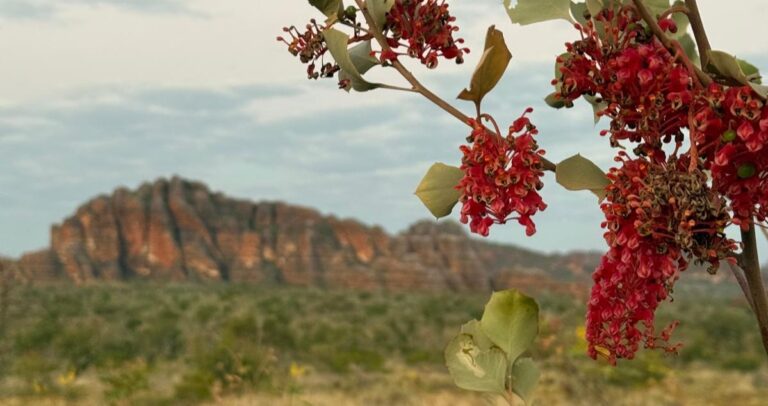
Photo: Purnalulu National Park, WA, June 2026
Building grief-literate workplaces.
Grief doesn’t wait for permission, and it doesn’t stay at home. Every year, hundreds of thousands of working-age Australians experience significant loss , and at any given time, around one in four people across an organisation may be carrying grief of some kind. They’re sitting in your meetings, answering your emails, serving your customers.
Yet most of us, leaders included, were never taught how to respond. We worry about saying the wrong thing, so we say nothing. We offer a card and a casserole, then expect business as usual. The grieving person learns to hide it, and the hidden cost shows up in wellbeing, connection, judgement, performance and turnover.
It doesn’t have to be this way. Grief literacy- knowing how to be with loss, in ourselves and others is a business issue. And workplaces that build it create cultures where people feel genuinely seen and supported through the hardest moments of their lives.
Registrations are now open for a one day Grief First Aid Training on 31 August 2026 (Public Program) where we practise exactly this: how to witness grief, and how to accompany it.
We’ll be on zoom so you can join us from anywhere!
We hope you can join us.
Grief First Aid for the Workplace Public Programs
www.evolvingleaders.com.au

The third story from the mountains – about grief, presence, and what becomes possible when someone can hold silence without rushing to fill it.
Sometimes the most powerful thing you can offer someone who is grieving isn’t more words- it’s fewer.
In my first story from the mountains, I shared how Rita, a stranger on a bus, met me in my grief with one gentle question: What was your husband’s name? Rita’s open questions and her kind, generous nature were a teacher for us all. But that wasn’t the only way. This is David’s story.
David was our guide on the Tour du Mont Blanc- an Englishman married to a French woman, living in France for over twenty years. Guiding was more than a job for him; what he loved most was the connection that unfolds on a trail. He was around my age, and as a father and husband himself, he understood loss from that vantage point too. But it was more than shared circumstance. David had a quality of presence about him, a capacity to sit comfortably with long stretches of silence as we walked, step by step. And somehow, held in that, I found myself dropping further into the layers of grief within me, one layer softly giving way to the next.
What Rita and David shared was presence, and a willingness to hold space. What differed was what they did within that space: Rita with more words, though never a rush of them, David with fewer, and a seemingly natural ease with the tension that silence often brings.
I felt met and being met was what made it feel safe to keep going. On a trail you don’t walk side by side; you walk one ahead of the other. No eye contact, nothing to read on the other’s face, just the rhythm of our footsteps helping to hold the container, and the mountains themselves holding it too, the wildflowers emerging from winter in splendid colour all around us.
My learning was this: someone who is grieving never needs a barrage of questions. Often one is enough to open the door and then it’s about holding the silence that follows, fully present, not rushing to fill it. That discomfort you feel? It’s usually the very sign that you’re giving the person something they need.
And here’s what surprised me. As I shared more of my own story with David, it created fertile ground for him, in the days that followed, to share deeply about his own experience of life and loss too , mirroring exactly what he had offered me. I was able to be there for him, the way he had been there for me. Real conversations. Deep care, moving both ways.
I want to name something important here. Sharing your own story is not the role of a Grief First Aider in the workplace when you’re offering grief first aid, the focus stays with the person who is grieving, and turning to your own experience can pull attention away just when they need it most. But David wasn’t there as a first aider. He was giving me something different, and equally precious: the companionship of a fellow traveller who had known loss himself.
From both Rita and David, I felt witnessed and accompanied, her questions and his silence were simply different doorways into the same care.
If someone you care about is grieving, remember that you don’t need to find the perfect words. There may not be any. A walk, a silence you don’t rush to fill, a hand on the back if you’ve asked and it’s welcome, your simple willingness to stay, these can say more than any words could. Of these, the silence is the hardest. It takes courage to stay in it rather than interject and most of us aren’t wired for it. We want to fix, to soothe, to fill the gap. But that urge to rush in is often more about our own discomfort than the other person’s need.
I am so grateful to all the humans who were able to meet me on that mountain in those early months, who didn’t shy away, and who each showed up in their own unique way. This is how we integrate loss, not in isolation but through connection with others.
Never underestimate the power of simply being there.
This story is part of why I now do the work I do. Through Evolving Leaders, I guide people through life’s hardest transitions with 1:1 coaching and registrations are now open for my first public Grief First Aid for the Workplace program on 31 August, where we practise exactly this: how to witness grief, and how to accompany it.
I would love for you to be there.
www.evolvingleaders.com.au

A trusted friend and colleague (and incredible coach) asked me these beautiful questions at the start of the year– who am I now? and what’s my unique offering as a coach?
The right question at the right time is gold. This precipitated an opportunity to pause, reflect and reset.
I wanted to share with you what I discovered by re-introducing myself and a wonderful new and much needed coaching program for senior women.
Hello, my name is Nicola Vague. I am a leadership coach, meditation teacher and art therapist. As a leader of leaders, my personal mission is heralding new ways of being and leading to transform outdated systems and ways of operating, creating a future where people and communities can flourish.
Eighteen years ago, in my mid-thirties, I experienced what I now understand to be an existential crisis. I was constantly stressed, short fused and unable to connect with the joy that was all around me. I was surviving but not flourishing; I knew that something needed to change. I made a promise to myself to stop focusing on the ‘shoulds’, to quieten the mental chatter and to follow my heart (I didn’t even know what that meant at the time). This commitment to move a little more towards myself was a turning point.
So began twenty years of personal exploration, evolution and development as a leadership coach, alongside extensive corporate experience in organisational development and change. What I now know, which serves as the foundation of my leadership work, is that to improve the quality of our decisions and actions, we must carve out space and cultivate the conditions that enable us to come into a more conscious relationship with ourselves. I don’t teach something that I have just read about; I teach what I have come to make sense of through my own evolution. This gives the learning I offer to leaders both depth and simplicity.
In 2014, I founded Evolving Leaders (www.evolvingleaders.com.au) with the purpose of evolving the consciousness of leaders to make the world a better place. My focus has been on leadership, change and wellbeing. Partnering with longer term clients on their leadership transformation journey supported by wonderful collaborative relationships is rich and rewarding.
I have been offering individual leadership coaching for over a decade now, mostly as part of leadership 360 assessments and broader organisational leadership development programs. I love this work. It is an honour and a privilege – especially supporting those leaders who are ready to embrace the opportunity of 1:1 leadership coaching.
Whilst I continue to offer this work and supporting clients on their leadership transformation path, what has also emerged is a new 1:1 coaching offering for women where I can explicitly bring the unique combination of skills, experiences and approaches that has radically shaped my own personal and professional development and wellbeing to supporting senior women.
Why women you ask?
In the words of Desmond Tutu “Once you have women liberated, it’s amazing how many other problems get resolved – poverty, education, health. Women are the key in any community.”.
Newly released evidence from an Australian wellbeing study – The Gender Wellbeing GAP (Global Leadership Wellbeing Survey – GLWS) shows that the overall wellbeing of women in senior roles is low and that this gap is increasing. This may not be surprising but it is alarming and requires attention. Women are the primary nurturers in our society, raising children, forging careers and managing many relationships and connections. This coaching program is about nurturing the nurturers, women who are juggling multiple commitments and competing demands, often at the expense of themselves.
In addition to navigating my career and personal evolution, I have the privilege of being a mother to three young woman, an aunty and friend to many, a sister, a wife, a daughter. Now in my fifties, I have navigated work and family through its many phases and continue to do so. I have been fortunate enough to have had the support of many therapists, healers and coaches. It is my turn to offer this to other women and to make a contribution to improving wellbeing for these women.
So I am delighted to be opening up limited places for senior women as part of Cultivating Well – 1:1 Leadership Coaching for Women.
Delivered via over a five month period, the purpose of the program is helping participants to slow down and reconnect with themselves beyond the noise of the external world, opening to new possibilities, improving wellbeing and creating a changed reality.
The Invitation
A place to pause, reflect and reset.
A place where your fears and dreams are safely shared and nurtured.
A place to become comfortable with not knowing.
A place where you will be supported.
A place where your true nature can emerge.
A place to turn a little more lovingly toward yourself.
A place where possibility becomes infinite.
The six-session coaching program is focused on:
- Guiding participants beyond the noise to hear their own wisdom through accessing the vast well of resources within them
- Providing a held space so that they can find thier centre and bring attention to their own well-being; and
- Cultivating the conditions, practices and habits to lead well!
Senior women might self-nominate or be recommended for this experience as part of broader leadership development, wellbeing, or talent management initiatives.
I look forward to asking you the right question. Read on for full program overview.
Not interested in this new coaching program? You may be interested to explore our Leading Change Development Program and other Coaching and Team Development services.
This post highlights the importance of space and time to reflect away from the ‘noise’ of life to refocus on what matters so that we can see different perspectives, shift energy and beliefs that are stagnant and move forward with a clear and healthy intention that can restore connection.
This week I am working remotely from Bright in north-east Victoria. It’s become the space that I take to regroup, reflect and refocus a few times a year. I never really know what is going to surface at these times but have learned to just create space and get out of my own way. What surfaced on day one this week took me a little by surprise.
But first – a little of the back story so it makes sense.
A month ago my eldest daughter (age 19) announced that she was heading overseas on a solo adventure for seven – s-e-v-e-n – months to Japan and South East Asia then finishing in India and Nepal. I have witnessed Amelia working three jobs to save the funds for her adventure along with the clarity and conviction in her decision to defer from her second year of university. I have also known for some months that the trip was coming. But her intention had been to travel with a friend – the whole ‘travelling alone’ thing was new. And it really sent me into a spin. In fact, I went into a whole fear-based reaction that left me with nightmares about abduction in Japan. I had broken sleep, waking up asking myself ‘Is this really happening, or did I dream it?’ I was generally motionless and speechless for a day or two as I tried to process the news.
From Fear to Courage
Over the days that followed, I started to move beyond my own fear-based reaction. I was able to step a little more off the dancefloor and up to the balcony and a broader perspective. I was then able to see and be present with the extraordinary courage of this amazing young woman. Here I was a short jog away from 50 and I have never done anything as seemingly courageous as this. My broader perspective helped me to re-frame a number of beliefs and stories that were much more useful:
- If anyone’s got what this takes, she does. She’s street smart, savvy and quick to think and act when she needs to.
- She always attracts amazing people into her life. She knows how to have fun and have deep honest conversations and connection with people so interesting people are always drawn to her.
- From the moment she was born, she has always been well and truly looking out into this wondrous world – this is just who she is. She has work to do in the world and this is the natural next step – into the world.
- If life is not a daring adventure – then what is it?
- She’s ready to step away from home – and if we’re honest with ourselves, we’re ready for her to take that step away from home too. (We’re a bit over being treated like a hotel and in many ways, this is payback time – as I recall doing exactly the same with my mum.)
Secretly (or perhaps not so secretly now) there is also a part of me that would love to head out into the world just as she is, into an adventure into the unknown…
Roll forward to yesterday – day one in this next week of space in Bright.
I had been feeling something was stuck energetically in me all day long and I was getting frustrated because I should be working/ writing/ planning/ thinking … doing something! Then inspiration struck me. What was needed was a walk by the river with the dog, revealing in the present moment through the dog’s pure joy as she chased the ducks (no hope of catching them) and fetched sticks along the Ovens River.
Perhaps you have had a similar experience too? Trying so hard to ‘do’ and needing to make a decision just to ‘be’? I surprise myself at how often I fall into this same trap.
The Realisation
As I sat on the riverside listening to the birds and watching the water flowing over the rocks, I was struck by something in relation to my daughter. It was time to make a choice – a choice to let go. I hadn’t explicitly been thinking about her travel that day but clearly it was right there not too far from the surface, waiting to be revealed when I finally found the space to reflect.
‘“To let go means to let be. When we let be with compassion – things come and go on their own’
Jack Kornfield
Emotion rose and tears rolled down my cheeks as this energy that had been ‘stuck’ started to move through me – the realisation that that I had been emotionally holding on to my ‘baby girl’ for too long now.
I spent the next hours journaling and reflecting on what it meant as a mother to ‘let go’ with compassion and to ‘let be’. I also called on Google for some parenting advice and came across the following statement: ‘The most productive relationship for adult children is for them taking primary responsibility for their lives and parents acting as their consultants’. Okay. Yep. Well, that makes sense – I could certainly transition to that, if that’s what Amelia needs.
Change and Transition
In my work supporting leaders to navigate change in organisations I have often spoken about ‘change’ being the external act – the decision to go overseas, the leaving home, etc. in this situation. But then equally I bring focus onto the transition that change brings – that is the internal emotional changes that must happen through the cycle of emotions to arrive at acceptance. I could now see that clearly Amelia and I (and the whole family in fact) were in the midst of an important life transition.
‘Space’ Creates Insight
I’m not in the habit of always sharing personal stories on this blog however I share this story as a great example of the need to carve out pockets of space in our lives and/or moments to take a balcony perspective. Unless we do that, it can be difficult to see what is right under our nose.
Had I stayed in Melbourne this week, I would still be ‘holding on’, not seeing that it’s high time to let this gorgeous, creative, amazing, strong, self-focussed angel spread her wings.
Being a big fan of the healing power of ritual, right there by the river yesterday I carefully chose three healthy green gum leaves. As a I released them into the free-flowing water of the Ovens, from deep within the core of my being and surrounded with so much love I spoke these words:
“I choose to let you go.”
And I did.
Are you needing some space in your life right now to give yourself permission to do some inner processing? Schedule a conversation with Nicola to discuss how Leadership Coaching or our new Coaching Program – Cultivating Well for senior women can work for you or the people in your organisation.
In my next post I will explore why the practice of reflection is a leadership ‘super power’ and how to build it into your own leadership rhythm.
This post was orginally published in 2018