

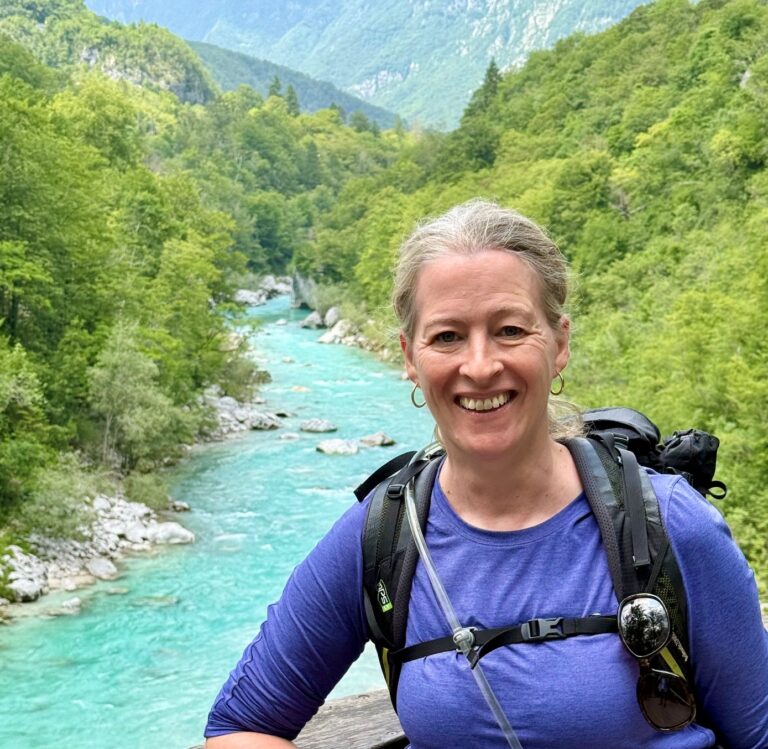
After three years away, I’m coming back to work (July 14th 2026) and I want to be honest about what this return looks like.
In 2023, my husband Jeff — my life partner of 33 years, father to our three daughters — was diagnosed with terminal brain cancer. He died 15 months later. Shattered. Our lives ripped apart and turned upside down.
I am not the same person I was. What matters to me now is different. And my mission is clearer than it has ever been.
Here’s what I’ve learned, living it: time doesn’t make grief go away but time doesn’t take love away either. We can grow around our grief. And, with the right support, it’s possible to grieve fully and live fully, often in the same moment.
Here’s what else I know. One in four people in our workplaces is carrying a loss right now. The diagnosis, the divorce, the death of someone they love. Work keeps going, and before long we expect them to do the same. We are, most of us, grief and loss illiterate — not because we don’t care, but because nobody taught us.
I have a role to play in changing that.
So from 14th July 2026, Evolving Leaders begins the first step in a new chapter: Guiding transitions for people, organisations and a changing world. The first step is walking alongside leaders navigating unexpected life events, as a transition guide and coach and, helping organisations truly support their people through them via Grief and Loss Education.
You can read more about that here.
This isn’t a polished re-entry. My website is still finding its new shape and there’s no glossy brochure. I could spend months waiting until it’s all perfect. But life is messy and imperfect and so is this work. I’m taking the first step and trusting the rest will unfold.
You can read about my new beginnings here.
Perhaps you are in the messy middle of a transition yourself, or you lead people who are? If so this next focus might resonate for you. My diary is open to book now with first available times from 14 July. You can book a conversation here.
In the meantime I have one more hike to do before I am full back and focussed. This time, I’ll be walking off-grid in the Kimberley until mid-July. I will respond to any messages when I’m back.
Thanks for your care and support and for following along as this new chapter unfolds.
Nicola Vague is a leadership coach and transition guide, and the founder of Evolving Leaders. She walks alongside leaders navigating unexpected life events, and helps organisations support their people through the line-in-the-sand moments that turn life upside down.
www.evolvingleaders.com.au

In this post I reflect on the life story of Bob Brown as shown in documentary The Giants (currently screening) and what he teaches us about leading change.
This photo was taken on a family visit to Tasmania’s Styx Valley in 2022 which is the home of Eucalyptus regnans, the tallest flowering plant on Earth. To stand in the presence of these giants, which have stood for more than 400 years, is nothing short of magical. They can’t help but to widen one’s perspective. I am deeply grateful to know that these beautiful trees are no longer under threat.
Humans and nature are inextricably linked. One person who perhaps knows this better than many is environmental activist, former politician, and Greens co-founder, Bob Brown. Last week, I had the privilege of seeing The Giants, a documentary recounting the personal story of Bob and his lifetime commitment to conservation. I was deeply stirred and inspired at multiple levels, so much so that I couldn’t get on with any other work/anything else until I shared this with you!
A qualified doctor, Bob walked away from his profession to follow what could be described as a ‘calling’ or a ‘knowing’ within himself, imploring him to attend to something greater. He has spent all his years since as a staunch activist for the protection of Australia’s wilderness, including his significant role in the infamous Franklin Dam protests and his 29 years in state and federal politics, during which he co-founded the Greens party.
Given much of my own work is about ‘leading change’ at a personal and systemic level, I couldn’t help but view The Giants through this lens, and I am so glad that I did. Bob’s actions and way of being in the world were well ahead of his time. Through viewing his story in its entirety, I was able to witness some of the qualities that guided his actions as a remarkable leader and changemaker.
1. He got ‘out of the way of himself’ and found his voice.
Bob was quiet by nature as a child and didn’t like public speaking. However, early on he had an ‘ah-ha’ moment that would compel his future actions: this wasn’t about him, it was about speaking on behalf of the trees.
We can so often let the ‘I’ get in the way of the collective good. When we show up in service of something greater than ourselves, particularly if it is in alignment with who we are and what we are here to do, then all manner of things can shift to help us on our path. Speaking up and challenging the status quo is often the birthplace of change. It’s uncomfortable; we can feel exposed and personally attacked. Attending to what matters, connecting deeply with our personal ‘why’ and navigating through any self-doubt, is the way forward.
2. He backed himself and took risks
In every step of his journey, Bob approached the seemingly impossible by believing in the possible. He walked away from a secure career as a medical professional into the relative unknown, guided by an internal knowing that he had a greater role to play. Every step in the campaigns that he spearheaded involved taking risks. Perhaps you, like me, recall the footage of campaigners in rubber dinghies getting knocked in all directions as the first bulldozer arrived on a boat? There was a lot at stake and people were prepared to put their lives on the line to ensure these ancient forests would be there for future generations. A further example of Bob’s preparedness to take risks occurred during a television interview in 1978, when Bob shared that he was homosexual at a time when it was illegal in Tasmania. The courage of this man is truly inspiring.
Change doesn’t happen when we are in our comfort zone. It is uncomfortable by nature. If it’s not uncomfortable, then check again – is anything actually changing, or are we just re-arranging the deck chairs? The higher the stakes, the greater the risks that need taking. As leaders, we must take risks. We must find a way to quieten the voice of fear and doubt and back ourselves against the inevitable barrage of resistance.
3.He challenged social constructs and norms
Bob was prepared to challenge social norms, even in very hostile environments. One example of this is when Bob was exited from parliament after he challenged US president George Bush during his address. The topic of conversation mattered so much to Bob and the people he represented that he spoke out, despite very clear social expectations warning him not to do so. A perspective needed to be voiced, so he voiced it.
Challenging social constructs and norms is key to our personal growth as leaders and changemakers. If we conform to social expectations and smile politely instead of confronting the status quo, then change doesn’t happen. As leaders of change, we must become masters of this.
4.He created a change ‘movement’
Bob was a visionary. He knew what really mattered, spoke up and enlisted allies across the nation. While Bob and his colleagues were unable to save the unnecessary flooding of Lake Pedder (which remains flooded to this day), in 1982, he and his colleagues built a nationwide following and significant on the ground support that influenced a change of government at the time and ultimately stopped the damming of the Franklin and Gordon rivers. The movement that Bob and his colleagues created was extraordinary, especially given they were without social media or the internet (imagine that!). At the time, the greatest avenue for doing this was via media coverage. People were arrested for protesting; jails were full and the coverage of this was on national television. He harnessed celebrities and enlisted Australian icon, Dick Smith, to helicopter in a radio communication system and a plane full of influential supporters. Through thinking ‘outside the square’, he enlisted the followers and created momentum.
Change doesn’t happen in isolation. We need to bring others on the journey with us. How we go about that is key. Through creating a change ‘movement’ as opposed to just keeping stakeholders ‘engaged and informed’ we can activate so much more of the human spirit which in turns adds positive energy and momentum to the change effort.
5.He approached the change as an adaptive challenge
Bob didn’t know how they would stop the planned hydro electricity scheme going ahead. He just knew what was at stake and answered the call. This meant that he and his colleagues took one step at a time almost like a series of experiments to see what was possible. It was only then that the next step would become clear. It was a true adaptive challenge where there was no existing ‘map’ or ‘process’ to follow, just one step informing the next towards the vision of protecting these ancient forests.
We often think about change as a series of linear steps from one state towards another. The reality is usually quite different. This is because transformational change is complex and multifaceted. We need to approach change as an ‘adaptive challenge’ ( where there is no known way to solve the challenge) rather than a ‘technical problem’ to be solved (where the solution is known or can be worked out) and leverage ‘experiments’ to learn and grow along with the change process.
Thank you, Bob Brown for being an extraordinary leader and change maker.
Please do yourself a favour and don’t miss seeing The Giants.
Nicola x
Our Leading Change Program is a nine-month in-house learning experience where a cohort of approx 16 leaders work or personal and organisational adaptive challenges supported by coaching, group coaching and workshops. The purpose of the program is developing leaders’ capability, capacity and confidence to lead change for themselves, their teams and organisations. Interested in finding out more? Book a conversation with Nicola.
A trusted friend and colleague (and incredible coach) asked me these beautiful questions at the start of the year– who am I now? and what’s my unique offering as a coach?
The right question at the right time is gold. This precipitated an opportunity to pause, reflect and reset.
I wanted to share with you what I discovered by re-introducing myself and a wonderful new and much needed coaching program for senior women.
Hello, my name is Nicola Vague. I am a leadership coach, meditation teacher and art therapist. As a leader of leaders, my personal mission is heralding new ways of being and leading to transform outdated systems and ways of operating, creating a future where people and communities can flourish.
Eighteen years ago, in my mid-thirties, I experienced what I now understand to be an existential crisis. I was constantly stressed, short fused and unable to connect with the joy that was all around me. I was surviving but not flourishing; I knew that something needed to change. I made a promise to myself to stop focusing on the ‘shoulds’, to quieten the mental chatter and to follow my heart (I didn’t even know what that meant at the time). This commitment to move a little more towards myself was a turning point.
So began twenty years of personal exploration, evolution and development as a leadership coach, alongside extensive corporate experience in organisational development and change. What I now know, which serves as the foundation of my leadership work, is that to improve the quality of our decisions and actions, we must carve out space and cultivate the conditions that enable us to come into a more conscious relationship with ourselves. I don’t teach something that I have just read about; I teach what I have come to make sense of through my own evolution. This gives the learning I offer to leaders both depth and simplicity.
In 2014, I founded Evolving Leaders (www.evolvingleaders.com.au) with the purpose of evolving the consciousness of leaders to make the world a better place. My focus has been on leadership, change and wellbeing. Partnering with longer term clients on their leadership transformation journey supported by wonderful collaborative relationships is rich and rewarding.
I have been offering individual leadership coaching for over a decade now, mostly as part of leadership 360 assessments and broader organisational leadership development programs. I love this work. It is an honour and a privilege – especially supporting those leaders who are ready to embrace the opportunity of 1:1 leadership coaching.
Whilst I continue to offer this work and supporting clients on their leadership transformation path, what has also emerged is a new 1:1 coaching offering for women where I can explicitly bring the unique combination of skills, experiences and approaches that has radically shaped my own personal and professional development and wellbeing to supporting senior women.
Why women you ask?
In the words of Desmond Tutu “Once you have women liberated, it’s amazing how many other problems get resolved – poverty, education, health. Women are the key in any community.”.
Newly released evidence from an Australian wellbeing study – The Gender Wellbeing GAP (Global Leadership Wellbeing Survey – GLWS) shows that the overall wellbeing of women in senior roles is low and that this gap is increasing. This may not be surprising but it is alarming and requires attention. Women are the primary nurturers in our society, raising children, forging careers and managing many relationships and connections. This coaching program is about nurturing the nurturers, women who are juggling multiple commitments and competing demands, often at the expense of themselves.
In addition to navigating my career and personal evolution, I have the privilege of being a mother to three young woman, an aunty and friend to many, a sister, a wife, a daughter. Now in my fifties, I have navigated work and family through its many phases and continue to do so. I have been fortunate enough to have had the support of many therapists, healers and coaches. It is my turn to offer this to other women and to make a contribution to improving wellbeing for these women.
So I am delighted to be opening up limited places for senior women as part of Cultivating Well – 1:1 Leadership Coaching for Women.
Delivered via over a five month period, the purpose of the program is helping participants to slow down and reconnect with themselves beyond the noise of the external world, opening to new possibilities, improving wellbeing and creating a changed reality.
The Invitation
A place to pause, reflect and reset.
A place where your fears and dreams are safely shared and nurtured.
A place to become comfortable with not knowing.
A place where you will be supported.
A place where your true nature can emerge.
A place to turn a little more lovingly toward yourself.
A place where possibility becomes infinite.
The six-session coaching program is focused on:
- Guiding participants beyond the noise to hear their own wisdom through accessing the vast well of resources within them
- Providing a held space so that they can find thier centre and bring attention to their own well-being; and
- Cultivating the conditions, practices and habits to lead well!
Senior women might self-nominate or be recommended for this experience as part of broader leadership development, wellbeing, or talent management initiatives.
I look forward to asking you the right question. Read on for full program overview.
Not interested in this new coaching program? You may be interested to explore our Leading Change Development Program and other Coaching and Team Development services.
Self Leadership Series – Part 1 #8
“What if we could put down our iPhones, our gadgets, our laptops and spend a little time just settling in?… Settling in to paying attention to what lies inside us. To see our troubles as a knock on the door to an invitation” – David Whyte The Door Beneath Everything July 2022
This blog series began close in – sharing the personal circumstances that I found myself in my mid-thirties. This was at its core, a deeply internal experience that would fuel my own self-leadership journey. So, for this final post I wanted to touch briefly on how I came to be aware of and begin to cultivate connection with my ‘inner experience’.
First a little bit of background……
When we moved house seven years ago, I stumbled across an assignment from my teaching degree back in the early nineties – complete in its original Atari computer format. Looking at the assignment took me by surprise at some level, while at another level I thought ‘of course I was interested in that’. The assignment was about student wellbeing practices, a topic less heard of at that time. It was built around The Inner Game by Timothy Gallwey. I recall it being a lightbulb moment for me at the time – this idea that there was an inner experience open to all of us that, if we were open to it, could greatly improve the way we showed up in our lives and help us achieve higher levels of performance.
I didn’t understand ‘inner experience’ beyond this conceptual notion at the time but looking back, I could see that a seed had been planted (as knowledge often does). It would take me another decade or more for this enquiry into the ‘inner game’ to come back onto my radar.
Roll forward …
So, until my mid-late thirties, beyond this idea of an ‘inner experience’ that had been planted years before, I had no way of understanding or accessing this ‘inner experience’. Sounds bizarre now but that was my reality. I was disconnected from myself – from who I was, from what mattered to me, from the life and love that was all around me. All my time and energy was spent reacting to the outside world and simply trying to keep afloat in day to day.
The invitation into my inner experience presented as a little voice inside of myself that was telling me that ‘something needs to change’. I decided to listen to this little voice. Through guidance and direction from trusted others and commitment to a daily reflective journaling practice, I slowly learned how to observe my thoughts and feelings and how to connect with my body to notice sensations.
Over time, and with the discipline (on and off as is most often the case) to keep practising the skill of self-observation, I learned a lot about myself and my reactions and responses in life; I learned how to rebalance my previously very stressed nervous system with obvious flow-on benefits to my wellbeing; I became better equipped to make decisions and choices in life from this place of a clear head; I cultivated clearer access to the wisdom of my heart and my internal knowing; I learned how to acknowledge and make space for all feelings so that they can move through me rather than to ‘fuse’ with them which allows both of us ( the feelings and I) to more far more freely. Most importantly, I have been able to come into a more conscious relationship with myself. This is continuous – changing and evolving as my relationship to self continues to unfold.
Cultivating a conscious connection with our internal experience is a pathway through which we can begin to peel away the layers of conditioning of our socialised selves and rediscover our true nature. Over time it can become the source from which we show up and operate in our lives, from the inside -out. Some of what I now understand about cultivating this relationship with self (our internal experience) is that:
- Discovering and nurturing this connection to self is a lifelong process.
- There is no ‘end point’ as the more you learn about yourself, the more you realise there is to learn.
- It takes practice and discipline (choosing to focus Key # 1 – Attention on this)
- If we choose to attend to it many benefits can follow. The greatest of these is that this is a pathway to re-discovering our true nature.
So, if this notion of’ inner experience’ is new to you, as it was for me, I just wanted to let you know that that is a perfect place to begin. Set yourself with a clear intention to nurture this beautiful opportunity to develop a more conscious relationship with yourself; and open your journal and leverage the discovery questions in the Three Keys to Practising Self Leadership to get started:
- What’s alive in me now?
- Body Sensations
- Thoughts
- Feelings
Enjoy the process of nourishing and cultivating this connection with yourself.
This is the final post in this Self Leadership Series. Thanks for your company.
This post is an excerpt from my draft book Activating Self Leadership.
Photo Credit: Bree Hughes 2022 (Taken on a trip to Mt Field National Park with Bree to see the Turning of the Fagus)
Self Leadership Series – Part 1 #7
This post introduces Three Keys to Practicing Self-Leadership to provide a practical way of attending to self-leadership.
At the heart of self-leadership is making a choice to live life and leader others more consciously, or simply put, with greater awareness. Self-leadership invites us to celebrate and acknowledge what is working well and to embrace the experiences from our daily lives – the good, the bad and the truly ugly – as opportunities to learn about ourselves and to grow.
This requires us to pause. When we give ourselves permission to pause, we can start to see more clearly what is happening within us and around us and can make better choices. We have the space to acknowledge our efforts and successes and to identify specific situations or experiences that we would like to attend to.
The Three Keys to Practicing Self-Leadership are designed to support this quest. The process begins with a scan of your internal experience and external environment to acknowledge what is working well and surfacing of a situation or experience (focus area) you would like to attend to. Focus area in hand, a series of structured questions are woven through the three-step process to support personal enquiry from observation through to action. Let’s take a look at the three keys: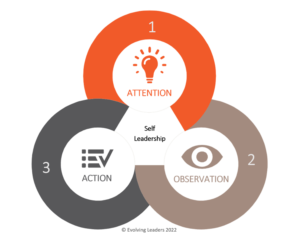
Key # 1 – ATTENTION – “To pay attention, this is our endless and proper work.” ― Mary Oliver
Scanning current internal and external realities to acknowledge what is working well and to surface a specific situation or experience (focus area) to attend to.
Key # 2 – OBSERVATION – “In the silence within, you will find relief, truth and the instructions you’ve been seeking. Go there. And listen.” – Brendon Burchard
Pausing to enquire and reflect on self and situation (as it relates to chosen focus area) to gain new insight and perspective.
Key # 3 – ACTION – “The future depends on what you do today” – Mahatma Gandhi
Undertaking planning and preparation to move from insight to action.
So how do we bring this to life? Each of the keys has a series of questions, that together help us to attend to self-leadership. If you would like to get started right away – grab yourself a journal or notebook and you can practice applying the questions as you read on.
Key # 1 – ATTENTION
Scanning current internal and external realities to acknowledge what is working well and to surface a specific situation or experience (focus area) to attend to.
Taking time to slow down enough to notice what is happening within us and around us is always the starting point for attending to self-leadership. It is in this process of slowing down that we can acknowledge what is working well for us and surface what needs our attention.
This first key to practicing self-leadership – Attention – invites us to listen, acknowledge and intend.
We begin with a scan of our internal experience and external environment. These questions help us to pay attention, slow down and to make conscious choices. We don’t ask them just once and forget – they are the foundation questions that we need to revisit often!
- What am I noticing in my external environment?
- What’s alive within me right now – thoughts, feelings, body sensations?
- What am I most proud of? What’s working well?
- Does something need to change?
If you identify a specific situation or experience that you would like to attend to, then ask yourself:
- What’s the reality I want that I don’t have now?
- What can I do to improve this situation?
- What is my intention ?
Let’s look at the second key – Observation.
Key #2 – OBSERVATION
Pausing to enquire and reflect on self and situation (as it relates to chosen focus area) to gain new insight and perspective.
Developing our capacity to pause, observe and reflect is a key self-leadership skill. Just like the first key – it begins with us making a choice – in this case a choice to undertake some exploration and observation of the focus area at hand. The pause part of this acts as a mechanism to challenge our pre-programmed reaction that might otherwise drive our reaction and behaviour – to enable different perspectives and insights to emerge.
This second key to practicing self- leadership – Observation- requires us to pause, inquire and reflect.
Ask yourself the following questions to draw your attention to the broader context and to observe your thoughts, feelings and body sensations as they relate to your focus area:
- Situation
- What do I need to understand in relation to the broader context/environment in which this situation is occurring?
- How do I choose to be in relation to this situation?
- Self
- What’s alive in me now in relation to this situation?
- Body Sensations.
- Thoughts
- Feelings
- What is making me feel that way?
- What’s alive in me now in relation to this situation?
Grounding the observation
-
- What really matters most to me and how does that apply to this situation?
- What do I now know?
Let’s now look at the third key – Action.
Key #3 – ACTION
Undertaking planning and preparation to move from insight to action.
Taking the new awareness or insight it is now time to move into action to ensure that the change that is possible from this new awareness comes to life.
Taking action isn’t just about making major decisions. Small and simple steps and a short and sharp list of actions can be very effective, impactful and a great way to start. For example, and dependent of course on what it is you want to change, consciously starting your day with five minutes of mindful breathing, drinking two litres of water a day, turning your phone off at a set time each evening … and of course giving yourself permission for some down time are all example of small simple steps. Alternatively, your required action might take the shape of specific goals and leverage a goal-setting process that identifies the goal and what a successful outcome will look like, defines the behaviour required to achieve each goal, the action steps needed, and any support you will need to stay on track.
Sometimes our actions just apply to us and in other times they may extend to interactions with others – for example having a difficult conversation, communicating a boundary, or applying a new skill to a challenging situation. And sometimes the insight that we get means that the action we need to take is on a grander scale – an example of this might be finally deciding to make that long-yearned-for career change a reality or discontinuing an unhealthy friendship.
The third key to practicing self- leadership – Action- requires us to prepare, plan and act.
Identify the specific actions that you will take to move towards a positive outcome:
- What would be a helpful outcome for this situation?
- What action do I need to take to enable this outcome?
- What support do I need?
__________________________________________________________________________________
There are so many things we are already doing well in leading our lives to have arrived at this moment. Let’s never lose focus of that and …..stuff comes up in life. There are conversations that we know we need to have, situations that we know we can and should positively influence, changes we know we need to make in our lives and times when we how we behave and the decisions that we make result in less than satisfactory outcomes. These situations/experiences, if left unattended and ignored can leave us feeling a misalignment between ‘who we are’ and ‘how we want to be’ and the actuality of what is.
As we travel the self-leadership path, we bring greater awareness to all of this. We begin to unpeel the layers of our socialised selves and get a little closer to the truth of who we. Choosing this path not only ignites change in ourselves, but naturally a source of inspiration for others.
Through applying the Three Keys to Practicing Self Leadership we can attend consciously to our lives and leadership. That includes celebrating and acknowledging what we are doing well and making a shift from reacting to life as it is thrown at us to noticing and attending to what matters.
The final post in this series will look at Self Leadership – An Inner Experience.
This post is an excerpt from my draft book Activating Self Leadership.
Photo Credit: Bree Hughes 2022 (Taken on a trip to Mt Field National Park with Bree to see the Turning of the Fagus)
Self Leadership Series – Part 1 #6
This sixth post introduces the idea of ‘mental real estate’ as a way of thinking about how you are allocating your energy and attention. You are invited to reflect on the things that matter most to you and consider the alignment or misalignment of that with your mental real estate to sharpen your focus on what needs to change.
‘Things which matter most must never be at the mercy of things which matter least.’ – Johann Wolfgang von Goethe
This post continues the theme of the personal story that I shared in the introduction to this series – that period in my life when I found myself in a state of overwhelm and was disconnected from myself. I wouldn’t recognise until sometime later was that one of the costs of disconnection was that I had lost sight of what truly mattered to me.
During this time, a leadership coach introduced me to the concept of ‘mental real estate’. It was a classic ‘light bulb’ moment. Our mental real estate is the capacity we have to hold onto, manage and navigate everything in our lives. Our work, our relationships, our family. Our day-to-day responsibilities in the many roles that each of us has: leader, partner, parent, sibling, child, friend, colleague, etc. Perhaps our community work or volunteer work at school or elsewhere.
The thing about mental real estate is that it’s not an infinite resource. There’s a limit to how much each of us can handle. Just like ‘real’ real estate, mental real estate has boundaries that can’t be expanded. The more we commit to extra things in our lives – the more we say ‘yes’ to every request or offer – the more our mind starts to push up against those boundaries.
Eventually it becomes like overpacking a suitcase and then still trying to get more in: something has to give. This is the point at which we are over committed.
The impact of this situation will be familiar to many leaders and other busy people. We start to lose focus on the things that really matter to us. We can get locked into ‘thinking and doing’ and lose the ability to ‘feel and be’. We can become overwhelmed, as I was. Stuck on a treadmill, we can become overly stressed – certainly stressed beyond a healthy level – and start making poor decisions. This diminishes our wellbeing and starts to affect our happiness, relationships, and overall performance.
It’s important to realise that, just like the real estate we live in, a lot of what is crowding our minds in these situations is clutter we don’t really need. It is noted in popular psychology that of the estimated 70,000* thoughts we have a day approximately 80 percent are not helpful in moving us forward. This mental clutter gets in the way of our ability to think clearly and make good decisions. It can lead to unnecessary overwhelm.
Reserving as much mental real estate as you can for the stuff that actually matters is the key here as our mental real estate is a precious commodity.
Activity – Allocate your mental real estate
Here’s a simple activity that might help you think about what you are allocating to your mental real estate and whether it could do with some decluttering.
- Bring into your awareness the things that matter most to you in your work and life: those things – people, places and experiences that make you feel full, happy and satisfied. Allow yourself a few moments to write in your journal, or even on a piece of paper:
- What matters to you most?
- What is most important for you in your life and leadership?
- Now ‘zoom out’ to take in everything that you have on your plate right now. All the tasks and roles that you are (or feel) responsible for right now.
- Are you making a concerted effort to ensure that some of your mental real estate is reserved for those important aspects of your life? Or is this exercise simply too hard due to your mental real estate being overcrowded?
- Is there an alignment? Is the stuff that is keeping you busy, and therefore occupying most of your ‘mental real estate’, contributing to those things that are most important to you?
- What do you notice?
- Does something need to change?
Bringing our conscious awareness to the things that matter most to us and the alignment or misalignment of how we are allocating our mental real estate to that is a great way of sharpening our focus on what needs to change. A leader I was working with shared their experience of this process:
‘When I did this exercise some years back, I noticed that where I was spending my energy and effort was definitely not in alignment with the things that mattered the most to me. The people I cared most for were simply not getting the allocation of me (my mental real estate) that they deserved, and that I truly wanted to make available for them. Work, and my inability to switch off from it, was completely and unnecessarily consuming me. It was impacting my sleep, I had little clarity of thought and I was often making poor decisions.
Something needed to change.
I set an intention around that making a change and through making different decisions and choices I was able to better align my mental real estate with what matters most. The concept of ‘mental real estate’ continues to be a useful frame for me to use on an ongoing basis when I invariably wander off track and need to re-navigate and focus my priorities.’
How are you currently allocating your mental real estate?
Does something need to change?
The next post in this series will introduce the Three Keys to Practicing Self-Leadership – aka the ‘how’ of practicing self-leadership where we will move from theory to action!
*Joe Dispenza, Breaking the Habit of Being Yourself (Hay House Inc., 2013).
This post is an excerpt from my draft book Activating Self Leadership.
Photo Credit: Bree Hughes 2022 (Taken on a trip to Mt Field National Park with Bree to see the Turning of the Fagus)
Self Leadership Series – Part 1 #5
This post defines self-leadership as being both a choice and a practice which helps us to honour ourselves and engage more consciously in life. This in turn positions us well to positively influence our own lives and the wider eco-systems of which we are a part.
Every thought we have, decision we make and action we take either moves us toward the life we want to live or away from it. Each of our decisions and actions are also either helpful or harmful (directly or indirectly) not only to ourselves but to the wider eco-systems of which we are a part.
Think about that for a moment. Sounds simple enough doesn’t it?
The truth is however, when we are moving at breakneck speed through our days and weeks, we can lose sight of this ‘simple’ map. We can find ourselves making decisions and choices that are misaligned to who we really are and the things that matter most.
Enter self-leadership.
What is self-leadership?
Self-leadership is a choice that we make and a practice that we enact to honour ourselves and to engage consciously in life. This is done with an intention to learn and grow and to positively impact self, others, and the broader systems of which we are a part.
Self- leadership is not passive, it is active. It requires us to bring attention to both our internal and external realities. It involves us making a conscious choice to attend to self-leadership and to find our own way of practicing it in our daily lives.
Through a commitment to self-leadership we move through life with greater levels of awareness and are better equipped to respond rather than to react to what life presents to us. Overtime and with ongoing attention, the practice of self-leadership helps us to peel away the layers of our social conditioning, re-discover our own true nature and become the author of our own reality.
Who does it apply to?
Self-leadership applies to all people. It doesn’t just sit in the domain of people who are in formal ‘leadership roles’ (where it clearly sits the heart of great leadership) Why? Because collectively as humans we have (mostly) been educated and socialised in a way that detracts from rather than enhances our connection with our own true nature. This needs to change!
A focus on self-leadership puts us on the path where we can begin to do this – to peel back these layers of social conditioning and begin to re-claim the powerful and unique beings that we are.
When we practice self-leadership, we are consciously choosing to live and lead our lives with growing awareness about ourselves and the environment in which we operate. This positions us well to positively influence our own lives and the wider eco-systems of which we are a part.
Getting started
Making the choice to attend to self-leadership is the first step. The next step is knowing what to focus on and how to go about it in every day.
This is where the final three posts in this series are designed to help!
The next post in this series will introduce you to the concept of ‘mental real estate’. It will invite you to reflect on how you are currently allocating your ‘mental real estate’ as a way of bringing attention to what might need to change.
This post is an excerpt from my draft book Activating Self Leadership.
Photo Credit: Bree Hughes 2022 (Taken on a trip to Mt Field National Park with Bree to see the Turning of the Fagus)
Self-Leadership Series 1 – #4 What’s your personal motivation for attending to self-leadership?
This post invites the reader to reflect on their current experience of life and the deeper motivation that might drive the decision to bring greater attention to self-leadership.
There are many life circumstances and experiences that can precipitate us making a conscious choice to bring greater attention to self-leadership. Perhaps some of these may also apply to you?
- Are you stuck in a rut of reacting to the expectations and demands of others?
- Do you regularly feel overwhelmed with everything work and life demand of you?
- Have you lost connection with what truly matters?
- Do you feel ‘foggy’ in the head and unable to make good decisions and choices?
- Are you falling short of having the level of impact that you want to have as a leader?
- Are you unable to give your time, energy and focus to the things that matter most in your life?
- Do you feel stuck on the ‘doing’ treadmill, not knowing where to begin to make change?
- Do you lack the capacity and ability you need to take your leadership and personal effectiveness to the next level?
While it may not necessarily feel like it, all of these can be symptoms and signs that there is an opportunity for to change your own reality through attending to self- leadership.
These circumstances and experiences, once acknowledged, can be the catalyst that helps us to take positive action on our self-leadership journey. I know this works because I’ve seen it happen on many occasions in the self-leadership work I’ve been privileged to support within a wide range of leaders. One described her personal change journey better than I would be able to:
I was feeling hopeless, helpless, full of misery. This affected my emotional and physical wellbeing. One day my inner self started shouting at me, ‘You need to change; you cannot keep living like this’. Through making a clear decision to no longer accept the status quo, I made a commitment to myself to activate a new level of self-leadership. This enabled me to open to new possibilities and start to make different choices in my life that step by step took me towards a different reality. I am glad I sought support and chose this path … Change is difficult in the beginning, but the end result is beautiful and worth it.
It is also possible that despite our level of dissatisfaction with whatever situation we find ourselves in that it still isn’t enough to convince ourselves to get started!
Enter – Personal Motivation. Taking time to connect with the deeper ‘why’ that is motivating us to create change can be the difference between inertia and action.
What’s your personal motivation for attending to your own self-leadership?
There are four common personal motivations that when leveraged can drive people from inertia to action on their self-leadership journey. Which one/s resonate for you?
Do you wish to:
- Experience greater levels of personal satisfaction, wellbeing and fulfilment?
- Uplift your capability and effectiveness in leading self /others towards creating outcomes that matter?
- Be the best role model that you can be for your children /younger generations/ employees/ colleagues/friends?
- Make your unique and valuable contribution to making the world a better place and recognising that the most powerful way of attending to this is to activate and commit to self-leadership?
Your personal motivation for creating change may also come from acknowledging a little voice inside of you that is telling you that something needs to change such as it did for my client above – perhaps it’s to do with a need to attend to your wellbeing or an unhealthy situation that you find yourself in or having a courageous conversation that you know you need to have?
These are just a few examples. Your specific motivation might be different from all of these and that’s perfect too.
We will be motivated by different things at different times based on the situation and context in which we are operating. Whatever that context is for you- it is worth getting clear on your personal motivation for attending to self-leadership. It can after all, hold the key to moving from inertia to action.
The next post in this series will explore the question: What is self-leadership?
This post is an excerpt from my draft book Activating Self Leadership.